
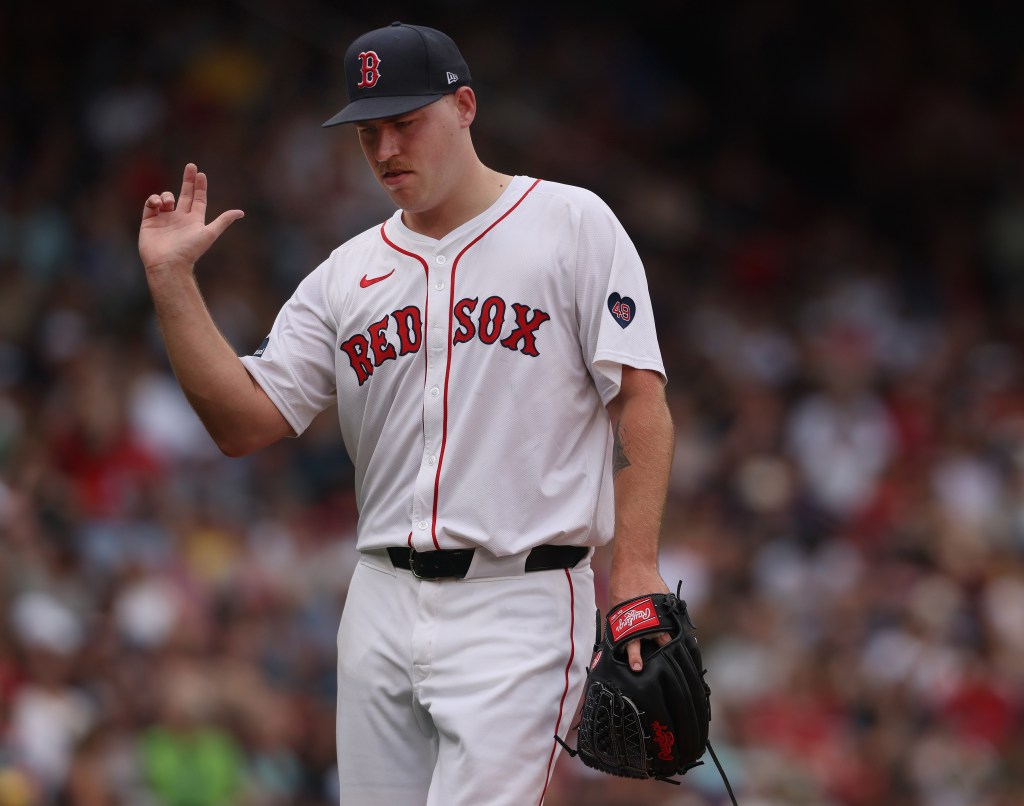
This past season the Red Sox dealt with a ton of injuries, and by season’s end the club had 10 players stashed on the 60-day injured list.
But while the 60-day IL allows teams to temporarily replace an injured player on the 40-man roster, that reprieve does not extend to the offseason.
Thursday marks the deadline for all clubs to reinstate players from the 60-day IL while ensuring their roster remains at or below 40 men. For the Red Sox, that means the club has to address an imminent roster crunch that will likely require the club to cut ties with one or more players.
Here is where things stand now, and who could possibly be on the chopping block.
One spot needed today
When the offseason began the Red Sox initially had four free agents: Steven Matz, Dustin May, Rob Refsnyder and Justin Wilson. Over the past couple of days three others have since joined them, Alex Bregman, Lucas Giolito and Liam Hendriks.
That brought the Red Sox down to 32 active players.
The Red Sox also have nine players currently on the 60-day IL: Triston Casas, Kutter Crawford, Hunter Dobbins, Vaughn Grissom, Luis Guerrero, Tanner Houck, Marcelo Mayer, Patrick Sandoval and Josh Winckowski. Hendriks was originally the 10th, but his becoming a free agent removes him from both sides of the equation.
So with eight spots available for the remaining nine players coming off the IL, at least one person will need to go.
How can they clear the space?
Of the players who are currently active, the most likely candidate to be designated for assignment is left-hander Jovani Moran. He appeared in just two big league games this past season, allowing three runs over four innings.
The Red Sox could also DFA someone who is currently on the 60-day, with Winckowski and Grissom standing out as logical candidates.
Even if the Red Sox only need to clear one spot today, they will eventually need more space to add players as the offseason goes along.
Non-tender candidates
One other way the Red Sox could free up roster space is by declining to offer a contract to a player currently under club control.
Every offseason teams will tender a contract to players on their roster who aren’t yet eligible for free agency, and as the offseason goes along they will either agree to terms or go to salary arbitration. But clubs can also decline to tender players a contract, and if that happens the player is “non-tendered” and becomes a free agent.
This can happen for a variety of reasons, but often it’s because a player is projected to earn more in arbitration than the team thinks they’re worth.
This will likely be the case with Nathaniel Lowe.
The Red Sox first baseman, who was acquired in late August ahead of the club’s postseason push, is entering his final year of arbitration and is projected by MLB Trade Rumors to earn $13.5 million in 2026. The Red Sox probably won’t want to pay that much for a player who batted .228 with a .689 OPS in 2025 and was tossed aside midseason by the Washington Nationals, so he will probably be non-tendered.
Another less likely possibility is Tanner Houck, who is projected to earn $3.95 million but won’t pitch in 2026 as he recovers from elbow surgery, and Winckowski could be a candidate here as well.
The non-tender deadline is Nov. 21.
Who could be protected from Rule 5?
Besides free agent signings and trade acquisitions, the Red Sox will also need to clear space on the 40-man for prospects they would like to protect from the Rule 5 Draft.
Held annually during the MLB Winter Meetings, the Rule 5 Draft serves as a mechanism to keep clubs from hoarding big league ready players in their minor league system. How it works is players who have either four or five years of professional experience must be added to the club’s 40-man, otherwise they become eligible for the Rule 5 Draft, where they can be poached by other clubs and added to that team’s big league roster. They must then remain in the majors for a full season or be returned to their original club.
Garrett Whitlock and Justin Slaten are both former Rule 5 picks, as was Danvers’ Shane Smith, who went on to become an All-Star in his first season with the Chicago White Sox this past summer.
Among the Red Sox prospects who are Rule 5 eligible, there is only one player who can be considered a lock. That’s right-hander David Sandlin, who currently ranks as the organization’s No. 10 prospect according to MLB Pipeline and who was a candidate for a big league call-up late this past season before Payton Tolle and Connelly Early ultimately got the nod instead.
Other less likely possibilities include left-hander Shane Drohan and right-hander Tyler Uberstine, who both finished the season in Triple-A and could serve as viable rotation depth.
When it comes to deciding how many prospects to protect, the Red Sox have to balance whether keeping guys like Drohan and Uberstine is worth possibly losing other players already on the roster. As the offseason goes along the club will eventually have to start making some tough decisions, so how the Red Sox handle their current 40-man crunch will have a subtle but significant impact on next year’s team.