
With the Toronto Blue Jays losing a heartbreak Game 7 to the Dodgers, every AL East team has reached the World Series in the last decade — everyone, that is, except the Orioles. In fact, it’s been nearly two generations since the O’s appeared in the Fall Classic in 1983, Cal Ripken’s second year.
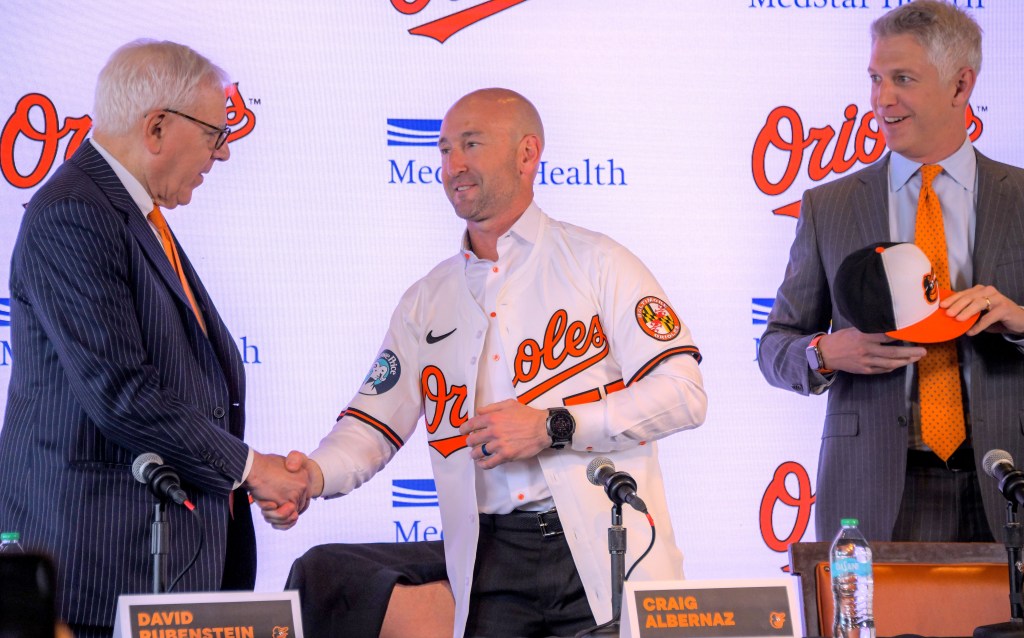
Against this backdrop, the Orioles last month chose a young new skipper, Craig Albernaz, who was most recently an associate manager for the Cleveland Guardians and also spent time in the Rays’ and Giants’ organizations. By all accounts, Albernaz, 43, is a fresh talent who gets on well with both players and other coaches. But whether a first-time manager can bring the Orioles long-absent postseason success is another matter.
Despite often having competitive teams and making the playoffs four times over the last dozen years, the O’s haven’t won a single playoff game since 2014, going a shocking 0-10 over that time.
So, as executive Mike Elias and owner David Rubenstein look to improve the club dramatically after the bitterly disappointing 2025 season, making the postseason in 2026 won’t be nearly enough. The goal must be to field a team that can win multiple series in October. Anything less must be regarded as failure.
Still, by examining the teams that have been successful recently in October, Elias and colleagues can zero in on a few specific characteristics needed to win in the playoffs as they create next year’s Baltimore squad.
By far the most important element for post-season advancement is stocking up on a plethora of viable starting pitchers. Today’s game demands most starters throw fastballs in the mid-90s mph, and so pitchers today are constantly getting injured, and you simply can’t have enough. An extensive MLB study last year showed that days spent on the injured list by pitchers nearly tripled over the last two decades, increasing from around 13,700 days in 2005 to more than 32,200 in 2024. And pitchers now throw every type of pitch much harder than ever.
This year, every starting pitcher for the Orioles spent significant time, if not most of the season, on the IL. Yet other teams have the same challenge, and the best are learning they must prepare by having 12 or more different available starters over the course of the tremendously long season. However, the true goal is much narrower — to both make the playoffs and still have at least two or three shutdown pitchers with enough gas left in the tank to carry the club through multiple rounds of playoffs.
Under the new playoff format, with a truncated wildcard round of just the best of three, and the division round best of five, having just a few strong starting pitchers can vault a team into the league championship series.
The Orioles have a strong base from which to begin with starters Trevor Rogers, Kyle Bradish, Dean Kremer, Tyler Wells and Grayson Rodriguez with the club in 2026. This means the Orioles brass must sign or trade for at least one or two more front-line starters and probably three or four others who can make a dozen or more starts. Note to Mike Elias: Now is the time to start spending chunks of owner David Rubenstein’s money on high-leverage pitchers!
The second characteristic of teams that are successful in the postseason is a smattering of dependable veteran hitters and position players who can be counted on in clutch moments in October. Among the examples in this year’s playoffs are George Springer for the Jays and Tommy Edman for the Dodgers, each of whom has contributed timely hits for his club. A mix of veteran players with playoff experience paired with the Orioles’ core of young talent represents an ideal roster with the best chance of October success.
The final piece of the puzzle is a clever manager who can outfox his rival skippers to win several series in a row. Here, the Orioles have fallen short in recent years.
A prime example was when, after winning more than 100 games in 2023, the high-flying O’s were shot down by Bruce Bochy’s Texas Rangers. Bochy rightly determined that the Orioles’ young hitters would be rusty after a bye-induced week-long layoff. He trotted out a left-handed junk baller named Andrew Heaney, who tied the anxious, fastball-loving Orioles hitters in knots for the first few innings, undermining their confidence and allowing Texas to steal Game 1. Meanwhile, in Game 2, overmatched O’s manager Brandon Hyde started inexperienced Grayson Rodriguez, who was shelled, giving up five runs in less than two innings, and the series was essentially over.
Many had speculated that the Orioles would choose a Bruce Bochy-type veteran manager with a proven record of winning in the playoffs, since a crafty, resourceful manager is particularly crucial for small market teams, like the Orioles, who rarely have rosters with as much sheer talent as higher payroll teams like the Yankees, Jays and Red Sox.
But with Craig Albernaz, the Orioles brain trust has gone for an inspirational but unproven young leader. Let’s hope this gamble pays off, because realistically, the O’s have just two or three more years to win with their core of young players before many become unaffordable free agents and a rebuild will probably be needed.
So, the time is now to single-mindedly pursue postseason success — with money for free agents, with bold trades, with managerial and coaching leadership — whatever it takes. After all, Orioles Orange is the color of autumn. And there is no fan base who will be more grateful than Birdland if Baltimore can finally turn the MLB playoffs boldly orange again deep into next October.
Paul Bledsoe (@paulbledsoe) is an Orioles fan from Arlington, Virginia.