
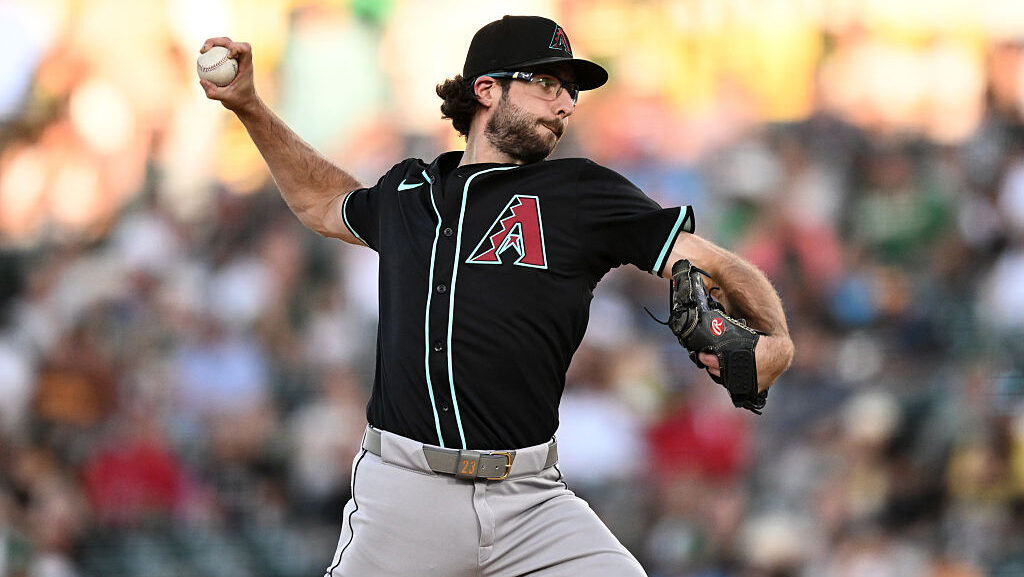
The Arizona Diamondbacks extended a qualifying offer to Zac Gallen ahead of Thursday’s deadline, Arizona Sports’ John Gambadoro reported.
Gallen has until Nov. 18 at 2 p.m. MST to accept or reject the offer.
If Gallen accepts the offer, he will be re-signed to a one-year contract with Arizona for $22.025 million.
If Gallen rejects the offer, he will become an unrestricted free agent and could sign with any team, including the Diamondbacks. If he chooses to sign elsewhere, the D-backs will receive draft pick compensation.
Thirteen players received the qualifying offer, as first reported by ESPN’s Jeff Passan:
RHP Zac Gallen (Diamondbacks)
OF Kyle Tucker (Cubs)
DH Kyle Schwarber (Phillies)
SS Bo Bichette (Blue Jays)
LHP Framber Valdez (Astros)
RHP Dylan Cease (Padres)
LHP Ranger Suarez (Phillies)
RHP Edwin Diaz (Mets)
LHP Shota Imanaga (Cubs)
RHP Michael King (Padres)
OF Trent Grisham (Yankees)
INF Gleyber Torres (Tigers)
RHP Brandon Woodruff (Brewers)
Gallen made 33 starts in 2025 with a 4.83 ERA and 1.26 WHIP, a down year based on his track record (3.29 ERA from 2019-24).
What is the qualifying offer the D-backs offered Zac Gallen?
The qualifying offer was first introduced in 2012 as a way for teams to receive draft compensation if their top free agents leave in the offseason.
The offer is a one-year contract worth the mean of the highest paid 125 players in MLB. Last year’s qualifying offer was worth 21.05 million.
A player may only be eligible for a qualifying offer if he meets two criteria. He must have never previously received a qualifying offer in his career and he must have spent the entire previous season with the organization offering the contract.
Players who accept the qualifying offer become unrestricted free agents upon the conclusion of the one-year contract.
What is the compensation for rejecting a qualifying offer?
If a player rejects the qualifying offer and then re-signs with the team that offered it to him on a different contract, the team does not receive any compensation.
If the player signs with a different team, the club that extended the qualifying offer receives a draft pick. The round of the acquired draft pick depends on the team’s classification and the price of the contract.
The Diamondbacks are classified as revenue-sharing recipients. Revenue -sharing teams receive their pick between the first round and Competitive Balance Round A if the free agent signs for more than $50 million, like Christian Walker last year. If the free agent signs for less than $50 million, the pick comes after Competitive Balance Round B.
Competitive Balance Round A occurs between the first and second rounds of the draft, while Competitive Balance Round B occurs between the second and third rounds.
What are the penalties for signing a free agent that received a qualifying offer?
If a team signs a player who received a qualifying offer from another organization, they are penalized.
For teams like the Diamondbacks in the revenue-sharing recipient tier, they lose their third-highest selection. Signing multiple free agents who received qualifying offers will also cost teams their fourth-highest selection.
The competitive balance tax payor tier loses the most from signing a free agent that received a qualifying offer, forfeiting their second- and fifth-highest selections and additionally losing $1 million of international bonus pool money. Signing multiple qualifying offer recipients will also cost the team their third- and sixth-highest selections.
All other teams lose their second-highest selection and $500,000 of international bonus pool money. Signing additional qualifying offer recipients will also cost the team their third-highest pick.
