
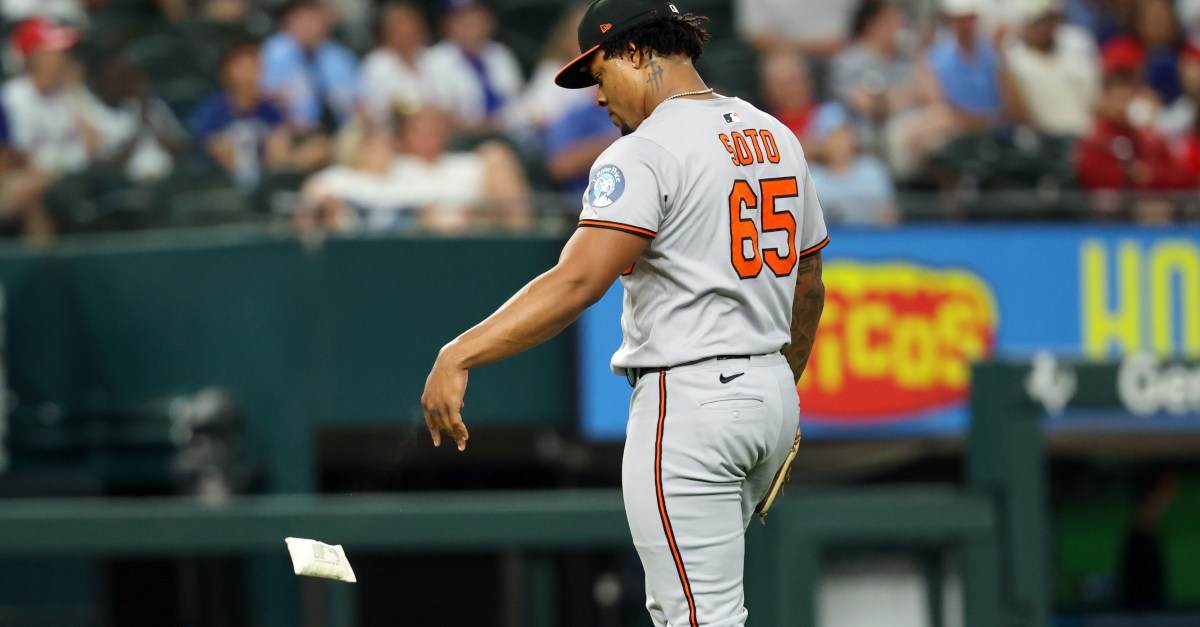
When a reliever makes you hold your breath every time he enters a game, but still somehow records outs, is it still “relief” pitching?
Ha. Ha. OK, but how should we estimate the value of a flamethrowing lefty who hits 98 on the radar gun, strikes out hitters in bunches, and also has an ERA around four while walking four-and-a-half batters a game? In Gregory Soto’s case, the answer depends on whether you’re measuring by game-by-game anxiety levels or by the prospects the Orioles ultimately received in return.
The Gregory Soto Experience in Baltimore was brief but memorable—and not always for the right reasons. Acquired from the Phillies on July 30, 2024, Soto arrived with an impressive pedigree as a two-time All-Star who had dominated in Detroit during 2021 and 2022. By the time he departed for New York at the 2025 trade deadline, O’s fans had witnessed both the tantalizing potential and the maddening inconsistency that defined his tenure.
Soto’s resume was legitimately impressive. He’d made back-to-back All-Star games in 2021 and 2022 with the Tigers, racking up 48 saves over those two seasons while consistently touching triple digits on the radar gun. His fastball velocity—the heater averaged 98.8 mph in 2023—made him one of the hardest-throwing lefties in baseball. The stuff was never in question. It was the other stuff, frankly, that kept managers, fans, and probably Soto himself up at night.
The control issues were real and persistent. While Soto posted solid strikeout numbers throughout his career, his walk rates told a different story. Even in his best seasons, he flirted with danger. By the time he joined the Orioles in 2024, those command problems had become more pronounced. In 23 appearances with Baltimore that season, he managed a 5.09 ERA while allowing 20 hits and seven walks in just 17.2 innings. His first three outings with the O’s were particularly brutal, allowing eight earned runs in just 1.1 innings. That’s not a typo.
Still, there were reasons for optimism. Soto showed flashes of his former dominance down the stretch in 2024, posting a 1.10 ERA over his final 19 appearances. When he was on, he was electric. He held right-handed hitters to a .195 batting average over parts of two seasons with Baltimore. The challenge was consistency—something that continued to elude him.
By 2025, with the Orioles sitting at the bottom of the AL East, it made sense to flip Soto at the deadline. He was a rental player on a sinking ship, set to hit free agency after the season. More importantly, he represented exactly the kind of asset that could bring back young talent in a seller’s market. Enter the New York Mets, desperate for left-handed relief help after losing A.J. Minter and Danny Young to season-ending injuries in April.
On July 25, 2025, the Orioles shipped Soto to Queens in exchange for two pitching prospects: Wellington Aracena and Cameron Foster. As for Soto, the former Oriole went on to became the second greatest Soto on the Mets—I jest. Soto finished with a 4.50 ERA in 25 games for New York, a team whose playoff aspirations didn’t really take off.
Now, let’s talk about what the Orioles actually got in return.
Wellington Aracena was the headline piece of the deal, and it’s easy to see why the Orioles were intrigued. The 20-year-old right-hander from the Dominican Republic was ranked as the Mets’ 19th-best prospect and had been putting up eye-catching numbers at Single-A St. Lucie. His 2.38 ERA across 64.1 innings was impressive, but the strikeout rate—84 whiffs in that span—really stood out. Even more remarkable: Aracena was one of just two pitchers in all of Minor League Baseball to throw at least 60 innings without surrendering a home run in 2025.
Of course, there’s a catch. Actually, several catches. Aracena’s walk rate was concerning, sitting at 4.9 per nine innings in 2025. That was actually an improvement from the previous year’s alarming 9.3 BB/9, but it’s still the kind of number that suggests a reliever future rather than a starting role. The Orioles are betting they can help him refine his command—a reasonable gamble given their track record with pitching development.
Aracena made an encouraging debut with the Orioles organization, throwing 4.2 scoreless innings with six strikeouts for Low-A Delmarva. After a quick promotion to High-A Aberdeen, he tossed 23 innings with six earned runs allowed. The raw stuff is clearly there—he was already hitting 97 mph and reportedly touched 101 earlier in the season. MLB Pipeline now ranks him as the Orioles’ 29nd-best prospect, making him a legitimate gamble worth taking.
Cameron Foster is the more under-the-radar piece of the return. At 26 years old, Foster is what you’d call a fast-moving organizational arm—the kind of player who could help a big league bullpen sooner rather than later, even if his ceiling isn’t as high as Aracena’s. The former 14th-round pick out of McNeese State had been dominant at Double-A Binghamton for the Mets, posting a microscopic 1.01 ERA over 26.2 innings with a 50% ground ball rate.
The Orioles assigned Foster to Triple-A Norfolk, where reality hit quickly. In his first two appearances with his new organization, he allowed three earned runs in 2.2 innings—a reminder that not everything translates smoothly up the ladder. Still, he finished alright: a 3.38 ERA in 16 innings with 23 strikeouts. For a lottery ticket throw-in on a deadline deal, Foster represents the kind of low-risk addition that could surprise.
Ultimately, the Soto trade boils down to this: the Orioles turned two months of a high-variance reliever into a high-upside pitching prospect with control issues and a 26-year-old reliever who might contribute soon. It’s not a blockbuster return, but for a rental player who made Orioles fans nervous more often than not, it’s a solid outcome. Aracena alone makes the deal worthwhile as a buy-low gamble on a power arm who could develop into something special.
And if nothing else, at least Orioles fans won’t have to nervously watch Soto enter in the eighth inning anymore. That might be the most valuable return of all.