
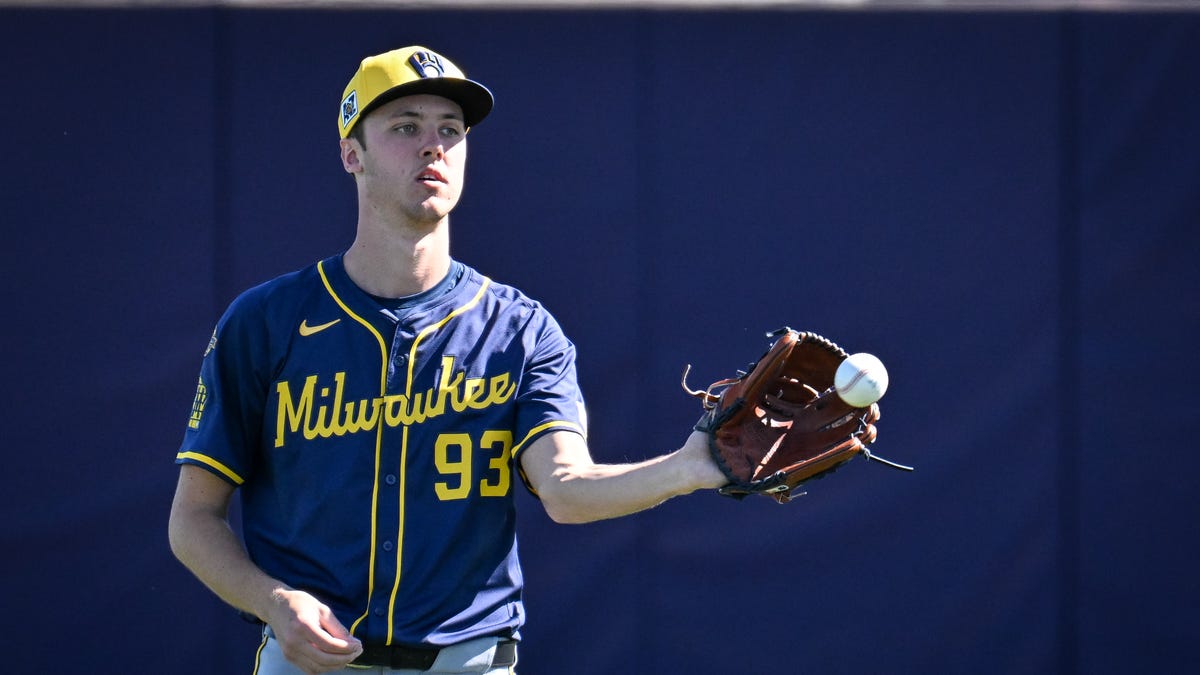
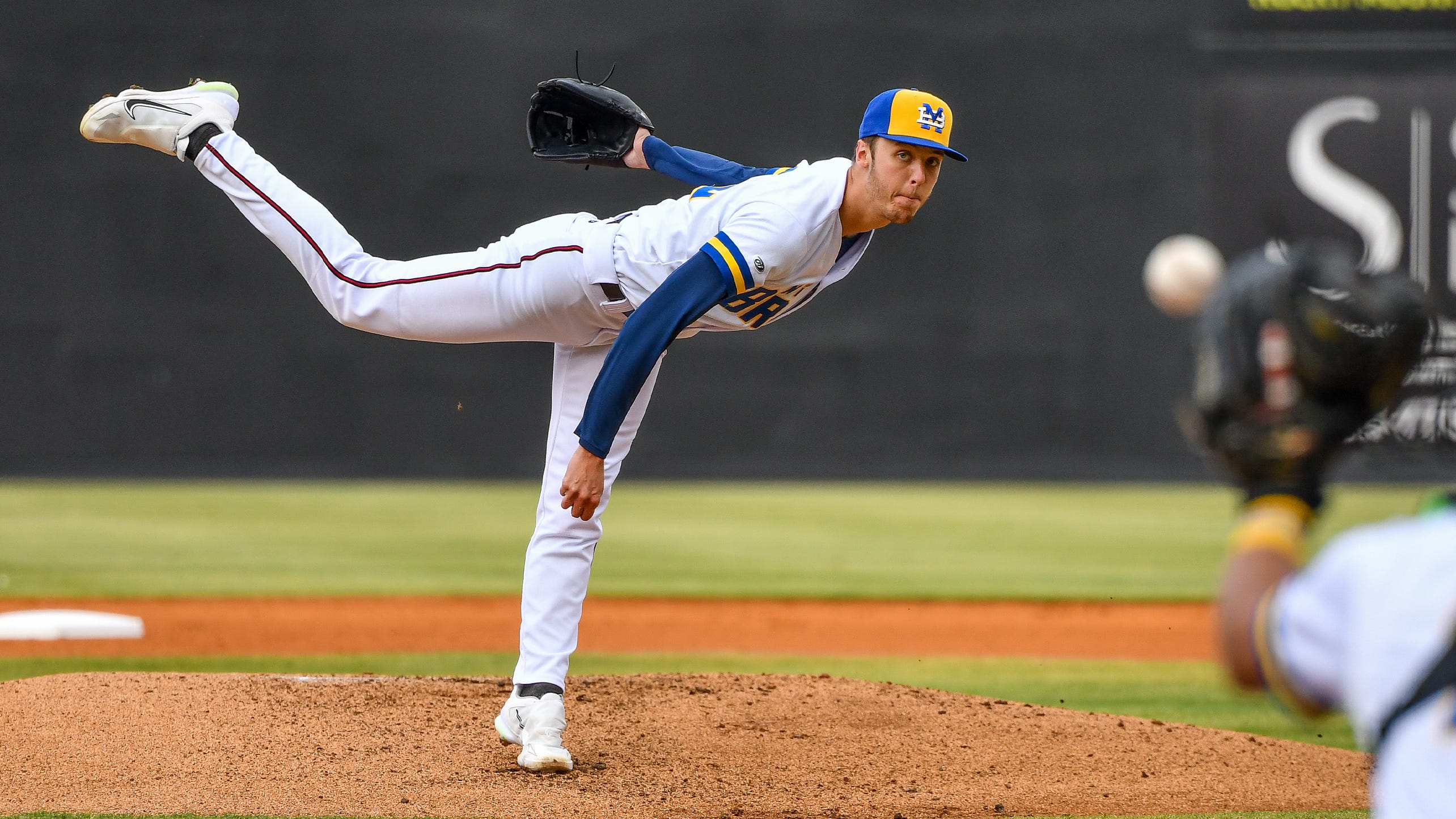

What 100+ m.p.h. fastballs looks like from Brewers Jacob Misiorowski
Top Brewers pitching prospect Jacob Misiorowski made his home debut for the Wisconsin Timber Rattlers and he dominated with triple-digit velocity.
Curt Hogg, Milwaukee Journal Sentinel
The Milwaukee Brewers have yet to call up flame-throwing right-hander Jacob Misiorowski, even though his dominance in Class AAA Nashville suggests he’s more than ready for the big leagues. There are frequently multiple reasons to keep a high-performing prospect in the minors, including roster flexibility, big-league need and plain-old maximizing preparedness.
But with a rash of injuries at the big-league level and the decision to start pitchers with options — like a struggling Tobias Myers, Quinn Priester or Carlos Rodriguez — instead of Misiorowski, it’s worth mentioning something else that potentially matters: Super 2.
What in the world is Super 2? How does it relate to service time, and why is it possible that the concept is putting an artificial barrier on Misiorowski’s first big-league outing? Here’s what to know:
Super-2 is not the same thing as the ‘free agency clock’
A Major Leaguer enters free agency after he accrues six big-league seasons of service time, which means time on the MLB 26-man roster (or MLB injured list).
If a player racks up 172 days of big-league service (in one season or over the course of several seasons), he hits an official year of service time. Each season is 187 days long, but the most days a player can pile up in a season is 172.
Years 4, 5 and 6 will involve salary arbitration — and we’ll get to that in a minute — but as a means of making sure teams can maximize a player, they could call up top prospects after the first couple weeks of the season to guarantee they won’t hit 172 days that first year. Because even if he never goes back to the minors, that means six years from now, he’ll still have one more year to go before reaching free agency. The player would play six full years and most of a seventh before hitting free agency.
Even in the scenario where the player reaches an official six big-league seasons within the first few days the following year, he won’t get a pay day until November, since salaries are all determined in the offseason.
MLB has implemented some draft incentives to keep teams from manipulating service time — keeping a more-than-ready prospect down in the minors to maximize team control.
None of this really applies to Misiorowski, though, because he already can’t hit 172 days in 2025. We’ve passed that benchmark on the calendar, so no matter when he joins the Brewers, he’s not a free agent until after the 2031 season at the earliest.
But there is a matter of when he hits salary arbitration. He’d be on track to play most of this season, then three more full seasons, before he gets to arbitration.
Unless…
‘Super 2’ means some players get to salary arbitration early
Though his path to free agency will take him through 2031, the Brewers stand to gain some financial savings if they keep him out of Super 2 status.
Through arbitration, a player finally sees salary increases from Year 4 to Year 5 to Year 6, the final three years of “team control.” The better the player, the higher the increases.
But a handful of players are eligible for arbitration before reaching a full three years of service time. The Super-2 rule stipulates that all the players between two and three years of service time are lined up at the end of a year, and the top 22% ranked by most service time are granted arbitration. Those guys ultimately get four years of arbitration before free agency — Years 3, 4, 5 and 6. It doesn’t impact when they’re a free agent, but it impacts what they get paid.
A player with, say, two years and 170 days of service time will certainly qualify as Super-2, because he’ll surely be in the top 22%. Last year, the cutoff was 2 years and 132 days. It was 2 years and 118 days in 2023. In recent years, it’s been as few as 2 years, 115 days (in 2019) and as many as 2 years, 146 days (back in 2011). Generally, that extra service-time cutoff falls between 120 and 135 days.
Let’s use 2024 as an example, when it was 132 days. Kutter Crawford of Boston (two years and 136 days of service time) and Beau Brieske of the Tigers (2 years, 134 days) just made the cut; they get to immediately go to arbitration and see a salary increase even though they don’t quite have three full years of service time. Plus another increase the year after that, and the year after that, and the year after that. By year six, these players are quite a bit more expensive than they would be if they had missed the cutoff.
It really does come down to just a few extra days in the big leagues triggering that early arbitration. A player at 2 years, 130 days would not have gotten immediate arbitration this offseason.
Since this process involves ranking all the players between two and three years each season (by service time), there’s no way to accurately say what the cutoff will be each season. A player who gets a full 172 days this year might start in the minors and only get 100 next year, so it’s not as simple as just figuring out how many players are already trending toward that space between two and three years of service time. The figure jumps around year to year based on the players in the pool.
Overall, there were 29 players who got Super-2 status last year. Those 29 represent 22% of the overall number of prospects between two and three years of service time at the end of 2024.
Let’s say we conservatively use 2 years, 115 days as the cutoff for the offseason after 2027 (the year Misiorowski would theoretically be evaluated for this process). That means a player can’t be on the big-league roster for 72 days to “avoid” this cutoff, and the “safe” decision would be to promote June 6 or later.
That’s on the extreme end; it’s pretty likely a player promoted a week earlier would also miss the Super 2 cut. But it’s happened at least once where the timeline is 2 years, 115 days, so teams that are being extra cautious might be willing to wait that long.
The Super-2 consideration isn’t a big deal for most players, but if we’re talking stars, it can be a massive difference. Colorado’s Nolan Arenado earned Super-2 status in Year 3 (2016) and made $5 million in arbitration, and his salaries escalated to the point that he earned a record-setting arbitration salary of $26 million in 2019 before inking a long-term deal.
If he hadn’t been Super 2, he would have made $524,000 in Year 3, and his salary would have probably escalated just beyond $5 million in Year 4 instead. It’s possible the ultimate cost was tens of millions of dollars for the Rockies.
Why does this Super 2 thing exist at all?
This mechanism was put in place so teams couldn’t universally delay arbitration by keeping their best prospects down in the minors for an extra couple weeks at the start of a season. If you want to delay a player’s service clock, you can, but you’re still going to pay earlier arbitration, so the player at least gets some likely financial benefit for the roster shenanigans.
MLB has implemented prospect incentives where teams can become eligible to receive draft picks if they promote their top prospects early, thereby even cutting down on any early-season delays for even service time.
Are the Brewers definitely keeping Misiorowski in the minors to keep him out of Super-2 status?
The team won’t tell you, since answering “yes” to that question would probably result in a grievance from the players’ union. It isn’t the best-faith labor practice. And when a guy has demonstrated the numbers Misiorowski has, it makes sense to wonder why he’s not being given a shot over other guys.
But there are other explanations for keeping Misiorowski in Nashville. It’s true that adding Misiorowski would require the team to make a move on the 40-man roster, though that inconvenience is easily rectified by moving a player to the 60-day injured list (like Aaron Ashby or Garrett Mitchell). The team could also designate for assignment a player like Elvin Rodriguez, though it’s defensible to say a move like that would harm the team’s depth. And a team like the Brewers can always say, “We still want him to work on things.”
Plus, in the case of Carlos Rodriguez, we’re talking about a player already on the 40-man who’s pitching well and probably deserves a shot so the team can at least see what they have in him. Furthermore, knowing that Aaron Civale is soon prepared to return from injury, it stands to reason that Rodriguez would be here only for a spot start, and the Brewers prefer to bring up Misiorowski with the intent of keeping him here permanently.
But the nature of MLB’s collective bargaining agreement at least creates the perception that service time is a consideration in play. If we assume Misiorowski will be a big-leaguer for full seasons each of the next two years, every day he spends in the minors obviously moves him closer to the “safety” below the cutoff.
This feels like kind of an injustice; is it?
It’s all collectively bargained with the players’ union. And it doesn’t often come up since players at Misiorowski’s talent level aren’t always in consideration for promotion at this stage of the season. Many top prospects open a season in the big leagues, and if he were a player poised for a callup in July or August, it also wouldn’t matter, because he’d be well past the “safety” of the Super-2 threshold.
It’s fair to see this as a weird technicality to keep Misiorowski off the roster, all in the name of savings that won’t even be realized for years down the line. But as with the Arenado example, this isn’t just a few thousand dollars at stake. And, a glance at the 2025 Brewers will tell you the problem is hitting, not pitching, so it’s justifiable to wait just a little longer without a glaring need (beyond simply the need of “playing all your best players”).
Furthermore, there is a silver lining: If the Brewers really are thinking about Super-2, then it suggests they expect Misiorowski to be an impact talent worthy of staying in the big leagues when he arrives and worthy of commanding a massive salary, not that fans needed added confirmation. And, it means he’s in line for a recall by the first week in June.