
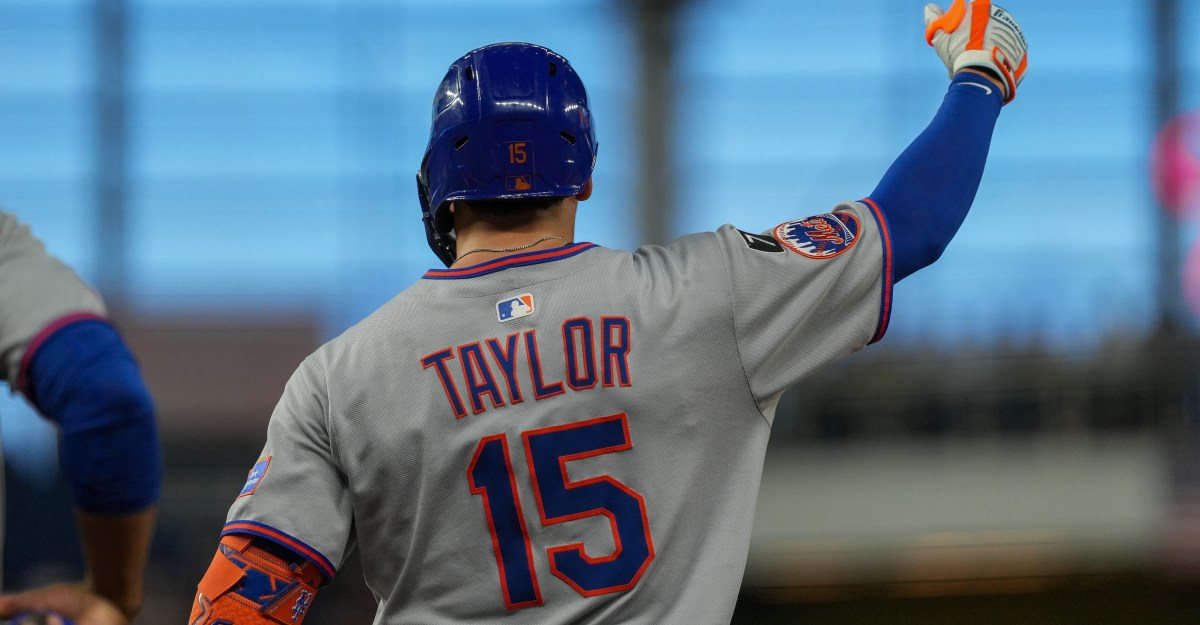
The highlight of Tyrone Taylor’s season was an absurd diving catch in centerfield, one where he ranged nearly 100 feet from right-center to left-center before going into a full extension dive to make the catch. Statcast inferred a 45% catch probability on that play, by I’m slamming the under on that. That play was also part of quite possible the best defensive inning you’ll ever see, sandwiched between two stellar places from Francisco Lindor. Watch those videos and enjoy a brief trip into a happier time of the 2025 season.
Ah, you noticed the date didn’t you. Yes, the fact that we’re starting off Taylor’s season recap by highlighting a single standout play from April 29th probably tells you pretty comprehensively how the rest of his season went – a feeble .223/.279/.319 over 341 PA, by far the worst line of his career. Despite hitting more line drives than 2024 and managing more pull-side air contact, Taylor’s performance on batted balls collapsed. His average exit velocity fell by nearly a full MPH, his barrel rate was nearly halved, and some bad luck* – captured by the 40 point gap between his wOBA and xWOBA – did the rest.
*Note: xwOBA is a nice public-facing metric, but fails to consider horizontal spray as a variable, limiting its accuracy to some extent; we can likely conclude that Taylor was to some extent unlucky, but not that the entirety of the gap between his expected and actual performance
Some players do fall off a cliff suddenly in their 30s, but a closer look at public-facing athletic measurements doesn’t suggest that was the case for Taylor. He actually posted the best sprint speed of his career in 2026, ranking in the 94th percentile at 29.3 ft/s. Taylor’s bat speed remained nearly identical, and his 4 OAA in centerfield was the best mark he’s posted since 2022. Perhaps his career low O-contact% suggests a decline in barrel control or eyesight in some way, but I’d expect that to show up in his Z-contact% as well, which actually improved.
A more compelling explanation might be that Taylor was simply overexposed as a full time starter. Recall that the Mets traded for Jose Siri before the season in an attempt to build a similar timeshare to what they rolled out in 2024 with Taylor and Harrison Bader. Instead, Siri exited a game on April 12th with a broken leg and missed the majority of the season, thrusting Taylor into more-or-less a full time role in centerfield. Taylor’s May performance was strong but he stumbled badly in June and July and eventually lost playing time first to Jeff McNeil and eventually Cedric Mullins.
Intriguingly, Taylor’s performance did rebound after the trade deadline. From August 1st on, he batted .357/.413/.476, good for a 155 wRC+ across 17 games and 47 PA. There’s a .429 BABIP that needs to be mentioned in there, but it sure seems like Taylor was simply more comfortable in a more limited role. That could be due to matchups, or it could be due to the wear-and-tear of playing a high quality centerfield everyday.
Whatever the root cause Met fans should hope there’s a real signal there because Taylor is quite likely to be on the roster next season. He’s due a relatively modest $3.6M in his final year or arbitration and is, at worst, a strong defender who can serve as a functional fourth outfielder. Going one step further, he’s probably the safe bet to be starting in centerfield on opening day.
No, that’s not exciting, but what’s coming behind Taylor is: Carson Benge, the Mets’ first round pick in 2024 who now sits in Triple-A as a top-20 (or better) prospect in baseball and is just about major league ready. Signing a more established veteran would just serve to block a top prospect that will likely be better sooner rather than later. Taylor, by contrast, is totally capable of keeping that seat warm and sliding back into the 4th outfielder role he seemingly excels at when the time comes.