
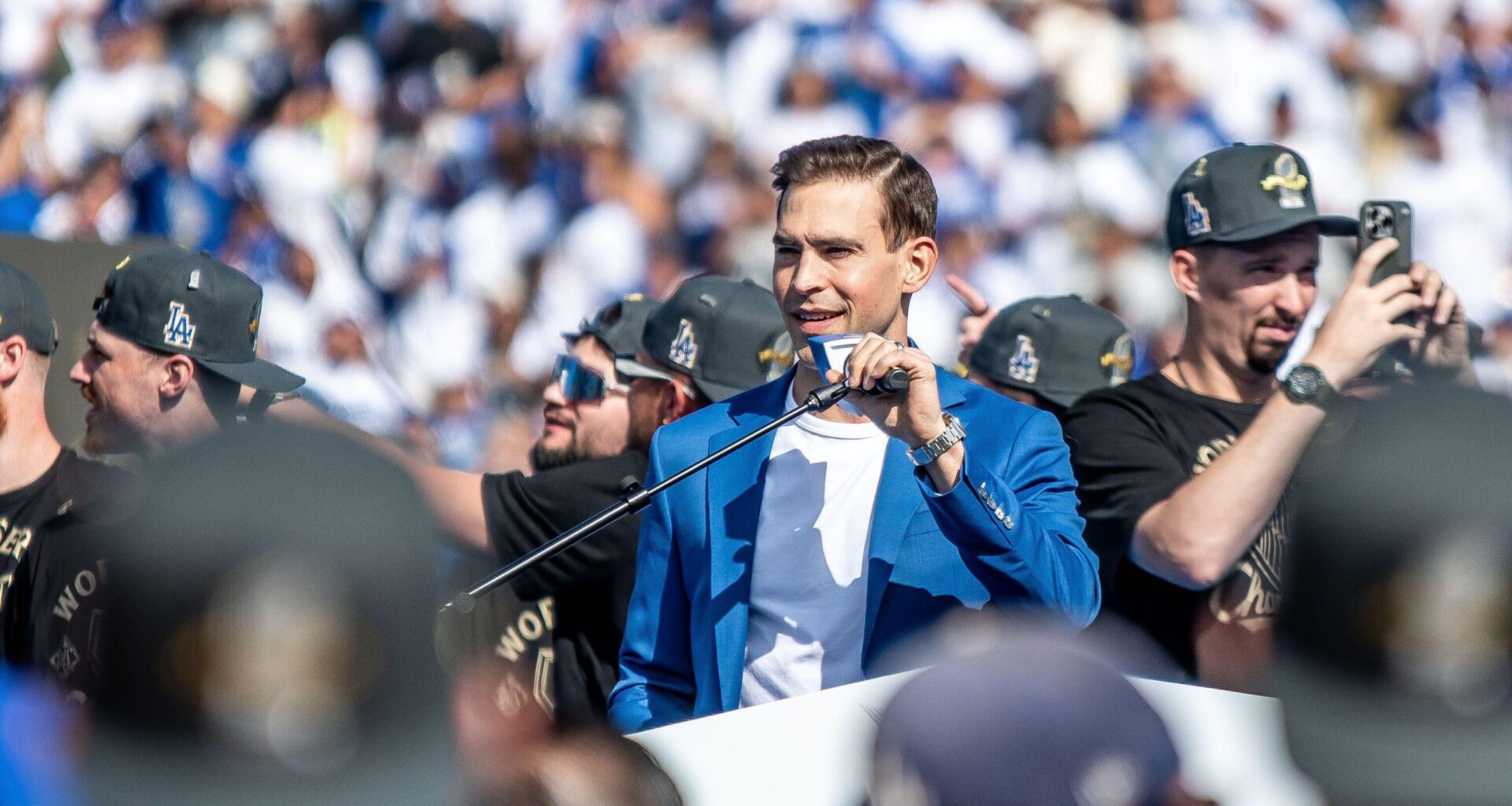
Welcome back to “On the Air,” in which Sports Media Watch Podcast co-host Armand Broady will offer in-depth breakdowns of broadcasters, on-air performance and career journeys, plus chronicle broader trends in the industry.
Vin Scully was the voice of the Dodgers for 67 seasons. For many of those final years, Dodger fans would hold their collective breath waiting for Scully to announce he’d be returning to the mic for the following season. The team would share the news of Scully’s return during a home game, allowing thousands of relieved fans to joyfully celebrate the news together.
Scully was more than a well-liked announcer. He was the team’s avuncular raconteur, its historian, its poet laureate, and its conscience. And when he died in 2022, generations of Dodgers fans mournfully remembered who he was and what he represented.
“A part of my childhood died yesterday,” said actor Bryan Cranston on social media after Scully’s passing. “That may sound dramatic, and maybe it is, but it is how I’m feeling today. From the time I was able to understand what the radio was I would listen to Dodger baseball games. It was the beginning of a lifelong joy. His stories made you feel like you were with him… like he was sharing a story just for you. Because even if it was for only the next three hours, listening to Vin’s voice made me feel safe. Comforted.”
The response of Cranston — and many others — illustrates the unique and often extraordinary relationship baseball fans have with their team’s announcer. The intricacies of that bond become more complex when that announcer also works nationally.
Joe Davis has been navigating those complexities. The 37 year old is the full-time television voice of the Dodgers and the lead MLB announcer for Fox Sports. He has been in the Fox booth for both of the Dodgers’ back-to-back World Series championships, including this year’s thrilling win over the Toronto Blue Jays. And when the Dodgers held their parade earlier this month, Davis served as emcee, a move which drew the ire of Sirius XM Radio host Chris “Mad Dog” Russo.
“When you’re a national broadcaster, and you’re the voice of the sport on the big stage, when you did a million playoff games, and one of the crippling losses that a franchise is gonna have in the history of the sport — that’s as bad a loss as you’re going to have,” Russo declared on his show Mad Dog Unleashed. “The body’s not even cold yet! And I got Joe at Dodger Stadium doing the freaking Dodger parade! Oh my god! That’s bad! I’m sorry! I don’t care what you say! You can say I’m screaming and yelling about nothing! That would [tick] me off if I’m a Blue Jay fan!”
While Russo’s often incomprehensible rants offer little more than bombastic rhetoric, his point here holds some validity. Davis is an award-winning professional and few objective fans would accuse him of rooting for the Dodgers during the World Series. But serving as emcee of the franchise’s championship parade exposes him to criticism. It fuels the belief that national broadcasters can’t be trusted to play it down the middle.
There’s a difference between attending the parade and hosting it. As emcee, Davis’ job is to not merely be a part of the celebration but to lead it. In those moments, Davis becomes as big a cheerleader as any fan inside Dodger Stadium. For fans of other teams (like the wounded Blue Jays), Fox’s lead announcer expressing such unbridled joy for the Dodgers could raise questions about his impartiality. Every year during the postseason, a collection of fans waits for any moment to call out perceived bias. It is easy to believe that Davis wants the Dodgers to win, but no one (outside the Dodgers) wants to hear or see him express that desire publicly.
Additionally, had Dodgers radio voice Stephen Nelson hosted the event, there would likely have been few objections.
At the same time, there is a difference between hosting a championship parade and a national broadcaster actively cheering in-game for the team he/she is paid to follow locally. What we ultimately learn from Davis’ dilemma is that journalism is not a straight line. There are crooks, bends and gray areas along the way. Given the scrutiny baseball broadcasters face and the connection fans have with local teams, networks and network broadcasters should always aim for objectivity in and around the game.
Plus: Vitale returns to the booth
ESPN’s opening week coverage of the new college basketball season was highlighted by the Dick Vitale Invitational, an annual event to honor the longtime college basketball analyst. This year’s event featured Texas and Duke with Vitale on the call alongside play-by-play announcer Dave O’Brien and analyst Jay Bilas.
Vitale, 86, has battled four kinds of cancer, yet maintains a buoyant spirit. With his advanced age and declining health, his presence is more valuable now than his commentary. His days as a lead analyst are long gone. His calls don’t carry the same punch and power, and his vocal cords won’t allow him to reach the octaves he once could, but Vitale can still fill a room, a screen or an arena with his unmistakable charm and his zeal for life. Fans and viewers just like to know he’s there.
According to Brendan Marks of The Athletic, viewers should expect to see and hear Vitale a good bit this year. The network plans to ease Vitale back into regular game analysis for the first couple months of the season. Depending on how he feels, Vitale could end up calling a game every other week or weekly starting in January.
As ESPN senior vice president for production Meg Aronowitz put it in the Marks article, there is a “void” in college basketball without Dick Vitale. And now fully into the winter of his career, each appearance becomes more special.
When the time comes, expect ESPN to celebrate Vitale’s retirement with as much — if not more — pomp and spectacle as those of the recently retired Hubie Brown and Lee Corso.