
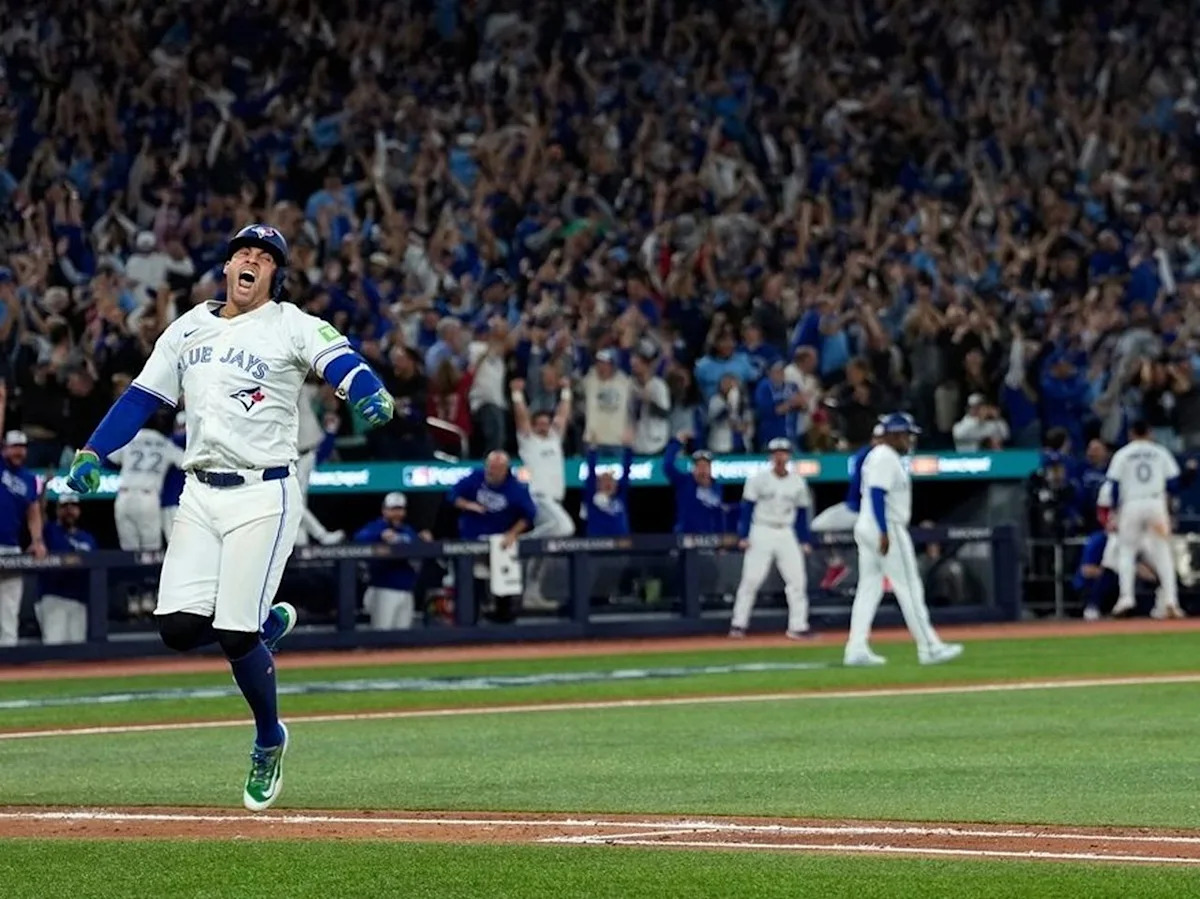
The Blue Jays lost a World Series, and that will hurt for awhile.
But the record-setting exploits of Ernie Clement, Trey Yesavage, Vladimir Guerrero Jr., and their close-knit Toronto teammates won them a legion of new fans all over Canada; many of whom might be heading to a baseball diamond for the first time next spring to give it a whirl.
And that will help, at least for awhile.
The Blue Jays bump is real, and it will be felt again when it’s time to register kids, teens and young adults for the 2026 season, just as it was in 1992 and ’93, when the Jays won it all, and in 2015 and ’16, when they went deep enough into the post-season to spread another epidemic of baseball fever across the country.
“What I can tell you is, going into ’15 and ‘16, which was kind of a Blue Jays resurgence if you will, with the (Jose) Bautista bat-flip and all that, we had a 14 per cent increase in participation,” said Baseball Canada’s media and public relations manager Adam Morissette. “Unfortunately, I don’t have the numbers for ’92 and ‘93, but I was a young player at that time, and I remember baseball was almost on a par with hockey at that point, not in registration, but in terms of popularity. And you have to remember the Montreal Expos had some pretty good teams at that time, too, knocking on the door of the playoffs. That also would have bumped registration up a little bit, certainly in the province of Quebec.”
A bump is great, but every sports organization knows that’s only half the battle. Baseball Canada’s strategic planning document covering 2023 to 2028 set a goal of three to five per cent annual growth and retention. Executives knew it was an achievable target, having seen registration nationwide increase at about that rate for several years to reach 230,000 in 2024.
“It certainly is attributable to the Jays, based on what history has told us,” Morissette said of steady growth through the past 10 years.
A weeks — or months-long run to the end of a championship series in hockey, baseball or basketball creates excitement and a deep, meaningful sense of community, and it certainly stirs up national pride in Canada when the opponent hails from the U.S. The Jays played a total of 18 post-season games against the New York Yankees, Seattle Mariners and Los Angeles Dodgers, and TV ratings north of the 49th parallel went through the roof. Game 7 of the World Series attracted 11 million Canadian viewers, fully one quarter of the country’s population. The seats at Rogers Centre filled up along the way too, and the bandwagon was jam-packed.
When the Toronto Raptors took the country on a similarly wild ride through the National Basketball Association playoffs to a Larry O’Brien Trophy title in the spring of 2019, Paul Sir was executive director of Basketball Alberta.
“It’s exactly the same. It captured everybody’s imagination,” Sir said on Monday. “For the first time, people were watching the games, bleeding with the team, hoping for the Raptors, riveted by what’s going on even though they probably didn’t understand what was going on out there.
“It was a magical time for basketball. The cool thing was driving around Edmonton, you would see playgrounds that usually sit empty, and kids were out there playing basketball. So it influenced and inspired people.
“And after the Raptors won, we just saw huge interest and participation in our sport. We had the surge for fall registrations in 2019, and I’m sure it was a 10- to 20 per cent jump. More for boys than for girls, but still for girls, a big jump as well. And then COVID hits in March of 2020 and just takes the air out of everybody’s balloon, regardless of sport.”
Baseball Canada and its member associations will be working diligently to capitalize on this Blue Jays bump and accommodate renewed interest in their sport.
“It’s one thing to have the demand, but you want to keep these players in the sport year over year,” said Morissette. “And that’s going to mean more volunteers, more baseball fields. We’re going to have to make sure that the coaches are properly trained and we’re recruiting coaches, as well. Oftentimes it’s parents and volunteers, so that’s going to factor into it as well.”
Baseball Canada already encourages local associations to adopt Rally Cap, an initiation program for kids aged four to eight that aims to replace T-ball. Instead of two, nine-player teams facing off as they do in T-ball, Rally Cap puts three teams of six players on the field. While two teams play against one another, the remaining players participate in drills, and all three teams rotate through the two phases. Baseball Canada said the program results in more engaged players who touch and hit the ball far more often than in a typical game of T-ball.
Another program called Baseball5 presents a five-on-five version of the game that can be played inside school gymnasiums, without bats, pitchers or home runs. The batter hits the ball with his or her hand, and it must land in the field of play.
Those programs address one half of the equation by making it easy for kids to experience the game, but many municipalities are facing infrastructure challenges because diamonds have been eliminated to accommodate soccer fields.
A 2022 survey of parents conducted by the Lifestyle Research Institute showed soccer was the No. 1 sport for Canadian kids aged five to 17, with participation at 28 per cent. Basketball was No. 2 at 17 per cent, while baseball and softball were No. 5 at nine per cent, trailing hockey/ringette and swimming/diving at 16 per cent.
Baseball Canada accepts the challenge and is working on solutions, one of them in partnership with the Blue Jays. The Field of Dreams program has seen the Jays donate more than $20 million to build, enhance or replace baseball diamonds across Canada. This year, 15 communities were beneficiaries of the donation, and the program has funded more than 230 projects since its inception.
“In Alberta, our biggest hurdle will be capacity,” said Danielle Moffat, executive director of Baseball Alberta. “Many municipalities have scaled back baseball facilities in newer developments over the years, so as registrations increase, we’ll be facing real pressure on field access and facility availability in several regions. It’s a great problem to have, more kids wanting to play, but it’s also an opportunity for communities to re-invest in the sport. Baseball Alberta would love to see this momentum turn into sustainable growth supported by infrastructure and development planning that matches the enthusiasm we’re seeing at the grassroots level.”
Sir said there were similar challenges for local basketball associations in the wake of the Raptors’ run; learning how to balance a stagnant or declining inventory of court time with an influx of enthusiastic new players.
“I think that challenge was exacerbated by public schools in particular becoming more selective in how they rent their gymnasiums out,” said Sir. “So we had a bit of what I would call shrinkage from that. Plus there were other pressures. You do have competition for gym space.”
Through the month of October, the Blue Jays had no competition for the spotlight in this country. They were Canada’s team, playing heads-up ball, inspiring a generation. It’s time again for Baseball Canada, its provincial partners, and municipalities to step up to the plate.