
The first thing to know about this game is that it was an unusually warm day for April in Chicago. It was 85 degrees at game time, and wound up being 92 degrees, which is still, 45 years later, the highest temperature ever recorded in Chicago in the month of April.
This was just the ninth game of the season. The Cubs had lost three of five in New York and Pittsburgh to begin the season, but then swept the Mets at Wrigley Field and entered this series against the Cardinals with a 5-3 record.
Advertisement
The wind was blowing out, per the boxscore at 22 miles per hour, pretty strong for a sustained wind. And hitters took advantage. The two teams combined for six home runs, including one by Cardinals pitcher Bob Forsch, and one by Cub shortstop Ivan de Jesus, who had five hits and hit for the cycle. Since then only two Cubs — Mark Grace on May 9, 1993 and Carson Kelly in Sacramento on March 31, 2025 — have cycled.
The Cardinals had taken a 6-2 lead in the third, but the Cubs tied it 6-6 in the bottom of that inning. That didn’t last long — St. Louis put five on the board in the fourth and one in the fifth to take a 12-6 lead. The Cubs made it 12-9 in the fifth, 12-11 in the seventh and Barry Foote homered in the eighth to tie it again 12-12. In the ninth the Cubs loaded the bases and, with two out, Foote came up again [VIDEO].
I remember this one well; people were walking out of Wrigley that afternoon as if the Cubs had just won the World Series, not just improved their record to 6-3 in the very young season. It was mostly downhill from there, although the Cubs managed to hang around .500 until early June. From a 22-22 mark June 3, they went 42-76 the rest of the way, by far the worst in the National League from that point, and manager Gomez was fired not long after the All-Star break with the Cubs floundering in last place in the NL East. The 98-loss season was, at the time, third-worst in franchise history and even today, this remains the fourth-most losses in Cubs history.
But that game remains memorable. The Cubs had 23 hits that April afternoon. They’ve had more than that at Wrigley just twice since that 1980 game — April 23, 2022, in a 21-0 win over the Pirates, and June 30, 2022, in a 15-7 win over the Reds.
Advertisement
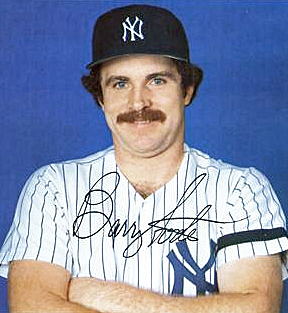
As for Barry Foote, that game represented just about the peak of his Cubs career. He had been acquired from the Phillies before the 1979 season along with Jerry Martin, Ted Sizemore and two minor leaguers for Greg Gross, Dave Rader and Manny Trillo. Well, it seemed like a good idea at the time.
Foote had a good year for the Cubs in ‘79, batting .254/.316/.427 with 16 home runs in 132 games, good for 2.0 bWAR. He threw out 37.9 percent of runners trying to steal and was considered a decent defensive catcher. At 27, it looked like he had a good career in front of him.
Foote suffered a back injury later in 1980 that limited him to 63 games, and in 1981 he began the year going 0-for-22. That is, to this day, the most at-bats in a season for a Cubs position player without a hit. (Carlos Santana came close to this mark after the Cubs acquired him, going 0-for-17 before finally getting one of his two hits as a Cub.)
The Cubs traded Foote to the Yankees in late April 1981 for a pitcher named Tom Filer, who had been considered a pretty good prospect at the time. This was a deal that didn’t help either team. Filer pitched in just eight games for the Cubs in 1982, posting a 5.53 ERA, and eventually left the Cubs as a free agent. He had a handful of decent years for the Brewers later in the 1980s. Foote played in just 57 games for the Yankees in 1981 and 1982, batting .191/.230/.347, and was released at the end of spring training in 1983.
Advertisement
After Foote’s playing career he managed in the Yankees and Blue Jays minor league systems for six years and was a major-league coach for the Mets and White Sox from 1990-93.
Decades later, though, that walkoff slam is still memorable.