
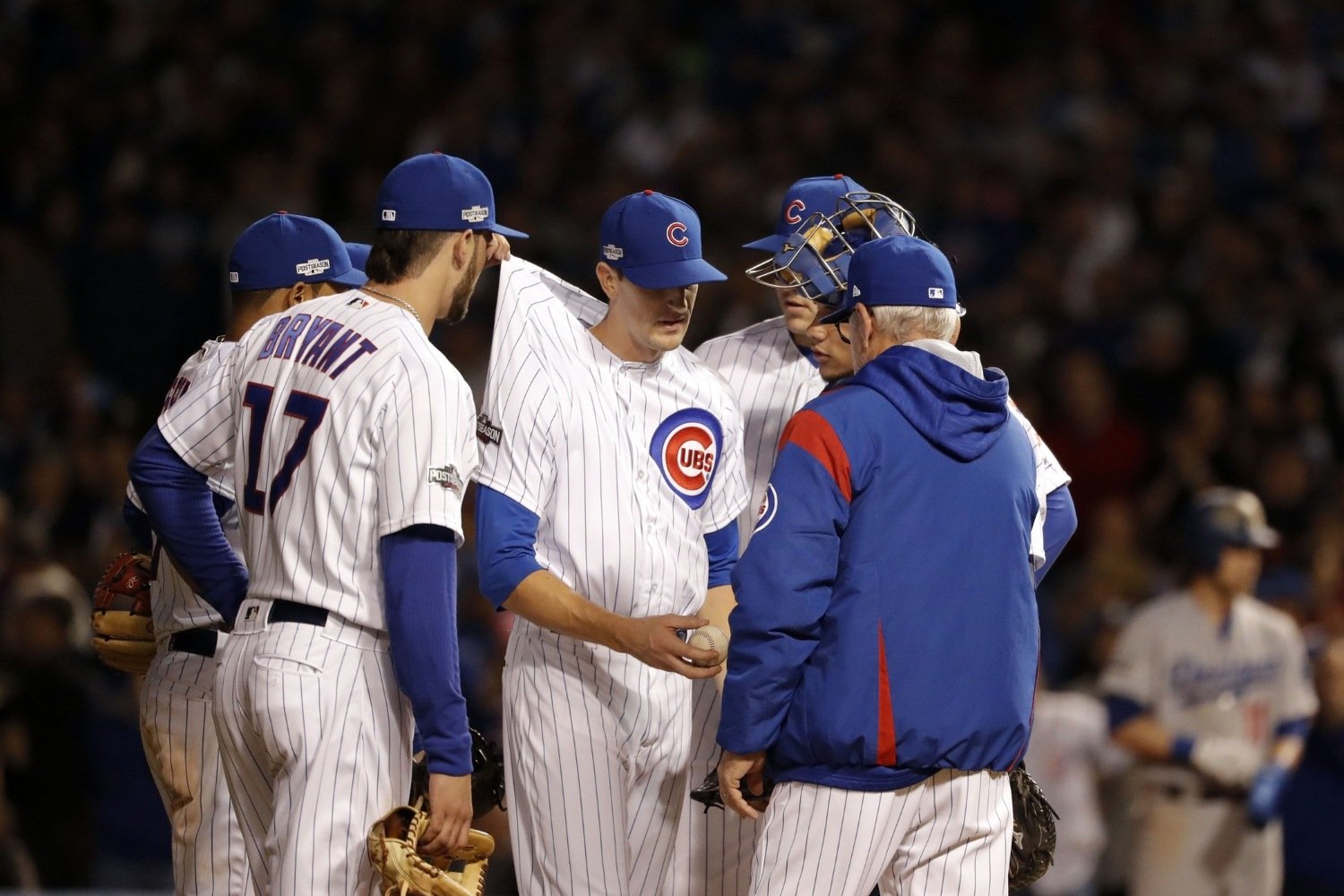
That Kyle Hendricks started Game 7 of the 2016 World Series—that it was he who first scooped up the baseball for the Cubs on the night that 108 years of waiting finally ended—is just trivia, really. It didn’t have to be. Joe Maddon could have trusted him more, if he’d so chosen, and Hendricks would have met the moment. Maddon was on tilt by the end of the Series, though, and the Cubs’ survival in that game ultimately had little to do with Hendricks. He was there. He mattered. But he wasn’t the man who drove the bus.
A week and a half earlier, though, he sure was. By pure happenstance, really, he was the man who took the ball in Game 6 of the NLCS. Jon Lester was the ace of that Cubs team, and he’d started Game 1 of the NLDS. Hendricks got the nod over Jake Arrieta for Game 2, but that was more because Hendricks pitched much better at home than away that year than because Maddon believed Hendricks was materially better than Arrieta.
Hendricks left that NLDS start early, after being hit by a comebacker. He avoided major damage, but that game wasn’t going his way, anyway. He only recorded 11 outs and surrendered two runs; he didn’t strike out anyone. If things had gone a bit differently in San Francisco, for that team, Hendricks might have landed in any of several very different places in the team’s rotation for the NLCS. Chicago nearly finished a sweep when they took Game 3 to extra innings. They nearly had to come home to face the Giants in a decisive Game 5, until a winning comeback in Game 4.
As things panned out, though, Hendricks got the ball in Game 2 of the NLCS, and he was very much his usual self again. That night, though, Clayton Kershaw outdueled him, evening that series 1-1 as it headed to Los Angeles. Hendricks didn’t participate in the West Coast segment of the series, but when it returned to Wrigley, he was slated to start, and his team held the 3-2 series edge.
This time, there would be no telling comebackers. There would be no duel. There was just Hendricks, taking a moment baseball history dropped on him like an anvil and heaving it heroically into place. That weight became no obstacle to Hendricks. It became, instead, the killing stone on which the team ritually destroyed the curse of the billy goat. Hendricks was the tip of the spear.
Baseball history contains two postseason games in which one side retired the other in 27 batters, winning and facing the minimum in the process. One is Don Larsen‘s perfect game in the 1956 World Series. The other was the night that Hendricks became a legend of Cubs lore, and of the 27 outs, 22 were his.
It didn’t start smoothly. Andrew Toles lined Hendricks’s first pitch into right field for a single. No matter. Hendricks is unflappability personified, a low cap and a drooping chin and all the physical expressiveness of a department-store mannequin—with exactly the same capacity to be intimidated as a department-store mannequin.
That first pitch had all the nerves he would show all evening in it. It was 89 miles per hour, which meant he’d overcooked it, and it ran right down the middle. His second pitch was a sinker to Corey Seager, perfectly placed, running to the outer edge at 87 MPH. Seager hit a ground ball up the middle, on which Javier Báez picked the ball on the run and made a brilliant tag en passant on Toles, then threw to Anthony Rizzo in one motion for the double play.
Justin Turner gave Hendricks his first real batter. Hendricks started the late-blooming slugger with a pair of cutters down and away, one a ball and one a called strike. Then came three sinkers in a row: ball low, foul, foul, each pitch working farther in on Turner, trying to speed him up and get him looking there. He tried a dipping changeup to get the strikeout, but Turner laid off. Finally, on 3-2, he went up and away—a hole in Turner’s swing, but only if you get him looking everywhere else before going there. It worked. Turner flied lazily to right fielder Albert Almora Jr. Three up, three down.
When Hendricks took the mound again, he had a 2-0 lead, and the biggest challenge was not to let the excitement or a relatively long sit in the dugout take his edge off. No problem. He started Adrián González with a cutter that started on the outside edge and ran into the white of the plate. That took guts, because González had taken Hendricks deep for the Dodgers’ only run against him six days earlier, to left-center. Hendricks knew, though, that González would take the first pitch unless it looked fat out of the hand. It didn’t; it only looked fat once it was in Willson Contreras‘s mitt.
González tried to get aggressive on the next offering, a changeup that tumbled down to his knees on the same line on the outer third, but whiffed. Hendricks ran a cutter way inside on him, then tried two changeups down and away. On the second of them, González hit a soft, floating liner up the middle, which reached a shifted Addison Russell on a leisurely bounce for an easy out.
That brought up Josh Reddick, on whom Hendricks again began with a cutter running into the middle of the plate. Called strike one. His next pitch, this time, was not the changeup but his little-used curveball, and its big, slow arc induced a fooled Reddick to hit a topspin bouncer to the right side. It was so mishit, though, that it fooled Báez, just as it had fooled Reddick. It hit the second baseman in the chest, and Reddick got first on the error.
No matter. They say Hendricks doesn’t have explosive stuff, but he certainly did on the first pitch to Joc Pederson. Just as he threw a fading outside-corner changeup, fireworks went off in the distance, somewhere near the lakeshore, and Pederson tried (far too late) to step out and call time. All he got for his pleas was strike one. Strike two followed, the same changeup but a little bit off the edge, a little low, fouled away by the anxious Pederson. No anxiety afflicted Hendricks. The next pitch was a high fastball, so rare a sighting from Hendricks that it beat Pederson handily for a strikeout.
Hendricks then went to work on Yasmani Grandal, but also on Reddick at first base. The Dodger right fielder was looking runnerish, and Hendricks always excelled at thwarting the running game with his quick feet. He nibbled against Grandal, with a changeup that just grabbed the outside edge for strike one and one buried in the dirt for ball one. A backdoor cutter stole him strike two and encouraged Reddick to get a little more. Lengthen that lead, try the steal, there are two strikes, anyway.
Bang. Hendricks fired his ‘A’ pickoff move over, with that sudden turn of the hips and shoulders and that brilliantly light bit of footwork. Reddick was out by as much as any runner you’ve ever seen, on a pickoff by a righty pitcher. Technically, it was six up, six down.
The Cubs tortured Kershaw again for a while in the second, and scored a third run. All Hendricks had to do was keep the train running. He did face an immediate challenge, though: how to get out Grandal a second time in a row, more or less. The answer was: cutter inside (ball one), then back to the outside corner (strike one, called) changeup fading away (ball two), changeup elevated (called strike two). That four-pitch sequence set up a battle.
Grandal, one of the most patient hitters in the league and one of its toughest outs, had seen seven pitches already against Hendricks. Hendricks tried a perfect change on the outer edge, but this time, Grandal spoiled it. Hendricks went farther down and away; spoiled. He tried his more cutting changeup, at the bottom edge over the middle of the plate; spoiled. The high fastball that had disposed of Pederson didn’t work on Grandal, because he missed too high with it. That brought the count full, but on 3-2, he went back to the cutter, down at the biottom of the zone. Strike three, on a swing that said Grandal expected the changeup.
Chase Utley was due next. Though at the end of his career by then, Utley was a great hitter, and wasn’t going to give away an at-bat. Hendricks took one from him by the force of precision: backdoor cutter, strike one; changeup down, on the same edge, ball one; sinker away, drawing X’s on the outside corner. Utley lined the pitch to left field, but Ben Zobrist caught it with ease. Hendricks didn’t mess around at all with Kershaw: three fastballs in the zone, three strikes. Nine up, nine down.
Unwilling to give Toles a second chance to hit the first pitch hard somewhere, Hendricks looped in a curveball on the outer black for strike one. The next pitch was a changeup low and away, nibbling the same edge, and Toles put a very good swing on it—but the only thing it was ever going to hit was the end of his bat. Almora made another easy catch. Seager got ahead 2-0, as Hendricks tried the front-hip sinker and the backdoor curve with insufficient precision. Retreating to his bread and butter, though, Hendricks ran the sinker off the outer edge, and Seager grounded out up the middle again. This time, Hendricks cut it off himself and threw to Rizzo.
Hendricks stole a strike with a backdoor sinker to Turner, then missed away with that high fastball that worked the previous at-bat. He came back with a changeup diving down and in on him for a swinging strike two, though, and ahead 1-2, he got a weak grounder to Rizzo by running the two-seamer right at Turner’s hands. Twelve up, 12 down.
It was when Contreras homered off Kershaw to lead off the bottom of the fourth that Wrigley went from loud and excitable to a true cauldron of sound and fearsome joy. It pretty much stayed that way, and that might have startled or overexcited a different player. Hendricks, for his part, got González on a first-pitch cutter at the bottom of the zone, inducing a sharp but manageable grounder to Russell.
He started Reddick with a low cutter, for a called strike. He lost an attempt to throw another backdoor curve, but when he came back from that with a changeup in the middle of the plate, Reddick just popped it up. Báez went over and took the ball away from Rizzo, but whichever of them caught it, the play was going to be easy. Home plate umpire Ted Barrett missed what should have been strike one to start Pederson, on a high cutter, but Hendricks came back with a lower one to even the tally. He missed away with another curve (really, he didn’t have great feel for that pitch for most of the night, but all his misses with it were far beyond the areas where he might have gotten hurt), then got strike two with a balloon ball of a changeup away. After that floater, when he threw a sharper, tumbling change in the dirt, Pederson had no chance. It was a swinging third strike. Fifteen up, 15 down.
Anthony Rizzo made it, officially, a blowout with a fifth-inning homer. Kershaw tried to get cute with a dropdown slider against him. Rizzo did decidedly non-cute things to that ball. Hendricks had only been expected to give the team about five innings in this contest, and he’d done that. The lead was five. If his night had ended there, no one would have blinked.
Instead, he took the hill again, facing Grandal—who had already seen 12 pitches against him in the game. He tried a high cutter to start him, but missed up. He went back to that floating, slightly slower high changeup away, to even the count, but then failed to get the chase when he threw a curve (executed correctly, this time, but to no avail) ankle-high over the inner third. For the first time, he started to look ever-so-slightly tired. He tested the outside corner with a cutter, but released it a hair early and missed high and away with it. For the first time all night, he was meaningfully behind in a count, 3-1.
No matter. He threw two gorgeous cutters, one down and in and one that found that upper, outer edge, both drawing whiffs from the sharp-eyed Grandal. Eighteen pitches weren’t enough for Grandal to figure him out; none of the other Dodgers would get anything close to that many chances.
His command was still a bit compromised. He started Utley with a good cutter down and in, but his impression of a backfoot curveball proved unconvincing, and a 1-1 backdoor cutter didn’t reach the plate. No matter. A 2-1 pitch that must have looked like a hittable sinker to Utley was really a changeup that ran off the plate away, and the aging star tapped a grounder to Báez.
Kershaw’s night ended with Andre Ethier pinch-hitting for him. Hendricks missed with a cutter, then a changeup down and away, but then he stole a strike with a low cutter. He tried to go even lower with a sinker, but missed. Another 3-1 count. No matter. Ethier was trying to buy a walk, and so Hendricks filled up the zone with a cutter. On 3-2, he landed another perfect backdoor cut-piece, and Ethier became the first Dodgers batter all night to hit the ball to Kris Bryant, at third base. It was an easy grounder. Eighteen up, 18 down.
Toles had clearly been looking down and out over the plate in each of his first two turns, and he’d been aggressive, too. That made Hendricks’s job the third time easy. He threw him a cutter up and in, tying him up badly and inducing a pop-up to Russell. He fired a first-pitch cutter to Seager to jump ahead 0-1, then went sinker-sinker, down and away. One of them missed off the edge; Seager fouled off the other. On 1-2, he tried a change of eye levels with a high fastball, but Seager fouled that off, too. Having set him up, Hendricks went for two straight buried changeups. but Seager laid off them, filling the count.
No. Matter. Hendricks had one more changeup to offer, and it was a thing of beauty. He turned it over hard, got two-plane fade on it, and Seager tried to kill it. No luck, no contact, and a strikeout where a walk could have been but was never going to be. Like every other Dodgers batter, Seager was more anxious than Hendricks.
He threw Turner another surgical first-pitch, backdoor sinker. He tried to get another whiff with that changeup slicing in under his bat path, but Turner laid off it for ball one. He tried again, but the pitch hung. Turner had been looking for the cutter, though, and even a slightly elevated change brought a weak foul pop-up to Rizzo. Twenty-one up, 21 down.
González looks to do damage on the ball down and away, so much that Hendricks tried a first-pitch bender below the zone to start the eighth. It missed. He tried a cutter up and in; it missed. He then went for three straight cutters starting on the outer edge and running in, trying to get weak contact to bail him out of the bad count. Even with five runs of cushion, he wasn’t going to walk González. He wasn’t pitching for strikeouts or glory, but for the team. On a 3-1 pitch, González obliged him with a fly ball to center field, where Dexter Fowler got his first action of the game.
Hendricks’s first pitch to Reddick was a cutter that didn’t start as far out on the edge as he’d meant, and which ended up right down the middle. Reddick hit a clean single to center, two balls in a row for Fowler, and that ended Hendricks’s night. No matter. Aroldis Chapman would finish the job, with two double plays leading to a four-up, five-down save. Before that, though, came the ovation of a lifetime. Hendricks left Wrigley Field with the crowd in as true a frenzy as has met the departure of any starting pitcher in the stadium’s history.
Báez tugged at the name on the back of his jersey as he started away. Maybe Hendricks wanted to absorb the adulation head-down, brow stoic, but his teammates wanted none of that. They’d just watched him knit them all together, pick them all up when they wobbled, and carry them to the end of the curse, if not quite the end of the night. As great as Kerry Wood‘s 20-strikeout mega-gem was, it’s not the best and greatest pitching performance in Cubs history. This was.
Officially, the Dodgers collected two hits against Hendricks that night, and they reached on one error. No matter. That night, that team was perfect, and their starting pitcher made them so. Destiny chose Kyle Hendricks, a nobody eighth-round pick with a fastball from the wrong generation and a changeup from Hell, to be the one who ended sport’s most famous droughts.
On the night when he made baseball history, the man who famously lived at 88 miles per hour threw 88 pitches. He was masterful, and unshakable, and such a team guy that (even though it took until the very end) he leaned on every teammate to assist or record at least one out, but he was also a towering individual performer in that game.
Hendricks won’t go to the Baseball Hall of Fame, but he’s a shoo-in for the Cubs Hall of Fame. He’ll retire, it was reported Monday, so we’ve seen the last of him in the major leagues. No matter. For most Cubs fans, he’ll live and pitch forever, over and over, whenever they close their eyes or go to YouTube to savor the highlights. There might be no more ideal image to capture one player’s career in one picture than that moment when, surrounded by teammates and a manager somewhat awestruck by the massiveness and the beauty of his performance, Hendricks handed the ball to his skipper, with Báez tugging at that name to make sure everyone in the park knew just who had dominated on the biggest stage in Chicago sports history.