
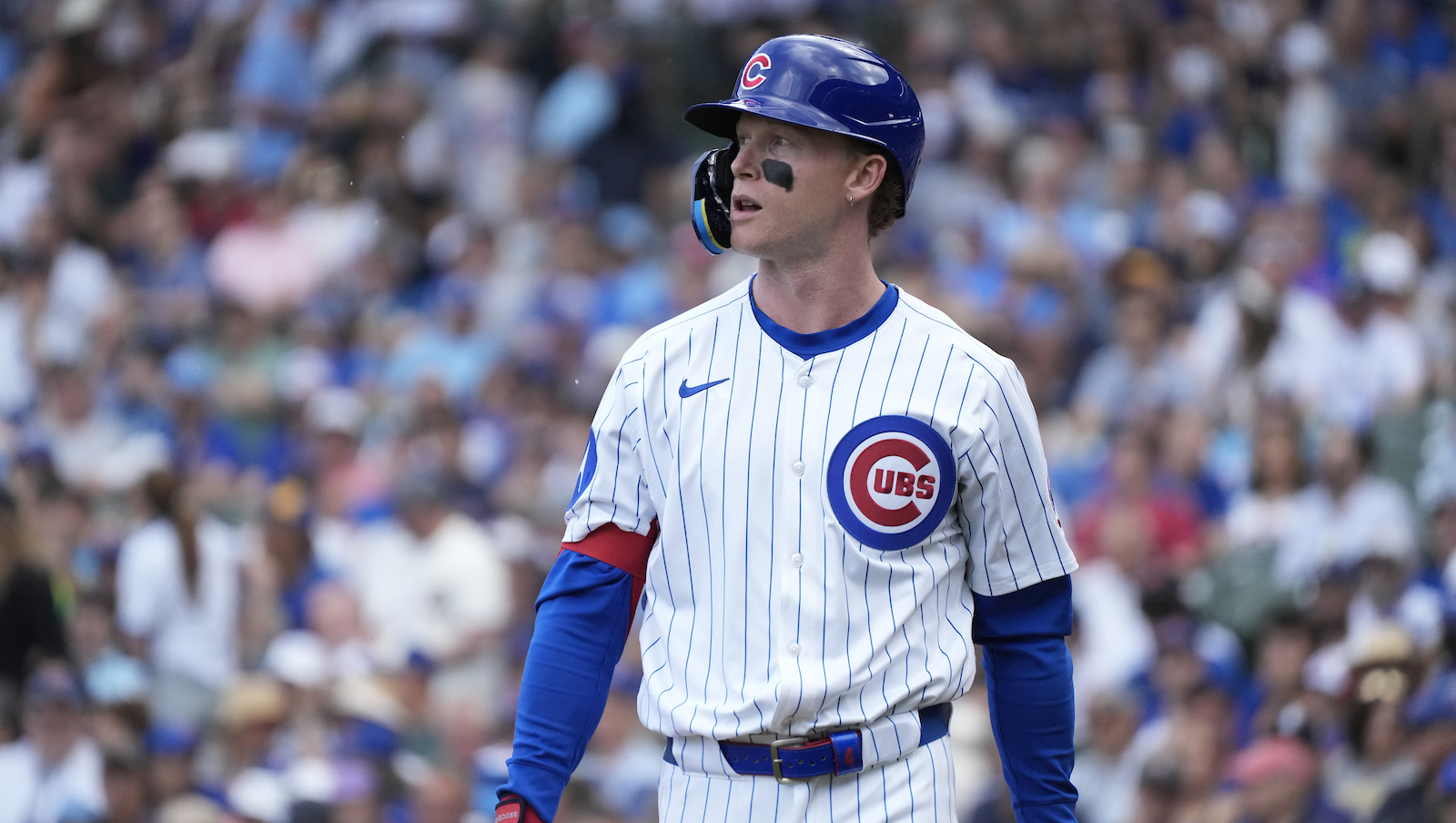
With an All-Star appearance, a Gold Glove and a historic 30-homer, 30-double, 30-stolen base season behind him, the future as a marketing dream for the Chicago Cubs and a mega-million dollar contract seems projectable for Chicago Cubs center fielder Pete Crow-Armstrong.
Going into his second full season in the major leagues, Crow-Armstrong and the Cubs will revisit a brief negotiation that had the 23-year-old player pushing aside a $90 million contract proposal in the spring, according to MLB sources.
Originally reported as a $75 million offer in April by MLB.com, Crow-Armstrong and his representatives believed that his future ceiling as a top player would eventually net him a more lucrative deal as the season and his career moved forward.
The numbers in the first half of the season proved that to be true. The second half batting metrics left some questions to be answered. Crow-Armstrong had the the 16th-highest selling jersey in baseball according to Fanatics’ sales. His jersey sales were tops among all Cubs players.
Players with 25 HR & 25 SB before the All-Star break 🤩
• Bobby Bonds – 1973
• Eric Davis – 1987
• PETE CROW-ARMSTRONG – 2025 pic.twitter.com/84y5If014k
— Marquee Sports Network (@WatchMarquee) July 10, 2025
Cubs president of baseball operations Jed Hoyer said at his end of the season press conference on Oct. 15th that part of the team’s strategy going forward this winter would be to talk to the Cubs players under contract about possible extensions.
“You have to start everything we do by evaluating the player,” Hoyer offered about the process. “You must focus on that evaluation and what’s that worth to the organization. That’s the backbone of what we do. I think in my career, if you make an evaluation on how you look and value that player, that takes some of that (indecision) out of it. If you don’t do that, you can make real mistakes. How much is that player worth to the organization is the consistent way to make good decisions.”
That list of players looked at will include the five-tool ability of Crow-Armstrong, who could become the highest-paid player in team history with continuous growth as a hitter over the next few seasons. The elite defense is already there. So are the base running skills.
Projecting the type of hitter he will be is another subject.
“Crow-Armstrong has elite bat speed,” said a National League Central scout. “The issue is for the young man to understand he doesn’t have to hit a home run or double on every swing. He is a player only using half the field to hit on. Pitch selection and working counts should be his game. He can bunt .300 if he learns how to handle the bat.
“This guy has the talent as you see by his world class defense and baseball acumen he has learned at each level. Very smart kid. He will continue to grow if he works on the small ball side of the game. He should hit 20 home runs, hit 40 doubles and steal 50 bases. He can be the Eric Davis of this era. There is no telling his ceiling as a ballplayer.”
The highest AAV (Average Annual Value) that a Cubs player has ever signed for was Cody Bellinger’s $27.5 million in 2024 as part of a three-year deal with opt outs. The $155 million, six-year deal Jon Lester inked with the North Siders prior to the 2015 season had an AAV of $25.830 million per year with deferments that are still being paid out. Dansby Swanson’s $177 million, seven-year deal came in 2023 with a slightly less AAV of $25.285 per season. The largest total contract was the $184 million, eight-year deal Jason Heyward signed with the Cubs in late 2015.
Will Crow-Armstrong be offered a 10-year contract at this point to waive all of his arbitration years and numerous free agent seasons?
Arizona’s Corbin Carroll signed an eight-year, $111 million at the same age as Crow-Armstrong in 2023. That contract does contain escalation bonus options for MVP top finishes. The deal guarantees Carroll an AAV of $13.875 million per season.
The Braves’ Ronald Acuna Jr. signed an eight-year, $100 million contract extension in April of 2019 at age 21. At that time, it was the first $100 million-plus deal given to an unproven major league player with one year or less of major league experience.
Looking at the upside for the Cubs to speculate on Crow-Armstrong’s future, they are banking on “PCA” becoming the next Kris Bryant or Anthony Rizzo. Marketing a superstar with the Cubs means big time merchandising money and a television superstar feature on the Marquee Sports Network, which the Ricketts family co-owns with the Sinclair Broadcast Group.
Injuries aside, it makes good business sense to ride the PCA popularity vehicle the for next decade.
For Crow-Armstrong, the lesson of Rizzo’s journey as a Cub should be paid attention to. The ever-popular Rizzo signed a seven-year, $41 million contract in 2013. With club options, the deal eventually earned Rizzo $70 million from 2013 through 2021. Rizzo was underpaid by an estimated $100 million by the end of the contract with escalation in player salary tripling over the life of the Rizzo deal. It was the best contract from a team standpoint in Cub history. The Cubs were sure they had a star of the future and credit then-team president Theo Epstein and GM Jed Hoyer for stepping up and making it happen after just one solid season by the first baseman at age 24.
Will there be a meeting of the minds when it comes to a PCA accord this offseason? After next season, Crow-Armstrong will reach Super 2 status, meaning he will be arbitration eligible with two years of service time and 170 days.
The clock is ticking for both sides this offseason to sign an agreement. If Crow-Armstrong goes through the arbitration process, he will be in that system for four years rather than the usual three-year window.
With another big season, Crow-Armstrong could easily pass Bellinger’s MLB high for first year arbitration — $11.5 million in 2020 with the Dodgers. The price of poker goes up from there!