
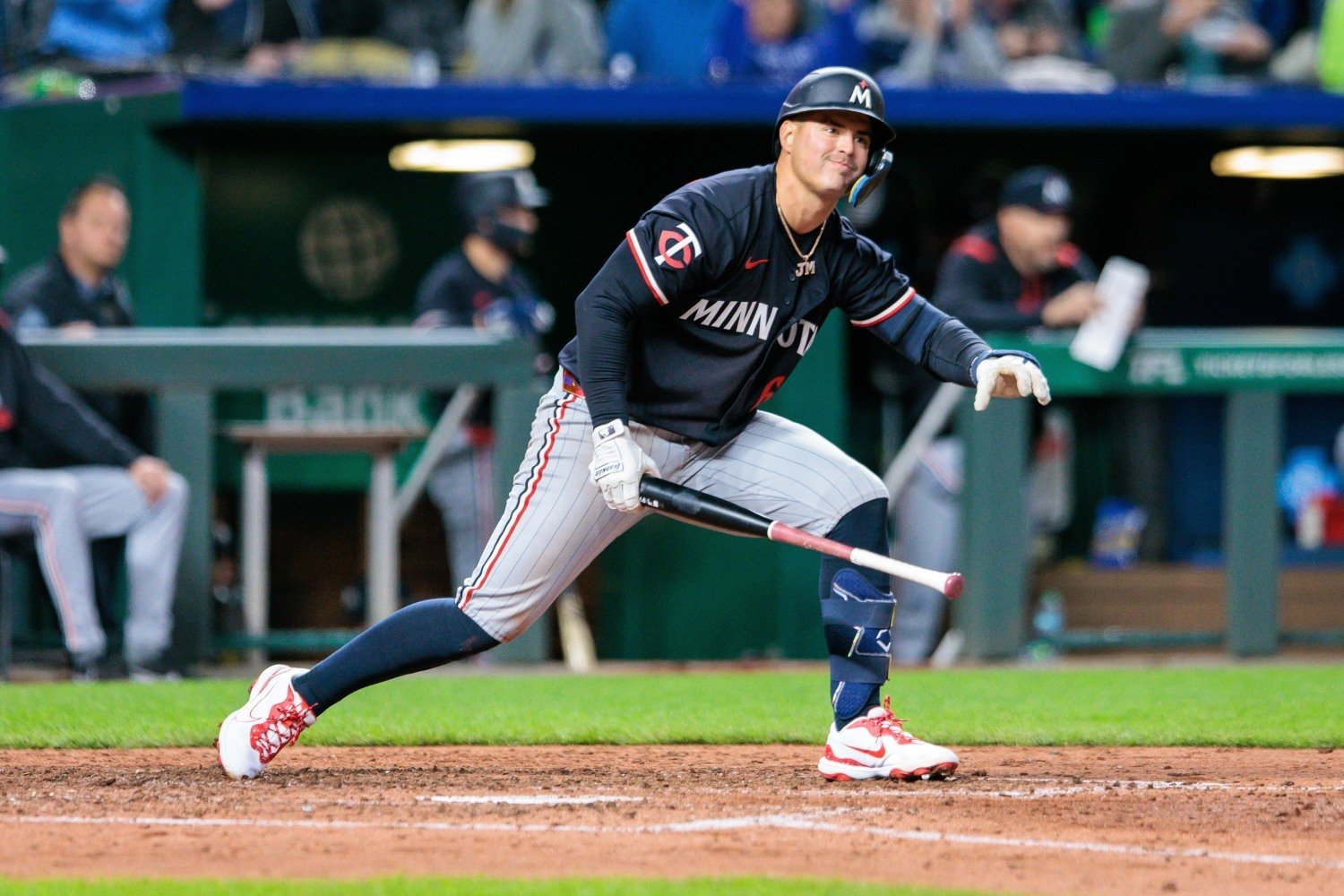
When the Minnesota Twins selected Jose Miranda out of Puerto Rico in Competitive Balance Round B of the 2016 MLB Draft, they believed his advanced bat could someday make him a fixture in their infield. It took several seasons for Miranda to emerge as a legitimate prospect, but when he finally did, his breakout was loud enough to make everyone in baseball take notice. The problem is, that peak proved fleeting.
A Star in the Making
Miranda’s path through the minors was slow and steady. After spending two summers in rookie ball, he gradually climbed the ladder, reaching Double A by the end of 2019. He wasn’t protected on the 40-man roster that winter, and every team in baseball passed on him in the Rule 5 Draft. Those decisions aged poorly when he erupted in 2021.
That season, Miranda led all of Minor League Baseball in hits and posted a .973 OPS, while launching over 30 doubles and 30 homers between Double-A Wichita and Triple-A St. Paul. His contact-first approach suddenly came with power, and his walk rate improved without sacrificing his elite ability to put the ball in play. Miranda struck out in just 12.5 percent of his plate appearances, rarely missing fastballs and routinely producing hard contact.
It was the type of offensive development the Twins’ system hadn’t seen in years. Scouts praised his compact swing and balanced approach, though some wondered if his aggressive tendencies would eventually be exploited. Still, it was hard to overlook a player who could make that much contact with that much authority.
Finding His Place
Miranda’s defense never matched his offensive profile. He moved between third base, second base, and first base, but his limited range and average arm strength left questions about his long-term position. The Twins didn’t seem to care. They believed the bat would play anywhere, and by 2022, he was proving them right.
In his rookie season, Miranda hit .268 with 15 home runs and 66 RBIs across 125 games, providing stability to a lineup ravaged by injuries. The Twins saw him as part of their young core, alongside players like Alex Kirilloff, Trevor Larnach, and Royce Lewis. Even after a step backward in 2023, he bounced back with a strong 2024 season that included tying a major-league record by recording hits in 12 straight at-bats. His confidence appeared to have returned, and his bat looked like it belonged.
The Collapse
Then came 2025. Miranda’s season began with a spot on the Opening Day roster, but unraveled almost immediately. Through 12 games, he batted just .167 with 13 strikeouts in 36 plate appearances. His timing was off, his contact quality evaporated, and the plate discipline that once fueled his breakout vanished. The Twins demoted him to St. Paul, where things somehow got worse.
Shortly after his demotion, he had a freak accident at Target while carrying a case of bottled water. One has to wonder if that injury impacted him throughout the year. Across 90 games with the Saints, Miranda slashed .195/.272/.296 with 57 strikeouts. His once-reliable contact ability seemed to disappear entirely. What had once been a plus bat-to-ball skill turned into a liability, as he continued to swing at pitches out of the zone and struggled to make solid contact when he did connect.
It was a shocking collapse for a player who, just a year earlier, had looked like one of the team’s most reliable hitters. In total, Miranda’s four-year Twins career ended with a .263 average, 28 home runs, and a 101 OPS+.
What Comes Next
Miranda’s fall from promising cornerstone to organizational afterthought culminated last week with the Twins dropping him from the 40-man roster. At 27, he’s still young enough to rebound, but the margin for error has shrunk considerably. He will need to rediscover his approach at the plate and prove that his 2021-22 breakthrough wasn’t a mirage.
For the Twins, Miranda’s story raises uncomfortable questions about player development and sustainability. How did a player with such natural contact ability and offensive instincts fade so quickly? Was it a matter of mechanical flaws, mental pressure, or organizational missteps? The answer is probably a mix of all three.
Miranda’s rise and fall is one of the most abrupt turnarounds in recent Twins history. He once symbolized the promise of homegrown offensive talent, but now stands as a cautionary tale about how difficult it can be to stay on top once you get there.
If Miranda finds his way back to the majors, it will be through the same perseverance that once defined his rise. But for now, his fall serves as a reminder that success in baseball can be as fragile as it is thrilling.
What stands out about Miranda’s time in the organization? Leave a comment and start the discussion.