
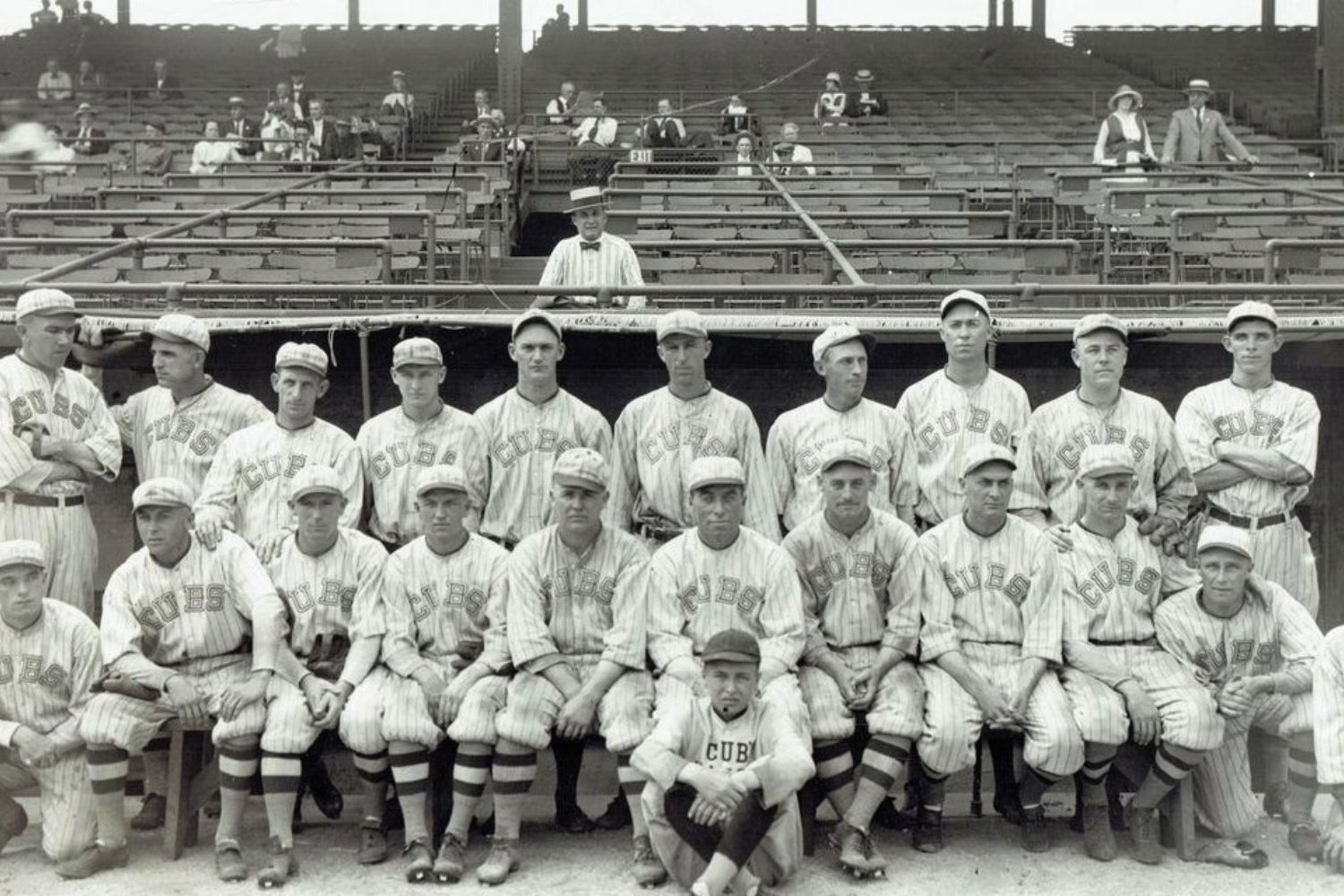
This offseason, we’re going to get in a time machine back to 1918. I’ll be doing a series of articles examining the 1918 Chicago Cubs. I’ll have game recaps, player profiles, summaries of major events, and all sorts of stuff in between. I plan on doing these chronologically, so you can feel like you are following along in real time.
Today is the introduction—the pilot, if you will. I’ll briefly summarize the 1917 season for the Cubs, I’ll take a look at the state of baseball, and more importantly, the world, at that point in time, and I’ll run down some of the bigger offseason happenings for the Cubs.
Huge shoutout to Baseball Reference and FanGraphs for all sorts of statistics and transaction history, and of course, the Society for American Baseball Research, which I will cite continuously in these pieces for their ability to track down and summarize all sorts of baseball history.
Chicago Cubs’ 1917 Season Recap
The 1917 campaign was a frustrating season for the Cubs, as they went just 74-80-3 and failed to qualify for the postseason, which back then was just the World Series. This was despite holding a 25-16 record through the month of May.
The team managed to score 552 runs, which was eighth among 16 teams, though their .239 batting average, which was a much more important statistic for baseball back then, was all the way down at 14th-best. Fred Merkle, Larry Doyle, and Les Mann were their only three full-time hitters to log above-average batting lines, according to wRC+ at FanGraphs.
Pitching was perhaps a slightly different story, as their 2.62 ERA was seventh-best. The staff was anchored by Hippo Vaughn, who was one of the best pitchers in baseball at that time. His 2.01 ERA was 11th-best among qualified pitchers, and his 16.0 percent strikeout rate led all of baseball. Imagine that?
Most famously, Vaughn pitched a game in 1917 where both he and his counterpart, Fred Toney of the Cincinnati Reds, threw no-hitters through the first nine innings of baseball. The Reds would inch ahead 1-0 in the tenth inning after breaking up Vaughn’s no-hit bid, and Toney would go on to complete his for the Cincinnati victory.
The State of Baseball and the World
If you know anything about history, you might already know that this time in history was a pretty significant time for the world. Way bigger than baseball, in fact. World War I officially began in 1914, and continued all the way until almost the end of 1918. The United States of America didn’t officially join until April of 1917, and while the war didn’t have a huge effect on that season, it was a large point of discussion in the months preceding the 1918 season.
It would end up being a whole lot of discussion for very few resolutions, with the Sporting News reporting at the time that the two leagues “made no departures from previous regulations whatever, so far as was disclosed to the public.” The season would proceed as normal.
There would be a tax implemented on ticket prices, though that was something that was mandated by the federal government. Ten percent of admission prices would go towards the war effort, but this actually increased ticket prices by more than 10 percent.
You see, if a 25 cent ticket was only increased by 10 percent, that would make it a 28-cent ticket, and, according to the New York Times in January of 1918, “The baseball committee in Washington last Monday explained to the officials that if pennies were handled at the turnstiles at the baseball parks, hopeless confusion would result and it would be an impossible task to handle the big crowds which flock to the parks on Saturdays, holidays, and on double-header days.” Thus, a 25-cent ticket became 30 cents, a 75-cent ticket became 85 cents, and so on.
Regardless, baseball would go on as scheduled, with many owners arguing that the public needed a distraction from the events that were happening overseas.
The Cubs’ Offseason
In what is regarded as one of the most lopsided trades in baseball history, the Cubs dealt Pickles Dillhoefer, Mike Prendergast, and money to the Philadelphia Phillies for Bill Kiillefer and star pitcher Grover Alexander. Killefer would take over at catcher in 1918, and Alexander was pencilled into the starting rotation.
The Cubs were also on the wrong end of a bad trade, though maybe not a historically bad one. They flipped Cy Williams for Dode Paskert, also of the Phillies. Williams would go on to club 217 home runs for the Phillies from 1918 to 1930, which might not feel like a lot nowadays, but it certainly was back then. That was third in all of baseball in that time frame, per FanGraphs, even if it was a far cry from Babe Ruth’s league-leading 556 home runs over that same stretch. Paskert would take over in center field for the 1918 Cubs coming off of a 1917 season in which he hit a robust .251/.331/.363, which was above average for the time.
The aforementioned Merkle and Mann were both back to reassume their positions at first base and left field, respectively. Max Flack also returned to play right field despite hitting just .248/.325/.320 in 1917. In addition, 22-year-old Charlie Hollocher’s contract was purchased from the minor leagues. He was brought in to play shortstop, a position that badly needed fortification.
Vaughn returned to front the rotation, and of course, had Alexander alongside him now. The Cubs also acquired Lefty Tyler in a trade with the Braves. Tyler’s 2.52 ERA in the 1917 season ranked 32nd among 73 qualified pitchers. Those three, plus returnees Claude Hendrix and Phil Douglas, who both pitched to ERAs in the mid-2s in 1917, figured to make up a strong pitching staff.
Overall, a solid group of returning players from a team that had started the previous season off well, plus the acquisition of players like Alexander, gave the Cubs and their fans reason for hope heading into opening day of 1918.
This series will continue in Part II!