
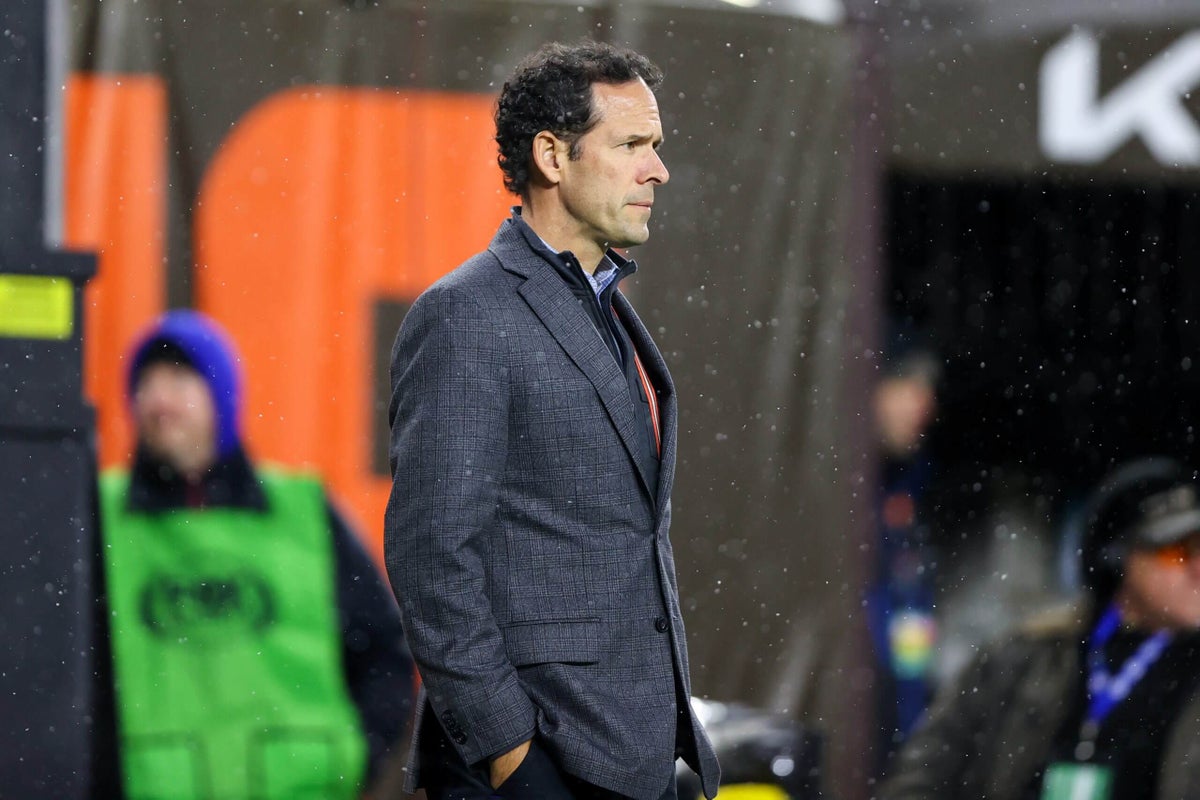
LAS VEGAS — On a call last week with the staff of the Colorado Rockies, Paul DePodesta offered a message to the baseball operations department he now runs: he was unsure what the identity of the club should be. He framed this as a positive. Together, he said he told the group, they would strive to solve the altitude-related issues at Coors Field, restock an insufficient minor-league system and rebrand a team coming off a 119-loss season.
“It’s not for me to decide, where I come in from the outside and say, ‘I have the answers, here it is,’” DePodesta said on the first day of the general managers meetings at the Cosmopolitan Hotel. “But I’m really curious for all of us to get together as an organization and decide what it is we want to be. And then stick to it, and figure out how we’re actually going to implement it, and how we’re going to get there.”
In an offseason of surprising staffing decisions, the Rockies hiring DePodesta still caused a stir. The team’s interest in him remained quiet as the franchise interviewed Cleveland Guardians assistant general manager Matt Forman, Arizona Diamondbacks assistant general manager Amiel Sawdaye and Kansas City Royals assistant general manager Scott Sharp. Forman and Sawdaye each visited Colorado during the postseason.
Yet five days after the World Series, the Rockies announced the arrival of DePodesta, who had spent the last 10 years as the chief strategy officer of the Cleveland Browns. DePodesta, 52, had gained unexpected fame as Billy Beane’s chief lieutenant with the Oakland Athletics before an unsuccessful two-year tenure running the Los Angeles Dodgers. That was two decades ago. Now he was back in baseball, tasked with turning around a franchise that has not completed a winning season since 2018 and bottomed out this past year.
For DePodesta, the offseason to-do list is long. He must find a manager, as organizational lifer Warren Schaeffer filled the role on an interim basis after the team fired Bud Black in May. He plans to hire a general manager. DePodesta indicated he has “significant” confidence in the willingness of owner Dick Monfort to expand the organization’s analytical and technological infrastructure, which had been considered antiquated compared to other teams. But he was unwilling on Tuesday to outline a specific plan until he had spent more time sounding out current employees.
“I’m very much in learning mode right now, and I think will continue to be,” DePodesta said. “I understand there are decisions we have to make, so I’m not going to be waiting until February to try to hire people in different positions, and things like that. But I think the most important thing for me to do initially is to understand what the current capabilities are within the organization.”
DePodesta must do all this while catching up to speed with the game he left nearly a decade ago. He has not run a baseball operations department since the Los Angeles Dodgers fired him in October of 2005. He has not worked in baseball since leaving the New York Mets for the NFL in January of 2016. And he is still trying to sort out just how the Rockies have become baseball’s laughingstock.
Since the publication of Michael Lewis’s revolutionary book “Moneyball,” DePodesta has not left a lengthy public record of his thoughts about the game. After being fired by the Dodgers, he rarely gave interviews during his time as an executive with the San Diego Padres and then the Mets. When contacted by the Los Angeles Times in 2018 for a story about former Dodger Adrian Beltre, DePodesta cited a contractual provision that he said prevented him from “speaking publicly about anything during my time with the Dodgers.” Details of his role during a decade with the Browns remain fuzzy.
He sounded vague on several topics on Tuesday, including his role in Cleveland acquiring quarterback Deshaun Watson, which he called an “organizational” decision but offered scant additional detail. DePodesta indicated that this union with the Rockies involved a “mutual third party who suggested we should connect.” He declined to say who.
Rockies fans, of course, may be unlikely to care much about DePodesta’s willingness to be forthcoming about sensitive topics — at least so long as he can build an organization with a better pitching staff. Colorado has finished in last place in the National League West for four consecutive seasons. The pitchers have posted the worst ERA in baseball in each of those seasons. The collective 5.99 ERA in 2025 was the worst since the 1999 Rockies put up a 6.03 mark.
Solving the dilemma of Coors Field will be a priority, something DePodesta said he intends to discuss with his new staff throughout the winter.
“I’m very willing to experiment and try to do things,” DePodesta said. “I’ve said this before: I don’t have all the answers by any stretch. I’m pretty relentless at trying to find them.”