
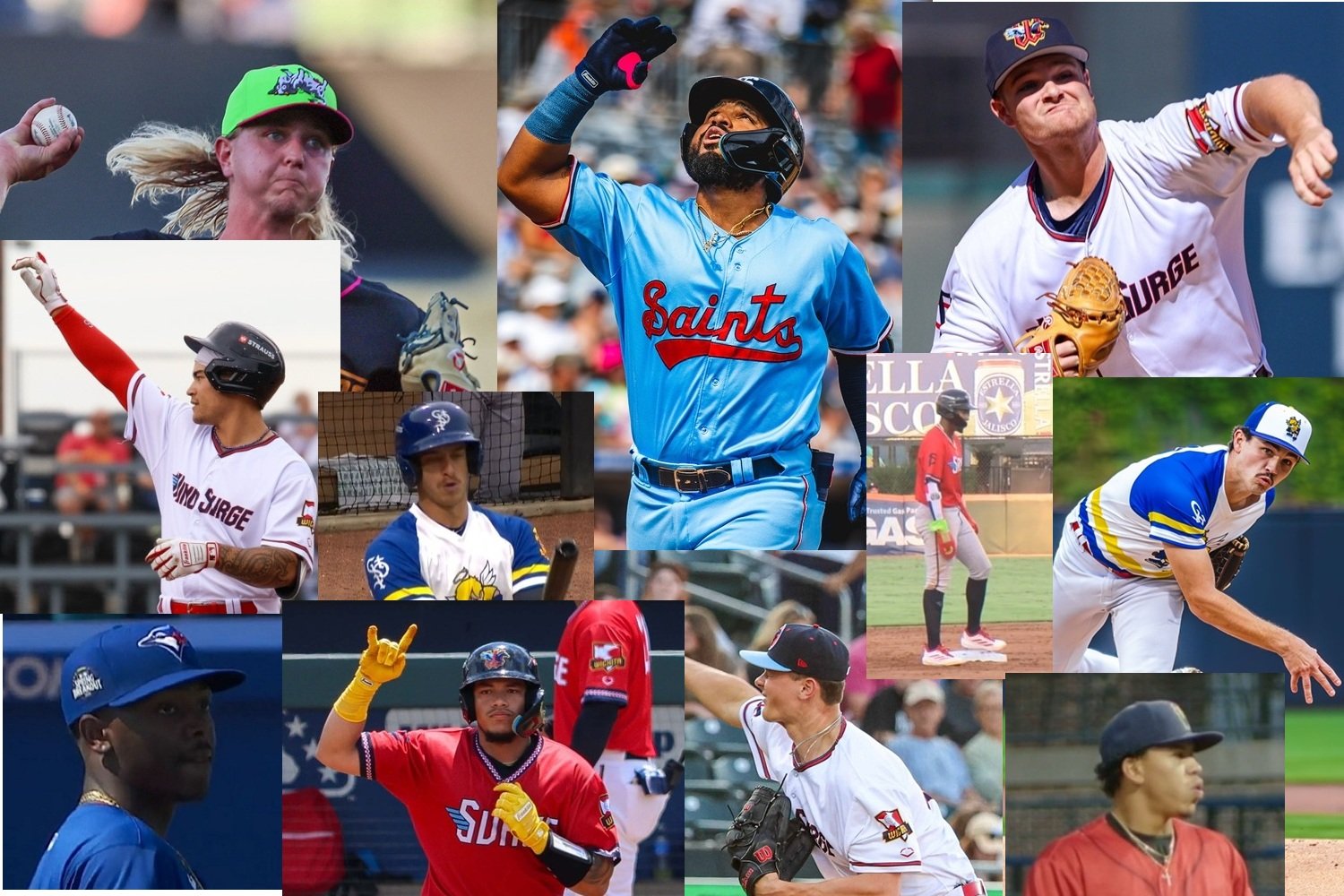
On Thursday, major league teams, including the Minnesota Twins, made a flurry of roster moves to start their offseason roster clean-up. Some players were removed from the 40-man roster, and when they cleared, they elected free agency. The Angels claimed Cody Laweryson. One former top prospect also became a free agent. In addition, the 60-Day Injured List doesn’t exist in the offseason.
The Twins’ 40-man roster is currently at 33, including 14 pitchers, two catchers, five infielders, eight outfielders, and four utility players.
Over the next couple of weeks, there will be more changes. The deadline for non-tendering arbitration-eligible players is in two weeks. Just a few days earlier, on November 18, teams will have to add players to their 40-man roster to protect them from the Rule 5 Draft. As of today, the Twins could add seven more players to the 40-man roster without other moves. Most years, two to four players get added, but this offseason, the Twins have quite a few players who likely need to be added. There are just as many, if not more, players one could make a case for protecting.
The following several paragraphs discuss some of the rules of the Rule 5 draft regarding eligibility, costs, requirements for a selected player, etc. If you feel you’ve got a good grasp on that information and really just want to see who I think will be added, feel free to scroll down to the subheading: The Givens.
Real quick, who is eligible for the 2025 MLB Rule 5 draft? Down below, you can see every single Twins player who is eligible (as of now) for the December event. At a high level, players eligible are:
not on the MLB team’s 40-man roster,
if they signed after age 19 and have been in the minors for at least four years.
if they signed before age 19 and have been in the minor leagues for at least five years.
Specifically for next month’s Rule 5, that means:
They don’t get added before or on November 18, and
Players signed when they were 16-18 years old in 2021. That includes international players and most high school draft picks.
Players signed after they turned 19 years old in 2022.
Players who were eligible for previous Rule 5 drafts. In other words, a high school player from the 2020 draft who meets the other criteria is still eligible.
Also of note, Players drafted or signed in 2019 who are not on the 40-man roster right now became free agents late last week. They are not eligible unless they sign a minor-league contract with a team before the Rule 5 draft.
Digging deeper. If a Major League roster has fewer than 40 players on it, it may choose a player in the Rule 5 draft. As of writing this, the Twins have 33 players on their 40-man roster, so in theory, they could draft up to seven players in the Rule 5 draft. They won’t, but they could take one. If they do, they would need to pay $100,000 to the organization from which they selected him. The player must stay on the team’s active roster (on the injured list) for the entire season. If the team wants to send him to the minor leagues, they have to offer him back to the original team for $50,000. There is a strategy to it as well, and that’s where today’s topic becomes essential.
If the Twins add seven of their players to the 40-man roster (and make no other moves before the Rule 5), they would be unable to make a selection. In addition, players added to the 40-man roster in November and those taken in the Rule 5 draft must remain on the 40-man roster until spring training. That means that if the Twins want to sign a free agent to an MLB contract between December and February, they would need to remove another player from the 40-man roster. That’s why there are some players still on the Twins’ 40-man roster now, and you may wonder about the likelihood of them remaining on the 40-man roster throughout the offseason.
Note that just a couple of days after players are added to the 40-man roster is the non-tender day. The Twins entered the offseason with the potential of 10 arbitration-eligible players. Roster transactions following the World Series have removed four of them from being eligible for arbitration. Could the Twins non-tender any of those six, or not tender 2026 contracts to anyone else on the 40-man? We shall see.
That is a lot of strategy before even getting to the stuff you’re here to read. But I always feel it is important to understand the above for multiple reasons. First, the $100,000 price tag is not a lot to work with a player in the offseason and spring training before potentially finding a gem, or getting $50,000 back in spring training as the Twins did last year with the Phillies and Eiberson Castellanos.
It isn’t ideal to lose players in the Rule 5 draft, so you want to protect the right players. It just takes one team to be interested in an eligible player to potentially lose him. So the most significant factor in that decision is whether that player will be able to stick on a big league roster for the entire 2026 season. How close is that player to being able to help a team in some capacity, even if for a year, that’s defense and base running, or enough “stuff” and experience to be a late-inning reliever who comes into low-leverage situations? That’s the role Johan Santana started in when the Twins acquired him in a Rule 5 trade. Does the player have much experience in the upper levels of the minors to hold a spot? Last year’s first overall pick in the Rule 5 draft was the White Sox, and they selected Shane Smith from the Brewers organization. Smith went to the All-Star game. That is rare.
OK, with all that, you are here to read my thoughts on which players the Twins will (or should) add to their 40-man roster to protect them from being a potential loss in the Rule 5 draft.
The Givens
There are six players that the Twins have to add to the 40-man roster. If any of the six are not added, another team may select them. Let’s start with those.
Right-Handed Corner Outfielder: Gabriel Gonzalez
Twins Daily #9 Ranked Prospect
When the Twins acquired outfielder Gabriel Gonzalez from Seattle in the Jorge Polanco trade early in 2024, he was ranked No. 79 overall by MLB Pipeline. His first year in the organization was rocky. He battled a back injury that sidelined him for half the season and posted a modest .255 average at High-A, showing little power against older competition.
Everything changed in 2025. Gonzalez opened the year by returning to High-A Cedar Rapids, hitting .319 with 12 doubles and five homers in 34 games. Promoted to Double-A Wichita, he dominated with a .344 average, 19 doubles, and four home runs over 55 games. He capped the season in Triple-A St. Paul, batting .316 with seven doubles and six homers in 34 games. Across three levels, Gonzalez recorded 38 doubles, three triples, and 15 home runs. More importantly, he consistently made hard contact and showed the offensive upside the Twins have long sought in a right-handed corner outfielder.
Still, Gonzalez isn’t a finished product. He will likely benefit from more Triple-A time to refine his defense, though his strong arm is an asset. Turning 22 early in 2026, his physical frame suggests even greater power potential ahead. If his development continues on this trajectory, Gonzalez could soon become a key piece in Minnesota’s lineup.
Left-Handed Pitcher: Connor Prielipp
Twins Daily #6 Ranked Prospect
When the Twins drafted Tomah, Wisconsin native Connor Prielipp in the second round of the 2022 draft, they were betting on upside. The former Alabama ace had missed most of 2021 and all of 2022 recovering from Tommy John surgery, but before the draft, he was already touching 97 mph. The southpaw was a first-round talent. After two years of limited innings, 2025 marked a breakthrough. Prielipp stayed healthy for 24 appearances (23 starts), logging 82 2/3 innings under a carefully managed workload. Early outings were capped at 50 pitches, but by season’s end, he was surpassing 75 pitches regularly. In his final start, he threw six innings and 84 pitches—a milestone for a pitcher once sidelined for nearly two seasons.
Across Double-A and Triple-A, Prielipp showed flashes of dominance while refining his arsenal. His fastball averaged 94 mph and reached 98, complemented by a sharp slider that topped 87 mph and a developing changeup. Though he allowed runs in most outings, he maintained velocity deep into games. He also experimented with grips and pitching sequencing, and will need to continue doing so. Turning 25 in January, Prielipp is trending toward a big-league role sometime in 2026. With health and continued development, his ceiling remains very high, and the Twins won’t risk exposing him to the Rule 5 draft.
Right-Handed Pitcher: Andrew Morris
Twins Daily #15-Ranked Prospect
Andrew Morris is back, and better than ever. After a breakout 2024 season, which saw him rocket through High-A Cedar Rapids, Double-A Wichita, and Triple-A St. Paul, the right-hander hit a speed bump in 2025 with a midseason injury. However, by the end of the year, Morris reminded everyone why he’s one of the Twins’ most intriguing young arms, flashing improved velocity and a pitch mix that screams big-league starter.
Early in the season, Morris was already impressive, sitting 94–95 mph with his four-seam fastball and touching 97. He paired it with a heavy sinker in the low 90s, a cutter in the upper 80s, and a mid-80s sweeper, plus a slow curveball that messes with timing. By season’s end, he took things to another level. His four-seamer averaged 95.7 mph and hit 98.5, while his sinker jumped to 95.3 mph. The cutter climbed into the low 90s, and his changeup settled at 86 mph—creating ideal separation from his fastball. His sweeper and curveball added depth, giving him six legitimate pitches.
That’s the kind of arsenal that can win games. Morris isn’t just throwing hard. He continues to learn more and more about pitching, refining his grips and sequencing. With health and continued work with coaches, Morris has the stuff to be a starter and make an impact in Minnesota sooner rather than later. That makes him an obvious add.
Left-Handed Pitcher: Kendry Rojas
Twins Daily #8-Ranked Prospect
Twins fans weren’t thrilled when the front office traded hometown flamethrower Louis Varland, but the return offers plenty to like, Alan Roden and especially left-hander Kendry Rojas. The Cuban-born southpaw has electric stuff and, despite injuries slowing his rise, he’s just scratching the surface of his potential.
Rojas missed early 2025 with an abdominal strain but quickly climbed the Blue Jays’ system once healthy, striking out 30 batters in 18 ⅔ innings at Double-A before making one Triple-A stint for Buffalo. After joining the Twins, his numbers in St. Paul weren’t pretty; control issues led to 23 walks in 27 1/3 innings, but the raw tools were undeniable. His four-seam fastball now sits 92–96 mph and touched 97 in his final start, a jump from the low-90s just two years ago. He pairs it with a lively sinker at a similar velocity, a sharp slider (84–90 mph), and a changeup in the upper-80s that could become more effective with added velocity separation. His slider flashes plus potential, and his ability to generate movement makes him a nightmare for hitters when he’s in the zone.
At just 23, Rojas brings rare upside for a lefty with this kind of velocity and pitch mix. He’s still learning, but if he finds consistent command, he could debut soon, and if the Twins ever shift him to the bullpen, his stuff could play up even more. Simply put: there aren’t many arms like this in the system. Rojas is a name to watch.
Left-Handed Outfielder/First Base Hendry Mendez
Ranks just outside Twins Daily’s Top 20 Prospect Rankings
Mendez’s journey from a 17-year-old international signing from the Dominican Republic to a promising Twins prospect that needs to be added to the 40-man roster has been a bit circuitous. The Brewers inked him for $800,000 in January 2021, and he quickly climbed from the Dominican Summer League to the Arizona Complex League that year. In 2022, at just 18, he impressed in Low-A Carolina with a disciplined approach, 62 walks against 70 strikeouts. Injuries slowed him in 2023, but a trade to the Phillies sparked a resurgence. He hit .284 with a nearly one-to-one walk-to-strikeout ratio and showed flashes of gap power.
In 2025, Mendez broke out. Starting in Double-A Reading, he posted an .808 OPS before being dealt to Minnesota for Harrison Bader. With Wichita, he elevated his game, slashing .324/.461/.450 and continuing his elite plate discipline (27 BB, 21 K).
At 6’3”, 200 pounds, he is putting in some time at first base before games, a position the Twins have struggled to fill long-term. His revamped swing produced 11 homers this season, matching his total from the previous three years combined. Just 22 years old, Mendez looks like a lock for the 40-man roster. He’s not expected to be the answer in 2026, but his size, athleticism, and improving power make him a name to watch.
Right-Handed Pitcher: CJ Culpepper
Twins Daily’s #19-Ranked Prospect
C.J. Culpepper has quietly become one of the Twins’ most intriguing pitching prospects. Drafted in the 13th round in 2022 out of Cal Baptist, the 6’3” right-hander has shown steady growth despite injuries that slowed him in 2024. His 2025 season was delayed by injury, and his workload was limited throughout the year. However, he posted a 2.43 ERA over 59 innings at Double-A Wichita, striking out 53 while holding opponents to a .223 average.
What makes Culpepper stand out is his deep arsenal of pitches. Early in his career, catchers joked that they needed more than two hands to give him signs. He throws at least five pitches—a lively four-seam fastball that sits 94–96 mph and touches 97, a two-seam sinker which can generate ground balls, plus a slider, cutter, curveball, and changeup. Ten years ago, Culpepper would have been deemed a flamethrower. Now his fastball velocity is described as about average. His slider and cutter have the makings of above-average pitches, potentially. He’s also shown improved command, pounding the zone and posting a near 10 K/9 rate in 2024.
Why add him to the 40-man roster now? With his combination of velocity, pitch mix, and recent success, Culpepper would undoubtedly be a target for other teams. His ability to sequence with his pitch mix and aggressive approach gives him a legitimate shot to stick as a starter or multi-inning reliever. We don’t know what the offseason has in store for current Twins starting pitchers. The organization would not want to lose potential replacements if they can avoid it.
Coin Flips (3 Pitchers, 3 Hitters)
It’s been a long time since the Minnesota Twins have added six players to their 40-man roster, but I think the six players above have a high likelihood of being lost if they are not protected. I also think they are another half-dozen players that I also think could be drafted. Below are (shorter!) summaries for each of them.
Right-Handed Pitcher: John Klein
Minnesota native John Klein, 23, signed as an undrafted free agent in 2022 and quickly impressed. In 2025, he split time between Wichita and St. Paul, logging 106 1/3 innings with 128 strikeouts. Klein throws two fastballs at 93–96 mph, a fading mid-80s changeup, and a slow curveball in the upper 70s. At 6-5, 225 pounds, he has room to add velocity. Despite struggles at Triple-A, his size, strikeout ability, and legit stuff make him a strong Rule 5 candidate.
Right-Handed Pitcher: Jose Olivares
Jose Olivares, 22, brings electric stuff and upside. In 2025, he posted a 4.38 ERA with 107 strikeouts and 57 walks over 90 1/3 innings at High-A Cedar Rapids. His fastball now touches 97 mph, paired with a sharp slider/sweeper, slow curveball, and mid-80s changeup. Command remains a concern, but his velocity and bat-missing ability make him a tempting bullpen stash for a team willing to gamble on raw talent.
Right-Handed Pitcher: Cory Lewis
Cory Lewis, 25, was the Twins’ Minor League Pitcher of the Year in 2023 and was very good in 2024, ending the season with five scoreless innings for St. Paul. 2025 was rough. At St. Paul, he went 4-6 with a 7.27 ERA over 73 innings, striking out 87 but walking 68. Known for his high-velocity knuckleball and full pitch-mix, Lewis still offers intrigue despite control issues in 2025. A team could take a chance on his unique arsenal and past success, hoping to unlock his upside.
Outfielder: Kala’i Rosario
Kala’i Rosario, 23, rebounded in 2025 after an injury-shortened 2024 season. The former fifth-round pick hit .256/.358/.487 (.844) at Wichita with 30 doubles, five triples, and 25 home runs in 130 games. He also stole 32 bases, far surpassing his previous high of seven, showing improved athleticism. Rosario’s calling card remains his power potential, but the added speed and mobility make him even more intriguing. His combination of pop and versatility could tempt a team looking for an impact bat with upside.
Outfielder: Kyler Fedko
Kyler Fedko, 26, enjoyed a breakout 2025 season. After posting a .645 OPS in 77 games in 2024 in Wichita, he posted an .868 OPS in 88 games for the Wind Surge in 2025 with 15 doubles and 20 homers, then .829 OPS in St. Paul with 10 doubles and eight homers. Across 130 games, he totaled 25 doubles, 28 home runs, and 38 stolen bases. Fedko offers quality at-bats, gap and home run power, speed, and defensive versatility across all outfield spots plus first base. His well-rounded skill set makes him a sneaky Rule 5 candidate.
Catcher/Outfielder: Ricardo Olivar
Ricardo Olivar, 24, is a versatile catcher/outfielder who still has some intriguing upside. In 93 games at Wichita, he hit .264/.356/.412 (.768) with 13 doubles, 13 homers, and 13 steals. While unlikely to be a full-time starting catcher, Olivar’s athleticism allows him to catch and play left field, giving him valuable flexibility. His balanced offensive profile and solid defense make him a potential backup catcher who could stick on a big-league roster. Teams seeking depth and versatility behind the plate may take a chance.
The Twins have other Rule 5-eligible catchers as well. Patrick Winkel and Noah Cardenas are both potential backup catchers in MLB because of their prowess behind the plate. Andrew Cossetti and Nate Baez are potential MLB backup catchers because of their bats.
Also Rule 5 eligible if not protected
Catchers: Patrick Winkel, Noah Cardenas, Andrew Cossetti, Nate Baez
Fielders: Danny De Andrade, Tanner Schobel, Aaron Sabato, Jake Rucker, Jose Salas, Ben Ross, Jorel Ortega, Andy Lugo, Rayne Doncon, Miguel Briceno
Pitchers
Left-Handed: Christian MacLeod, Jaylen Nowlin, Aaron Rozek, Cleiber Maldonado
Right-Handed: Miguelangel Boadas, John Stankiewicz, Darren Bowen, Mike Paredes, Alejandro Hidalgo, Trent Baker, Kyle Jones.
Interested in learning more about the Minnesota Twins’ top prospects? Check out our comprehensive top prospects list that includes up-to-date stats, articles and videos about every prospect, scouting reports, and more!