
MLB awards season is officially underway, with the announcement of this year’s top rookies Monday serving as the opening act in a week celebrating baseball’s best from the 2025 season.
The Athletics’ Nick Kurtz took home the Jackie Robinson AL Rookie of the Year Award unanimously. His teammate, shortstop Jacob Wilson, finished second with 23-second place votes. The Red Sox’s Roman Anthony finished third in the race with three second-place votes and 15 votes for third.
Atlanta Braves catcher Drake Baldwin was also named NL Rookie of the Year on Monday.
Advertisement
This year’s Rookie of the Year ballot came with a new wrinkle, as it was expanded from three to five spots, affording voters the opportunity to recognize a few more rookies from the season that was. (For reference, MVP ballots have long featured 10 spots, and Cy Young ballots expanded from three to five in 2010).
Each award’s electorate is made up of two representatives from each of the 15 chapters of the Baseball Writers Association of America coinciding with the 15 markets in each league, amounting to a total of 30 voters. This year, two of the 30 voters for AL Rookie of the Year were members of our MLB team: Russell Dorsey from the Chicago chapter and Jordan Shusterman from the Cleveland chapter.
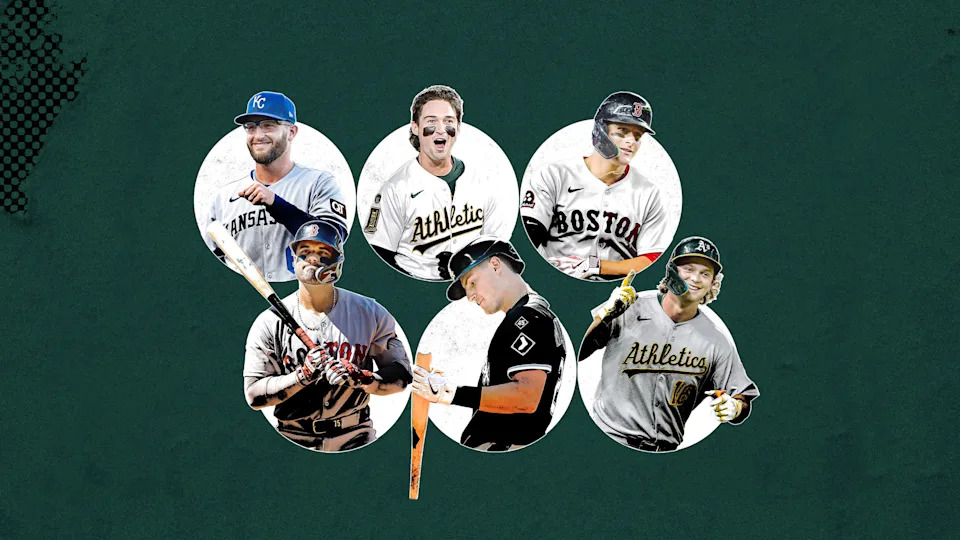
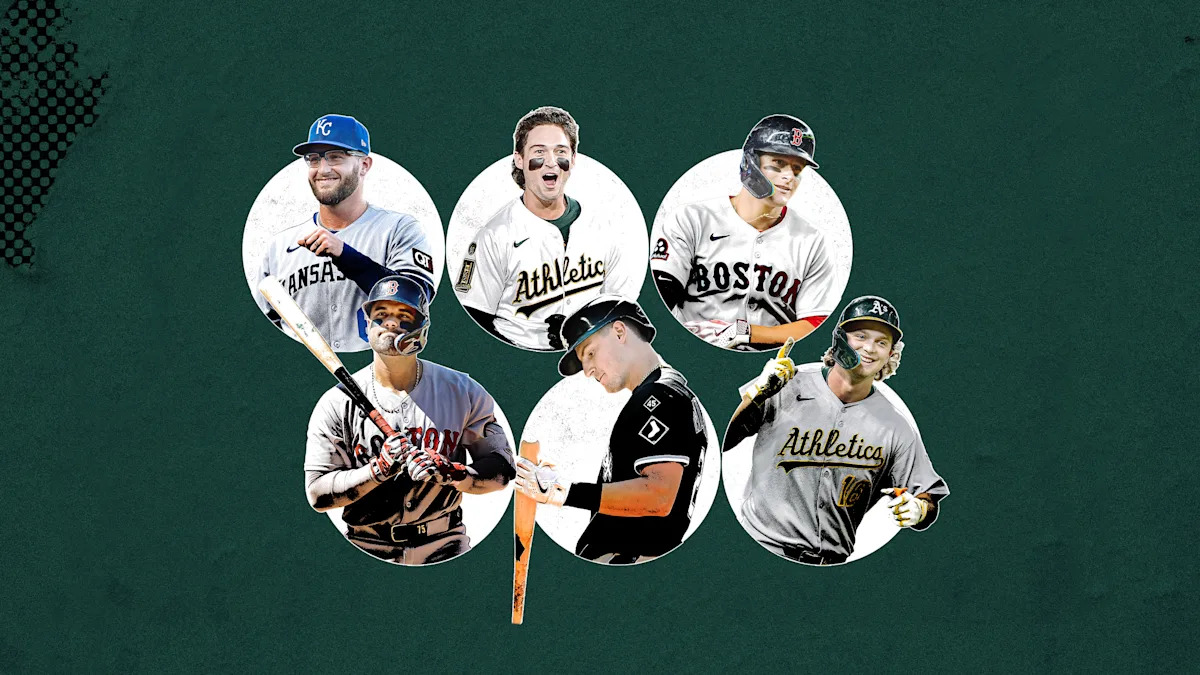
AL rookies who shined in 2025, from top left going clockwise: LHP Noah Cameron, SS Jacob Wilson, OF Roman Anthony, 1B Nick Kurtz (the unanimous ROY), White Sox SS Colson Montgomery and C Carlos Narváez. (Henry Russell/Yahoo Sports)
(Henry Russell/Yahoo Sports)
[Get more Athletics news: A’s team feed]
While Kurtz’s unanimous award came as no surprise, considering how dominant he was at the plate, there were several other intriguing storylines among AL rookies that made the remainder of the ballot a challenge to fill out. Here’s a behind-the-scenes look at how Dorsey and Shusterman voted, and what motivated their support for the five players included on their ballots.
Advertisement
Jordan Shusterman’s ballot
1. Athletics 1B Nick Kurtz
2. Athletics SS Jacob Wilson
3. Red Sox OF Roman Anthony
4. Red Sox C Carlos Narváez
5. Royals LHP Noah Cameron
Russ Dorsey’s ballot
1. Athletics 1B Nick Kurtz
2. Red Sox OF Roman Anthony
3. Athletics SS Jacob Wilson
4. Royals LHP Noah Cameron
5. White Sox SS Colson Montgomery
Wow, Nick Kurtz is amazing
It wasn’t just that Nick Kurtz was the best rookie in the 2025 class, which he was. The A’s young first baseman was one of baseball’s best hitters. And while he burst onto the scene with his four-homer game against the Houston Astros on July 25, it was only the tip of the iceberg for the 22-year-old slugger. If you need to know just how absurd Kurtz’s season was, take a look at any advanced metric, including his eye-popping 170 wRC+ in 489 plate appearances. Kurtz joined MVPs Shohei Ohtani and Aaron Judge as the only players in MLB with an OPS over 1.000 this past season and got additional hardware for his outstanding season in the form of the AL Silver Slugger Award for first base. The A’s slugger showed that debuting in the big leagues less than a year after being the No. 4 overall draft pick was no problem for him. Kurtz capped off his stellar rookie campaign leading all rookies in home runs, runs scored, RBI, walks and OPS. — Dorsey
Advertisement
Blue Jays pitcher Trey Yesavage might have rightfully stolen headlines as the most remarkable story from the 2024 draft class, but what Kurtz did at the plate in his debut season just a year after being drafted deserves ample acknowledgement as historic in its own right. Kurtz’s 1.002 OPS was the sixth-highest ever for a rookie with at least 450 plate appearances in a season, and he finished tied for fifth in the AL in home runs with 36, despite playing only 117 games. Kurtz’s peak came midsummer, when he hit an outrageous .395/.480/.953 across 23 games in July, headlined, of course, by his six-hit, four-homer game on July 25.
And while that epic showing was the apex of his rookie campaign, Kurtz hardly fell off afterward, demonstrating that his red-hot July wasn’t much of an outlier. From his four-homer game through the end of the season, Kurtz hit .271/.394/.530, good for a 154 wRC+ that ranked 11th in MLB over that span. While his sky-high strikeout rate and struggles against southpaws represent moderate red flags, this version of Kurtz is doing more than enough damage to warrant the whiffs and platoon splits. And considering he’ll turn just 23 before Opening Day next year, it’s entirely reasonable to think Kurtz will improve upon his current weaknesses and unlock an even higher offensive ceiling in short order, establishing himself as one of the game’s most feared sluggers for years to come. — Shusterman

The Red Sox missed Roman Anthony’s presence late in the season and in October. (Photo by G Fiume/Getty Images)
(G Fiume via Getty Images)Jacob Wilson vs. Roman Anthony for second
After a dreadful first half, the Red Sox surged to the second AL wild-card spot after Roman Anthony arrived on June 9, going 57-38 from then on. And with Boston looking for offensive consistency, baseball’s No. 1 prospect provided that spark. Anthony’s .396 on-base percentage jumps off the page, but the rookie phenom’s well-rounded game was impossible to deny, as he sported a .292 batting average and .463 slugging percentage before his season ended early due to an oblique strain.
Advertisement
What was tough about my second-place vote is that it was impact vs. body of work. Jacob Wilson was as consistent as any player in this season’s rookie class, and there was a time before Kurtz’s arrival when he was likely going to claim the Rookie of the Year Award. But what ultimately led me to vote for Anthony second and Wilson third is that I don’t believe the Red Sox make the postseason without Anthony’s spark and instant impact in the lineup. You could see that in the fact that the Red Sox weren’t the same after his injury. Wilson had a phenomenal campaign, but he didn’t raise the level of play for the A’s like Anthony did for the Sox. — Dorsey
The Red Sox indisputably played their best baseball with Anthony in the lineup, and they sorely missed him down the stretch and into October. And if we’re choosing which American League rookie I’d want on my team for the long haul, I’d take Anthony over Wilson, considering his significant offensive upside, and I’d even consider choosing him over Kurtz.
Ultimately, this award is about which players had the most outstanding rookie seasons, and I considered the playing time and positional difference to be a wide enough gap to give Wilson the edge over Anthony on my ballot. Wilson started 124 games at shortstop, while Anthony started 32 games in right field, 17 games in left and another 17 at DH. Even if Wilson’s glove didn’t grade out especially well and might eventually fit best at second base, that pure workload as a rookie at a premium position was meaningful, especially with Wilson also boasting a fairly compelling offensive résumé.
He finished tied with Bo Bichette for second in the American League with a .311 batting average, and his 13 home runs far outpaced both my and many evaluators’ expectations for his slugging output. Wilson might not hit the ball hard, but he has already demonstrated a knack for translating his elite contact ability into extra-base hits in a way that lends optimism that he can be an all-around offensive threat in the majors. Given their wildly different skill sets, Wilson and Kurtz are a tremendously fun duo for the Athletics to build their lineup around. — Shusterman
Advertisement
Don’t forget about Noah Cameron
In a down year for rookie starting pitchers, Royals rookie left-hander Noah Cameron separated himself from the rest of the pack this season. Cameron got an opportunity to pitch every fifth day in a Kansas City rotation that was beat up for most of 2025, and he made the most of his chances. In his first 13 starts, Cameron allowed more than three earned runs just three times, showing that he was more than capable of sticking in the rotation. While Cade Horton got much more love on the National League side for his contributions to the Cubs’ success, Cameron, who finished fourth in the ROY race with three second-place votes, deserves similar love for his body of work in ‘25. — Dorsey
In the wild-card era, before 2025, 18 pitchers threw at least 130 innings in their rookie season while recording an ERA under 3.00, including just four in the American League. All 18 received Rookie of the Year votes, with five winning the award outright and another seven finishing runner-up. Enter Cameron, whose 2.99 ERA in 138⅓ innings across 24 starts helped stabilize an injury-ravaged Royals rotation all summer — a large enough sample of stellar run prevention to warrant inclusion on my ballot.
Cameron was a delight to watch do his thing in 2025, a crafty lefty with two distinct breaking balls that graded out as elite pitches per run value, including a curveball that rated as one of the best of its kind across the league. While his modest peripherals and velocity indicate he might not have much more upside than what he demonstrated, Cameron still showed enough to suggest that the Royals could feature a terrific trio of left-handers in 2026 if Cole Ragans and Kris Bubic can return fully healthy. — Shusterman
Advertisement
Russ’ final pick: Colson Montgomery
The fifth spot on my ballot came down to two players who both deserved recognition. One was Red Sox catcher Carlos Narváez, and the other was White Sox shortstop Colson Montgomery. Narváez had the body of work on his side, and while being the starting catcher for a playoff team is one hell of an argument, Montgomery’s power production was hard to deny. The White Sox rookie hit 21 homers in just 255 at-bats and finished the season with a very respectable .841 OPS.
Montgomery’s season is in many ways similar to Gary Sánchez’s 2016 rookie campaign, in which he burst on the scene with 20 homers in 53 games. Sánchez owned a ridiculous 1.032 OPS and did it over the last two months of the season. Sánchez finished as ROY runner-up that season, and while that was too high for Montgomery in this year’s class, there’s precedent for a similar body of work being recognized. Also, while not known for his defense, Montgomery finished the season as a well-above-average defender at shortstop, with plus-seven defensive runs saved and plus-six outs above average putting him top-10 among shortstops in both categories. — Dorsey
Jordan’s final pick: Carlos Narváez
Montgomery’s power production, plus his surprisingly stout defense at shortstop, were difficult to overlook, and yes, he played the same number of games as Anthony (71), so the sample size on its own was not necessarily disqualifying. But in the end, I opted to vote for a catcher in Narváez who made an impact on a playoff team, emerging as one of Boston’s more unlikely key contributors after he arrived via a rare trade with the rival Yankees last winter.
Advertisement
Russ rightly pointed out how much better Boston played once Anthony joined the lineup, and Narváez had a similar effect over the entirety of the season: The Red Sox went 67-40 — a .626 winning percentage — in Narváez’s 107 starts behind the dish and just 22-33 otherwise. That’s mostly a reflection of his work as a defender, with Narváez rating as a plus blocker, plus framer and nearly unrivaled at controlling the running game while regularly receiving praise from his pitching staff as a worthy field general and game-caller.
And while his second-half decline at the plate resulted in a mediocre 99 wRC+ (.241/.306/.419) by the end of the season, even league-average production with a plus glove at catcher amounts to an immensely valuable player. In a season that began with substantial hype surrounding Boston’s top three prospects in Anthony, Kristian Campbell and Marcelo Mayer, it was Narváez who emerged as Boston’s second-best rookie in 2025 and snagged a spot on my ballot in turn. — Shusterman
Advertisement