
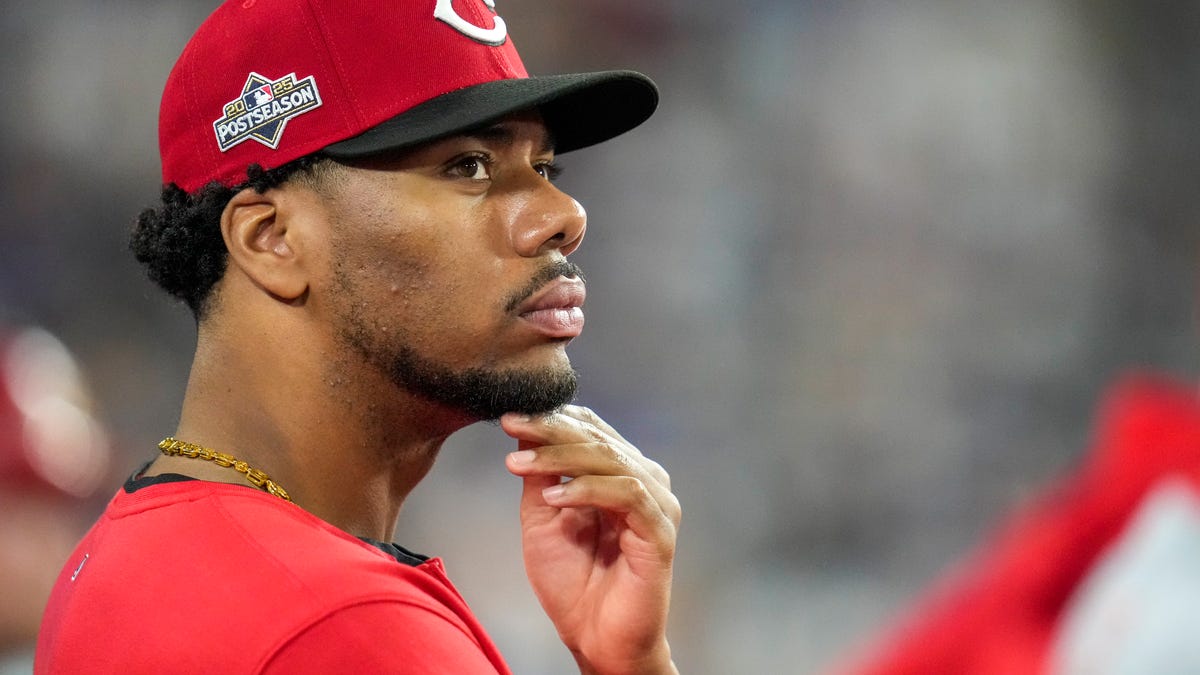
LAS VEGAS — The Cincinnati Reds already are starting to get questions about All-Star pitcher Hunter Greene’s availability from those outside the market — at least by baseball writers covering teams that seek pitching upgrades this winter.
For now, team president Nick Krall is tamping down the notion that his triple-digit frontline starter is in play as a trade chip this winter.
“Look, we’re trying to do what’s best for our team. I don’t want to rule out anything,” Krall said Tuesday. Nov. 11 during the general managers meeting when asked by Boston media about Greene’s availability. “But that’s a hard one to actually say, ‘Hey, we’re going to trade the guy that has a chance to be the ace of your staff and top-of-the-rotation guy going into the postseason.’
“We’re looking to figure out how to get better, but right now that’s not on the table.”
Greene, a 2024 All-Star who looked like a very early Cy Young candidate this year before a groin injury sidelined him for the better part of three months, is halfway through a six-year, $53 million contract.
It has $42 million in guaranteed money left on the deal, including $8.3 million this year and a $2 million buyout on a 2029 club option ($21 million if exercised).
Further muddying the potential for a big return in any trade involving Greene is the fact that several other frontline starters are rumored to be potential trade chips this winter in addition to a strong top end of the free agent market.
Those include Detroit Cy Young winner Tarik Skubal, Cardinals ace Sonny Gray, Brewers ace Freddy Peralta, Washington’s MacKenzie Gore and Miami’s Sandy Alcantara, another former Cy Young winner.
“There’s clearly a lot of interest in Freddy,” Matt Arnold, the Brewers’ baseball operations boss, said Tuesday. “We can never shut the door on anybody, we can never shut the door on anything. In our market we’ve had to make some very tough decisions over the years. But he means a lot to our group as well, and we want to try to compete next year.”
Krall acknowledged his front office will have to get creative to make improvements to a playoff team with a payroll budget that remains flat from last season, a long list of free agent departures and an even longer list of holdovers eligible for arbitration-level raises.
But even when asked again this week about the idea of trading from a perceived surplus of starting pitchers, he downplayed the likelihood – as he did last month when asked even before he had his 2026 budget.
“That’s the hard thing,” Krall said, citing injured-list moves that involved six guys who made starts for the Reds in 2025 (not counting the three who missed all season with injuries). “We all know every year we lose one or two starters throughout the year, and you have to make sure you have depth.
“So to go in and say, ‘Hey, we’re going to trade a starter just because we have a handful of guys right now’ doesn’t mean you’re going to have those guys at the end of spring training,” he added. “I’d prefer not to trade from our starting rotation because I think that’s our strength right now, and hopefully we can continue to build on top of that.”
The depth chart for the 2026 Reds rotation looks something like this with more than three months left before pitchers and catchers report for spring training:
RHP Hunter Greene (7-4, 2.76 ERA, 19 GS in ’25)LHP Nick Lodolo (9-8, 3.33, 28)LHP Andrew Abbott (10-7, 2.87, 29)RHP Brady Singer (14-12, 4.03, 29)RHP Rhett Lowder (DNP, injuries)RHP Chase Burns (0-3, 4.57, 8)LHP Brandon Williamson (DNP, injury)RHP Chase Petty (0-3, 19.50, 2)RHP Julian Aguiar (DNP, injury)