
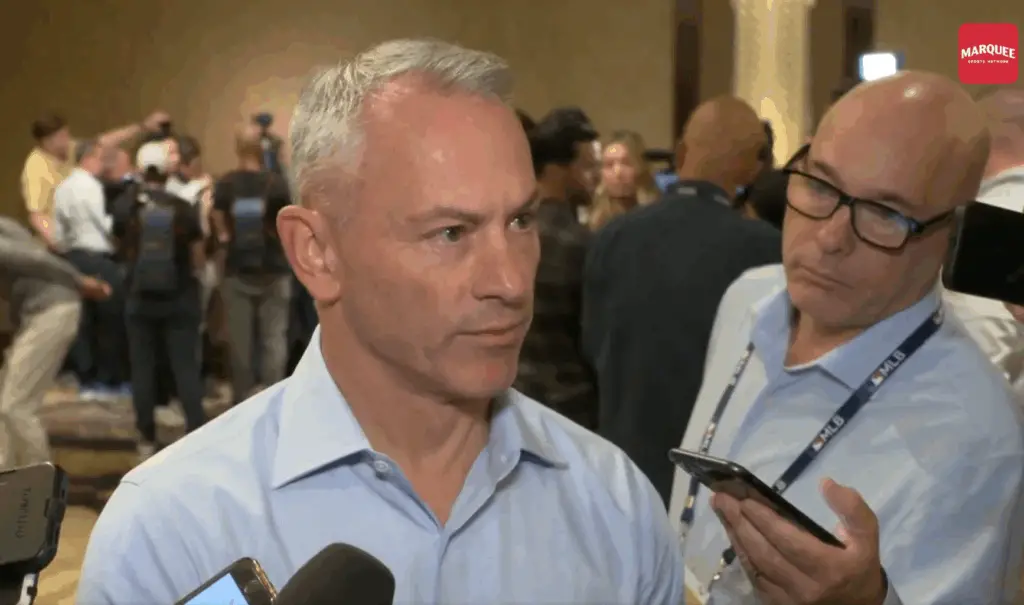
This isn’t anything you haven’t already assumed or heard before, so let’s just address it quickly for the sake of posterity. Jed Hoyer and most of the rest of his fellow baseball executives are gathered at the Cosmopolitan in Las Vegas, which is kind of ironic given the latest scandal involving fixed pitches, to fan the flames of the hot stove. The Cubs’ baseball boss addressed some basic strategic targets of the offseason in his typical general sense.
“We’re gonna have an active offseason,” Hoyer told reporters. “Take that for what it’s worth. I think the largest focus will be on pitching; I think that’s obvious looking at our depth chart. We’re in pretty good position on the position player side; on the pitching side, we’re thinner.”
Part of that thinner staff was by design, as the Cubs chose to decline their three-year extension option on Shota Imanaga. That made the most sense given his falloff in performance and the fact that guaranteeing him nearly $20 million annually also would have meant triggering a full no-trade clause. Imanaga then declined his $15.25 million player option, along with what would have been at least another such option after next season, and was extended an $22.025 million qualifying offer.
While some see that as a sign of acrimony between the two sides, it’s really just a matter of each doing what they feel is best. Between his age, performance, and penalties to other teams for signing him should he turn down the QO, there seems to be an increasing likelihood that Imanaga accepts and stays in Chicago for 2026. It’s also possible the two sides could work out a restructured deal, though the uncertainty around the 2027 season clouds things a bit.
“We obviously value Shota a ton,” Hoyer said. “He was amazing for us as a pitcher, as a teammate. I don’t want to close that door completely by any stretch, but ultimately we didn’t think the club option was the right value. He didn’t think the player option was the right value, and that happens.”
Even if Imanaga comes back, the Cubs know they need to do a better job of raising the floor of their rotation. Cade Horton and Ben Brown (both 95.8 mph) were the only starters last season whose fastballs averaged more than 94 mph, and four starters were under 93 mph. Imanaga (90.9) and Justin Steele (90.8) were at the bottom of that list, though the latter had a very small sample. The league-average fastball for starters is up to 94 mph, and the Cubs ranked 24th in MLB with a 93.4 mph average.
Velocity may not be everything, but it is most definitely a powerful factor in success. It’s also something the Cubs have seemingly made attempts to avoid improving over the last several years, almost like they’re hoarding devalued foreign currency in the hopes that the exchange rate will eventually flip. Well, it’s not going to. So whether it’s Dylan Cease or Tatsuya Imai, who Jeff Passan named as their perfect move, the Cubs need more gas.
Making that happen will require Hoyer to get out of his comfort zone a little bit, but it’s clear they need to adjust their SOP if they’re going to overtake the Brewers and make more noise in the postseason. They have a chance to own the division if they spend more money in the right way, which can create its own sort of value. Or maybe they can take a more budget-conscious route and hope a career 92 mph hurler suddenly gains six ticks on his heater. Hey, it worked for Brad Keller.