
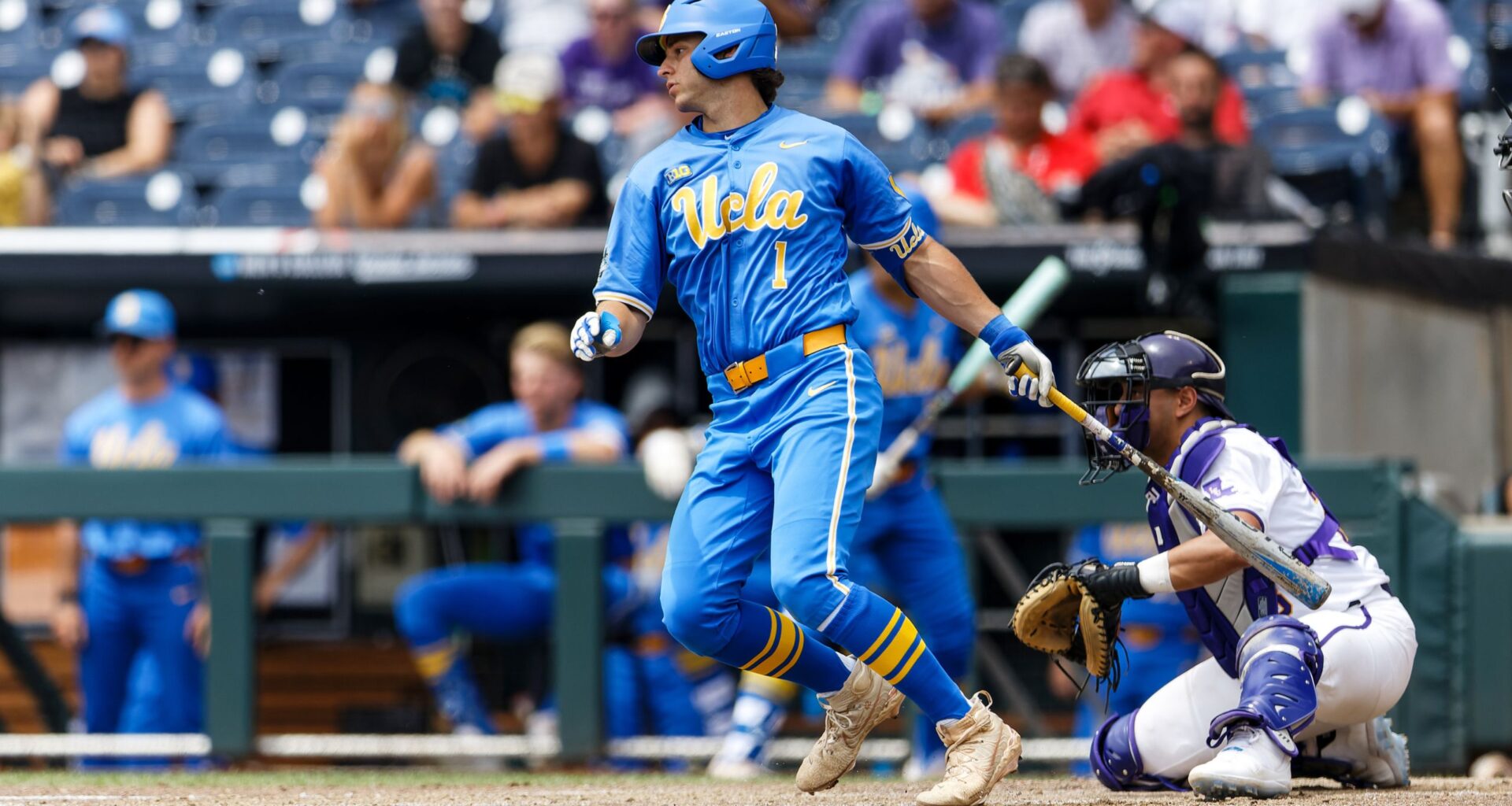
When it comes to college MLB Draft prospects, performance and underlying data can separate real impact from early noise.
Below, you’ll find 10 players ranked in Baseball America’s latest Top 100 draft board for 2026 who have already produced meaningful samples against strong competition, allowing clearer evaluation of their approach, contact quality and batted-ball shape.
Roch Cholowsky, SS, UCLA
2026 Draft Ranking: No. 1
Cholowsky enters the 2026 draft cycle as the top player in the class with a complete data foundation and the defensive certainty clubs covet in a top-of-the-draft shortstop. The actions at short are easy and fully formed. He plays low to the ground with clean glove presentation, advanced footwork and internal clock and a short, accurate arm stroke that produces carry from multiple angles. The pace and decision-making separate him. UCLA coach John Savage publicly referenced Brandon Crawford when describing Cholowsky’s defensive presence, and the comparison aligns with how he organizes the field and manages tempo. There is no projection question about where he plays.
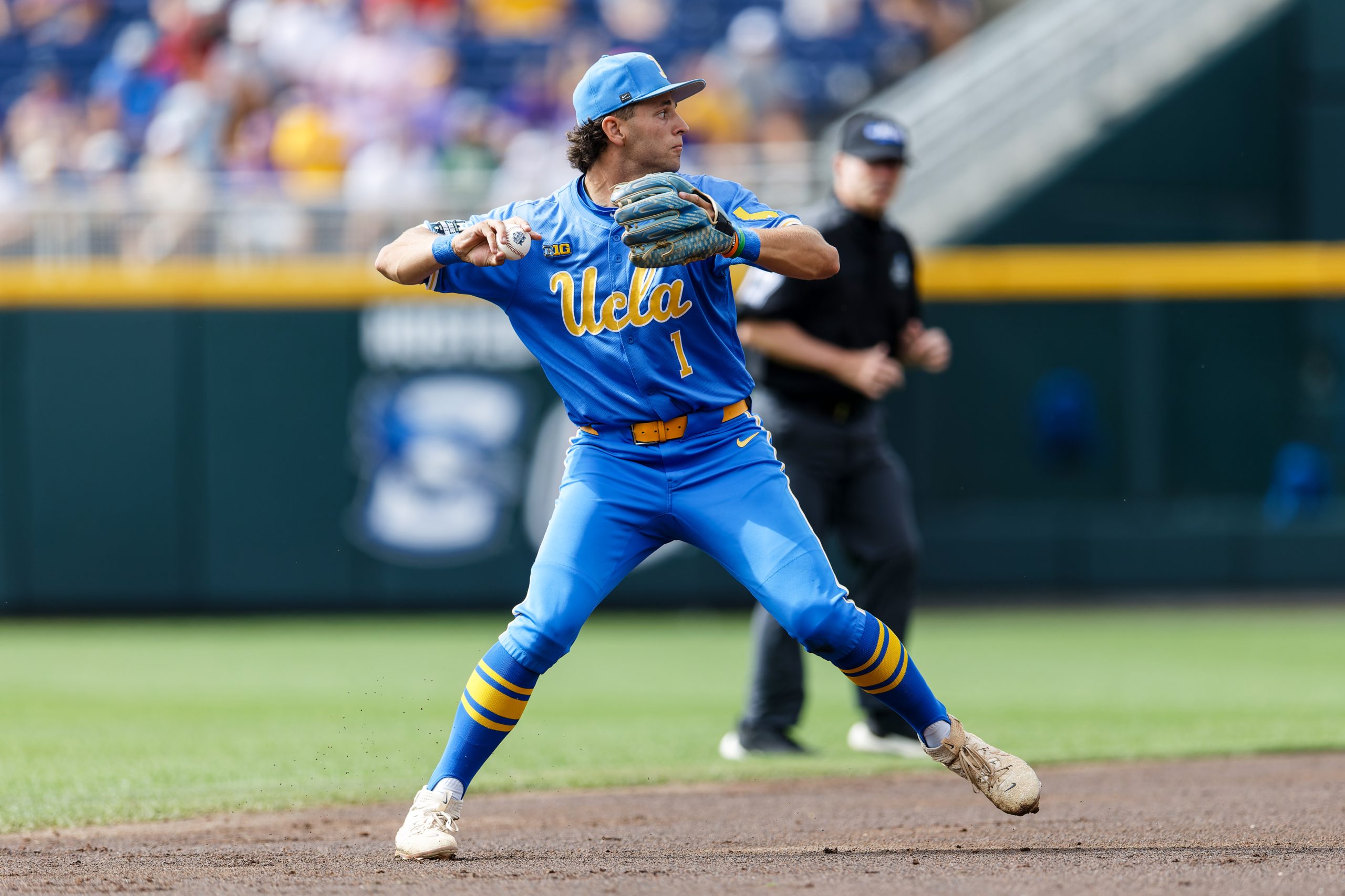
Cholowsky’s offensive profile is supported by one of the most convincing batted-ball datasets in recent college classes. Cholowsky, who hit .353/.480/.710 with 23 home runs and 45 walks to 30 strikeouts last season en route to being named Baseball America’s College Player of the Year, produced a 91.5 mph average exit velocity with a 106.5 mph 90th percentile mark. He paired a 54% hard-hit rate and 31.3% barrel rate with an 89% zone contact rate and 81.7% overall contact rate while also lifting the ball with intent, shown in his 44.3% air-pull rate. He was the only hitter in the country to reach all of those thresholds. The bat speed, contact frequency and contact quality allow him to profile without needing mechanical overhaul.
He will chase at times, and the approach in Japan with Team USA showed some timing drift against offspeed pitches, though that trip was a uniform struggle for the roster. The two-strike approach remains competitive and adaptable. Cholowsky’s overall profile is that of a shortstop with above-average defensive reliability and a hitter with top-tier contact and impact markers. He should be one of college baseball’s best offensive players in 2026.
Derek Curiel, OF, LSU
2026 Draft Ranking: No. 5
Curiel arrived at LSU with one of the more polished hit tools in the class, and it immediately translated against SEC competition. He hit .345/.470/.519 with seven home runs and 20 doubles while serving as the team’s everyday left fielder and leadoff hitter. The swing is simple with a direct path and few moving parts, producing consistent line-drive contact rather than targeted lift. After adding strength over the offseason, he is expected to move to center field this spring, and evaluators anticipate at least average outfield defense with efficient routes and above-average feel for timing plays off the bat.
Curiel’s offensive identity is rooted in swing decisions and contact quality. His 34% overall swing rate reflects a patient approach that can veer passive, but his contact skill is among the best in the class. Last season, he made contact on 94.7% of swings in the zone and 85.8% overall—both well above college first-round benchmarks. His 51% hard-hit rate and 89.9 mph average exit velocity, paired with a 104.1 mph 90th percentile, indicate that added strength is already materializing into firmer contact. His 31.8% air-pull rate and lower average launch angles support the observation that he generates flush contact but without consistent lift intent.
The developmental focus lies in how often Curiel is able to inflict damage. His 51.3% zone-swing and 56.6% heart-swing rates show an extremely tight approach that values base-reaching but leaves power untapped in hitter’s counts. The underlying markers suggest at least average raw power and the ability to access more if he selectively hunts lift in counts designed for damage.
Curiel projects as a high-contact, top-of-the-order profile with room to grow in impact if he refines when and how he looks to elevate.
Drew Burress, OF, Georgia Tech
2026 Draft Ranking: No. 16
Burress has been a divisive evaluation for clubs due to his shorter stature. Despite the frame questions, Burress has produced high-level impact against ACC pitching and enters the spring as one of the more data-forward outfield bats in the class.
Burress is a selective but intentional swinger. His 36.8% overall swing rate shows he does not chase offense through volume. Instead, he targets pitches he can drive.
His 70.3% heart-swing and 62% zone-swing rates land around average for impact bats while supporting an approach built around controlling damage windows. He chased only 19.8% of the time, which is comfortably better than typical power profiles.
When he goes, the quality of contact stands out. Last season, Burress posted a 91.7 mph average exit velocity and 106.9 mph 90th percentile with a 52% hard-hit rate and 24.9% barrel rate. Each of those numbers indicates real strength in the hands and forearms with efficient bat speed.
The batted-ball shape is geared toward carry. Burress posted a 57.6% air-pull rate and a 14.7 degree average launch angle to the pull side, reflecting a deliberate attempt to lift and drive the baseball. The consistency of his barrel direction is a positive indicator for translating to wood, though the margin for timing error will tighten at the next level. Clubs that are skeptical cite the possibility that velocity at scale and professional breaking ball depth could limit how often he gets to his damage contact. Supporters see an efficient move, true strength and a well-structured batted-ball profile that is difficult to coach into players who lack it.
Burress enters the year as a data-supported power bat with clear conviction in approach and lift intent.
Caden Bogenpohl, OF, Missouri State
2026 Draft Ranking: No. 38
Bogenpohl fits into a well-defined physical and offensive archetype shared by recent Guardians draft picks Jace LaViolette and Nolan Schubart. All three are extra-large outfield profiles with real strength and plus raw power.
Bogenpohl’s quality of contact data from his sophomore season aligns closely with that group. He posted a 94.2 mph average exit velocity and a 110.4 mph 90th percentile exit velocity. His 55% hard-hit rate supports the strength-driven contact profile. The bat speed and strength traits are evident and allow him to produce impact without needing to maximize swing length or external effort.
Where Bogenpohl’s profile diverges significantly is in batted-ball shape and contact consistency. His overall contact rate (69.6%) and zone-contact rate (76.9%) trail both LaViolette and Schubart, which places more pressure on the impact contact he does generate.
Bogenpohl’s groundball rate of 46.2% is significantly higher than LaViolette’s (25.9%) and Schubart’s (19.6%). His hard-hit launch angles and pullside launch angles are notably lower, as well, which shows that much of his best contact is occurring on flatter or downward planes. His 26.5% air-pull rate reinforces the observation that he has not yet accessed his power consistently in the air.
The chase behavior is well above average. He chased 16% of pitches overall, and his two-strike chase rates are in line with LaViolette and Schubart. The developmental question is whether or not he can make more contact and how efficiently he can reshape his angles to convert power into more power production.
Bogenpohl enters the year as a high-exit-velocity center fielder with real strength and room for meaningful gains if he can adjust the swing plane to reduce ground balls and access more frequent pullside lift.
Maddox Molony, SS, Oregon
2026 Draft Ranking: No. 39
Molony has produced across two seasons at Oregon with a .314/.405/.569 line and 25 home runs. The foundation of his offensive profile is contact efficiency. Molony’s 90.8% zone-contact rate and 81% overall contact rate are comfortably above the college baselines, reflecting a direct swing with minimal length and reliable barrel entry.
The swing decisions are assertive. A 47.7% overall swing rate paired with an 80.5% heart-swing and 76.2% zone-swing rate show he is proactively getting off swings at hittable strikes rather than operating passively or in react mode. Still, he limited chases to a 24.6% clip in 2025, which is moderate.
The contact quality shows real pullside intent. His 50.9% air-pull rate supports a swing geared to access the left-field line and left-center gap rather than working line to line. His 88.3 mph average exit velocity and 102.9 mph 90th percentile are closer to average among hitters in the top half of the class, while the 40% hard-hit rate and 20% barrel rate indicate that his best contact presents as selectively strong rather than universally loud.
The average launch and impact patterns suggest that the power he gets is primarily a product of how often he gets to the pullside air window rather than raw force.
A 33.1% chase rate with two strikes shows some approach leakage when behind. Overall, though, Molony is an athletic middle infielder with above-average contact skills.
Carson Tinney, C, Texas
2026 Draft Ranking: No. 43
Tinney’s profile is built on baseball-melting power that shows up consistently in the data. The contact he produces at peak is among the firmest in the class. Tinney posted a 95.8 mph average exit velocity and a 111.1 mph 90th percentile with a 115.6 mph max in 2025. His 58% hard-hit rate and 31.5% barrel rate show that when his swing connects, it produces top-end damage.
A 55.8% air-pull rate with a 17.7-degree hard-hit launch angle indicate that his best contact is already organized in the air to the pull side rather than needing swing-path rework to access the power.
The question is how often he’ll get to it. Tinney’s overall contact rate sits at 69.4% with a 79.4% rate in-zone. The approach is not reckless. His 39.3% swing rate and 20.8% chase rate show he is not expanding wildly or chasing power outcomes.
Reports out of the fall at Texas indicated a return to loud contact after a poor summer on the Cape, consistent with his underlying strength and bat speed.
Steven Milam, SS, LSU
2026 Draft Ranking: No. 57
Milam’s contact profile is built on frequency and barrel accuracy rather than raw impact. His 89.3 mph average exit velocity and 102.2 mph 90th percentile show that his hardest contact does not reach the top end of the class, but the ball comes off his bat with steady firmness. The contact rates are the defining feature. He made contact on 91.8% of swings in the zone and 84.8% of swings overall, which reflects a swing that finds the ball often.
The batted-ball shape supports how his production is built. Milam works to the pull side in the air.
Milam’s developmental focus is approach-based. He makes contact on much of what he chooses to hit, but LSU’s coaches would like to see him be more aggressive on pitches thrown in favorable locations. Last season, he posted a 66.7% heart-swing rate, which was below average. He also chased at a 24.5% clip, which is solid but far from elite.
Milam does not profile as a top-end power producer, but the underlying marker is that the process to create contact is stable, the angles are repeatable and the athleticism supports continued refinement. The path forward lies in leveraging those traits to convert swing decisions into more frequent damage outcomes.
Ryder Helfrick, C, Arkansas
2026 Draft Ranking: No. 70
Helfrick enters the spring in the mix for the top catcher spot in the class with a profile that blends defensive stability and emerging offensive indicators. Arkansas coach Dave Van Horn told Baseball America that Helfrick’s receiving took another step forward this fall and that he will call his own game this season—a notable marker of trust in his field awareness and handling. The arm strength and overall catching skills give him a real pathway to stay behind the plate.
Offensively, the contact quality suggests more impact may be coming. His 87.2 mph average exit velocity last season sits near the middle of the college range, but his 106.3 mph 90th percentile exit velocity shows there is real strength in the bat when he gets to his best contact. The 50% hard-hit rate supports that, too.
His barrel rate (16.9%) did not separate last year, but his batted-ball angles did. He created a 22.3 degree launch angle on his hard-hit balls and an average 13.1-degree launch angle to the pull side.
The swing decisions point to intent without over-expansion. Helfrick swung at 78.8% of pitches over the heart and 72.3% in the zone, while chasing at a 21.3% clip. The contact rates are lighter at 78.3% in-zone and 69.8% overall, which places more emphasis on how often he can get to the contact that produces his stronger batted-ball outcomes.
Van Horn said Helfrick was Arkansas’ best offensive performer this fall. The data from 2025 supports the idea that his strength, swing decisions and batted-ball shape give him a chance to show more damage if the contact rate improves.
Aiden Robbins, OF, Texas
2026 Draft Ranking: No. 87
Robbins’ contact is consistently firm. He posted a 91.5 mph average exit velocity and a 107.1 mph 90th percentile with a 109.8 mph max in 2025. He recorded a 48% hard-hit rate and a 25.2% barrel rate, which indicates that a large share of his balls in play were struck with significant force.
His swing decisions show he is selective about when to unleash but does not get passive in the zone. He swung at 42.2% of pitches overall, with an 80.0% swing rate on pitches over the heart and a 69.5% swing rate in the strike zone. His 20.6% chase rate shows limited expansion outside the zone.
The contact rates reflect frequent ball-in-play outcomes. He made contact on 87.1% of his swings in the zone and 79.6% of swings overall.
The batted-ball direction is less air-pull oriented. His 30.2% air-pull rate shows that a smaller portion of his airborne contact occurred to the pull side compared to players who produced similar exit velocities. But the swing decisions, contact purity and raw strength are all working in the favor of the 6-foot-2, 190-pound outfielder.
Myles Bailey, 1B, Florida State
2026 Draft Ranking: No. 94
Bailey is a 6-foot-4, 265-pound lefthanded hitter whose offensive identity is built around top-of-the-scale raw power. He showed 70-grade raw power as a high schooler and carried it directly into college, homering 19 times as a freshman at Florida State.
The batted-ball data reflects the strongest impact contact in the class. Among college hitters with at least 100 batted-ball events in 2025, Bailey led the country in average exit velocity (96.9 mph) and ranked second in 90th percentile exit velocity (112.1 mph). The contact he produces when the barrel arrives is consistently gaudy, and his swing path is constructed to access that strength. The move to the ball is steep, producing high carry and long flight when with home runs leaving the bat to all fields.
Bailey’s swing characteristics that create that power also show up in the swing-and-miss. He struck out at a 31% rate in 2025, and his overall contact rate was 59%, which is well below average, even for a power hitter. The mismatch between contact frequency and the impact level of the contact he does produce is central to his offensive profile.
Bailey produces the hardest and most damaging contact in the class, and he will need to increase contact frequency to fully access the value of that power.