

As Paul Skenes continually conjured magical starts this summer, Pittsburgh Pirates catchers Henry Davis and Joey Bart lowered their voices to a whisper when they talked about the Cy Young Award. Skenes was the preseason favorite to win the award, having finished third in his abbreviated rookie season, but never spoke of it. His catchers followed suit.
“Never mentioned it around him,” Davis said.
The whispers ceased and celebration ensued Wednesday night when the 23-year-old Skenes won his first National League Cy Young Award, having earned all 30 first-place votes for a unanimous win. Skenes is the second pitcher in MLB history, along with Dwight Gooden, to win Rookie of the Year and Cy Young in consecutive seasons, and the first pitcher since 1917 with a sub-2 ERA through the first 55 starts of his career.
Skenes led the majors in ERA (1.97) and the NL in WHIP (0.948) this season, striking out 216 over 187 2/3 innings. He is the Pirates’ third Cy Young winner, joining Vern Law in 1960 and Doug Drabek in 1990.
Skenes’ ascent to ace-dom is unquestioned. He is the greatest right-hander in the game. His starts are must-see TV. To understand how Skenes reached the peak of the profession, The Athletic spoke this week with nine of his current and former catchers, covering every level from youth ball to the big leagues. Tracing Skenes’ pitching evolution takes 14 steps and begins with his first catcher: his dad, Craig.
1. Paul was 4 when he started firing foam balls off the living room wall in his family’s home in Lake Forest, Calif. Little Paul, never that little, made his love for baseball known to all around him. He was always watching Los Angeles Angels games, always throwing something, always asking to play.
After work or on weekends, Craig would take his son to the elementary school a short walk away from their home. Sometimes Skenes’ mother, Karen, came along to shag batting practice. But most of the time, it was Skenes learning the basics of a game of catch, tossing a ball with his dad.
“You treasure every moment at that age,” Craig said. “It’s always great playing catch with your kid.”
2. Once he joined a local youth league and overcame the fear of being in front of a pitched ball, Skenes took to the catching position. He was naturally gifted, with a strong arm and keen situational awareness. From behind home plate, Skenes surveyed the field and felt in command of the action.
Matt Spear was Skenes’ backup on the Irvine Rox, a summer travel-ball team. Skenes was the team’s starting catcher and best hitter.
“Paul was always a stud, man,” Spear said. “He raked.”
“He was nasty at catching,” added Blake Penso, another Rox catcher.
In 2014, Skenes was on the 12-and-under Team USA roster that took silver at the Pan American Championships in Mazatlan, Mexico. Team USA’s top starters were Pete Crow-Armstrong and Masyn Winn, who now share the National League Central division with Skenes. Twelve of the team’s 18 players pitched in the tournament. Skenes was not one of them.
3. Pitching, his dad says, was “the side thing.”
Skenes pitched sparingly for the Rox, entering in relief here and there. He was a reliable right-hander, throwing hard and for strikes. “Guys couldn’t hit him,” Spear said, “even though it was just fastballs.” The Rox coach, Ryan Flanagan, a former minor-league pitcher, didn’t want to tax anyone’s arm and liked to get his players experience all around the diamond.
But when Skenes was on the mound, it was apparent his pitching approach was notably advanced. He thought like a catcher. He took pitch sequencing seriously, read swings and targeted hitters’ weak spots.
“Catching Paul was weird, because he had a game plan,” said Garret Guillemette, a former Rox catcher now in the Houston Astros organization. “When you’re 14, you don’t have a game plan. You just want to throw hard.”
“It’s so easy for a power pitcher to say, ‘Screw it, I’m just going to chuck,’” Penso said. “Paul does not leave a detail of the game untouched.”
4. That intent was how Skenes prepared for all aspects of the sport.
In middle school, teammates teased him for taking the game too seriously. Skenes studied players at higher levels and tried to carry himself the way they did. How he set up in his catching stance, how he threw the ball back to the pitcher, how he held a runner at second base — all of it was carefully rehearsed to be as professional as possible. Eventually, teammates realized that intent was what separated Skenes from other players.
“What we thought was eyewash at the time,” Penso said, “was actually the key to the whole thing.”
Skenes dislikes the term “work ethic,” yet it was used by each one of his former catchers in this story — even his dad. Craig instilled in his son from a young age that he could not count on a baseball career, but so long as he prepared academically for his future, it would be a wonderful Plan B. The more success Skenes had on the diamond, the more it motivated him to prepare even more meticulously.
5. When Evan Cramer played against Skenes in travel ball and in high school, he thought: This guy is gross. The arm. The way he carries himself. When Cramer transferred to El Toro High School as a junior and played alongside Skenes, he thought: This guy is going to be a big-league catcher.
The summer before his senior year, Skenes had a growth spurt. Because fashioning himself as a two-way player might help his recruiting and draft chances, Skenes started training to pitch. Cramer tagged along a few times to catch Skenes’ bullpen sessions at 108 Performance in Danville, Calif. Between pitches, Skenes consulted with trainer Eugene Bleecker.
“They were talking about things I had never even heard of,” Cramer said. “It sounded like a pro coach talking to a pro player. But Paul was 17.”
The first pitch of Skenes’ senior season snapped Cramer’s mitt at 90 mph.
“He put everybody on notice,” Cramer said.
Skenes allowed one run in 27 innings in his pandemic-shortened senior season. He had a plan with every pitch, Cramer said. If he missed with a fastball inside to a right-handed hitter, he’d start a slider in the same spot on the next pitch and land it in the strike zone. He dotted first-pitch fastballs on the inner half. “It just ruined the at-bat for the hitter,” Cramer said.
6. At the Air Force Academy in Colorado Springs, Colo., cadets go straight into six weeks of basic training when they arrive on campus. So when the Air Force baseball team convened in the summer of 2020, Braydon Altorfer, the team’s junior starting catcher, had not laid eyes on the freshman class.
“All I knew was that we had a really tall catcher coming in,” he said.
That was ultimately an accurate yet incomplete scouting report. Had the 2020 MLB Draft not been cut to five rounds, Skenes surely would have been drafted, though his dad doubts he would have signed. Some major college programs recruited Skenes, but he’d told his parents for years that he wanted to attend a military academy — three of his uncles had served in the armed forces.
In fall ball, Skenes smoked the ball. He was smooth behind the plate. “I was like, this guy is pretty damn good,” Altorfer said. Then Skenes stepped on the mound, and what came out of his hand was better than anything Altorfer had seen in the Mountain West. Skenes had a 1.183 OPS and a 2.70 ERA as a freshman, appearing as a catcher, first baseman and closer.
Skenes spent the next summer playing in the Cape Cod Baseball League. That’s where Guillemette, his former travel-ball catcher, faced him for the first time in years.
“He just blew my doors off,” Guillemette said.
7. One day, if a stranger asks Altorfer for a story about playing with Skenes, the one that Altorfer — now an Air Force pilot flying the U-28A Draco — will tell is the time he took Skenes yard in an intra-squad game (at altitude). He guessed fastball and got one, up and away.
“I threw my bat out,” Altorfer said, laughing, “and the wind did the rest.”
But he’ll also talk about the part Skenes played in their greatest season at Air Force. Skenes was a starting pitcher as a sophomore, turning in a 2.73 ERA alongside his 1.046 OPS, and led the Falcons to their first Mountain West Tournament title and their first NCAA Tournament appearance in 53 years.
After that season, Skenes’ Air Force coaches practically begged him to transfer. So did his teammates. “Dude, I know it’s one of your dreams to be in the Air Force and fly planes,” Altorfer told him, “but …”
Skenes needed to chase his baseball dream first.
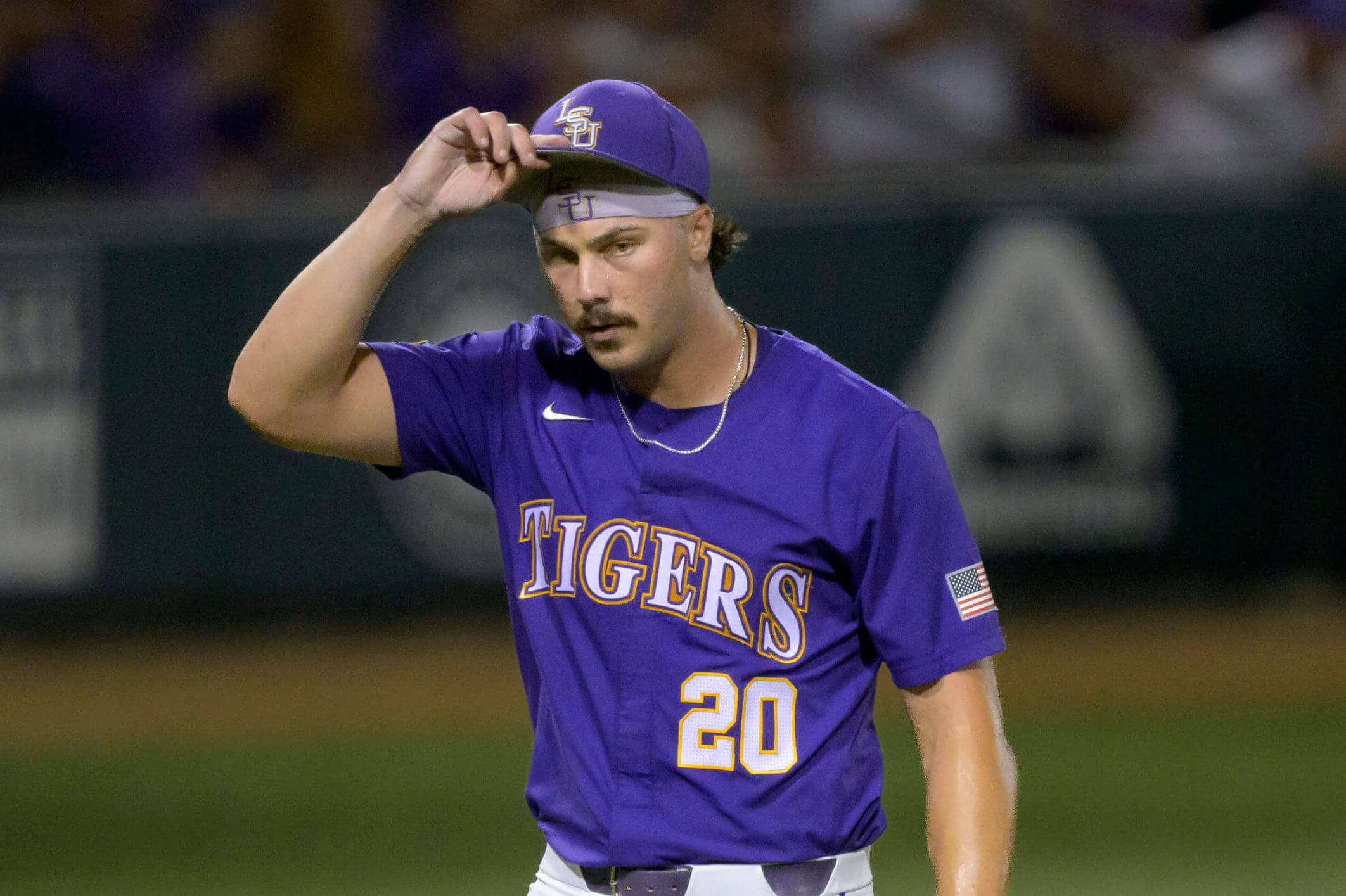
Skenes won the College World Series with LSU in 2023. (Matthew Hinton / Associated Press)
8. LSU was introduced to Skenes when, in the first series of his freshman year, he caught eight innings for Air Force and then secured the save in a stunning 6-5 upset of the seventh-ranked Tigers.
“He was throwing 96 (mph), with changeups over 90,” LSU catcher Hayden Travinski said. “We were like, what the hell is this?”
Upon transferring to LSU as a junior, Skenes hit well that fall, yet LSU head coach Jay Johnson determined Skenes was most valuable to his club’s College World Series chances as a pitcher. Skenes’ arsenal evolved rapidly as he worked with pitching coach Wes Johnson. By the time the season started, Skenes had added muscle and a couple ticks to his fastball, which was touching 100 mph. He had a slider, changeup and curveball and had started tinkering with a sinker-splitter hybrid pitch — the “splinker.”
Travinski caught LSU’s NCAA Tournament regional win against Tulane, a complete game Skenes capped with a 101 mph fastball on his 123rd pitch.
“He’s 6-foot-7 and thinks he’s going to fly planes,” Travinski said. “I told him, ‘Shut the hell up. You’re throwing a fastball.’
“He was born to do this.”
9. Around that time, in the Pirates clubhouse, veteran left-hander Rich Hill remarked from his locker, “Whoever that kid is for LSU could be pitching in the big leagues right now.” Teammates gathered around a TV playing the NCAA tournament and watched the fiery, mustachioed Skenes work. Word of the phenom who was the talk of the Pirates’ scouting department had finally reached the clubhouse.
Less than two weeks after the Tigers won the College World Series and Skenes was named the tournament’s Most Outstanding Player, the Pirates selected him with the No. 1 pick in the 2023 MLB Draft.
10. When Skenes started off the 2024 season by punching out the Louisville Bats’ leadoff hitter with his fifth 100 mph fastball of the at-bat, neither he nor his catcher, Grant Koch, had Cy Young chances in mind.
Skenes was clearly on the doorstep of the majors, having thrown just seven innings before reaching Triple A, but was still fully focused on what it would take to feel comfortable when he debuted.
“He was dialing everything in,” Koch said.
In one Triple A start, Skenes breezed through the early innings, throwing 80 percent fastballs and splinkers. He told Koch, “This is great. But we can’t do this every time.” That was not technically true — hitters couldn’t touch those pitches — but Skenes wanted to work on the whole pitch mix.
That Skenes arrived in the majors as polished as any pitching prospect in recent memory comes as no surprise to his former catchers. With his attention to detail, it couldn’t have happened any other way.
11. At one point this summer, Davis asked Skenes, “Did you know you’re the best in the league at controlling the running game?”
Skenes wasn’t specifically aware that no right-hander this season prevented more advances, via stolen bases and balks, than him, but it’s no coincidence. Skenes thinks constantly about holding runners. He told Davis, “I’ll never give anyone the slightest advantage to beat me.”
His attentiveness to the running game is one area in which his past life as a catcher informs his ace present. He still surveys the field and commands the action.
Setting a game plan with Skenes is easy, catchers say, because he understands each perspective: pitcher, catcher and hitter. He thinks two pitches ahead. He knows what hitters want in specific counts and how they’ll react to certain pitches. He trusts his stuff and his catchers’ calls, yet he’s also aware of how difficult it is for hitters to square up a baseball.
“A lot of pitchers put so much burden on themselves,” Davis said. “They feel like they need to be perfect. His hitting background gives him some humility: Hitting is hard, and if I throw my stuff consistently, things will go well. When in doubt, throw a fastball down and away at 100 (mph).”
12. Early in his June 3 start against the Astros, Skenes met with Davis in the tunnel behind the home dugout at PNC Park, as they typically do between innings, to revisit their strategy after seeing Houston’s early swings. The Astros were ambushing him, trying to put the ball in play as soon as possible. Skenes had one strikeout through three innings.
“Then who cares about strikeouts?” Davis said.
They rewrote the game script. Skenes fed Houston hitters low strikes and off-speed stuff to induce soft contact early in counts. Then, the third time through the order, he let loose the kitchen sink. Skenes threw eight innings of one-run baseball, striking out four of the last five hitters he faced.
“The fact he can flip that switch and be able to do whatever the game is asking is what really separates him,” said Davis, with whom Skenes had a 1.81 ERA in their 169 innings together this season.
13. After his rookie season, Skenes decided the next step of his pitching evolution was to go deeper into games. A newfound efficiency was on display this year, as Skenes topped out at 105 pitches yet threw his first complete game and pitched into at least the sixth inning in 27 of 32 starts. He also widened his arsenal to seven pitches. He throws six pitch types to lefties, six to righties — something for each hitter’s weakness.
Skenes is at the stage of his pitching career where only hyperbole applies. A Cy Young winner — and nearly a two-time winner — at 23. A sub-2 ERA and sub-1 WHIP through two seasons.
“I really think he could be one of the greats,” Koch said.
“This will be fun to tell my kids about one day when he’s got 15 (Cy Youngs), hopefully,” Davis said. “I don’t know what the record is.”
Roger Clemens holds the record, with seven.
“That’ll be on the docket, I believe,” Davis said.
14. While Skenes didn’t mention the Cy Young to anyone in his orbit this season, it was in the back of his dad’s mind throughout the summer. Craig has watched a lot of baseball over the years, but not this intently, and never this many teams. He was struck by how differently starting pitchers dominate, their varying approaches, arsenals and arm slots.
But sometime early this summer, Craig thought, He might have a shot at this. Skenes had a 2.39 ERA after April, a 2.15 ERA through May, a 2.01 ERA at the All-Star break and a 1.83 ERA at the trade deadline.
Craig still drives past the elementary school often.
“Time flies,” he said. “Enjoy every pitch you’re able to catch.”