
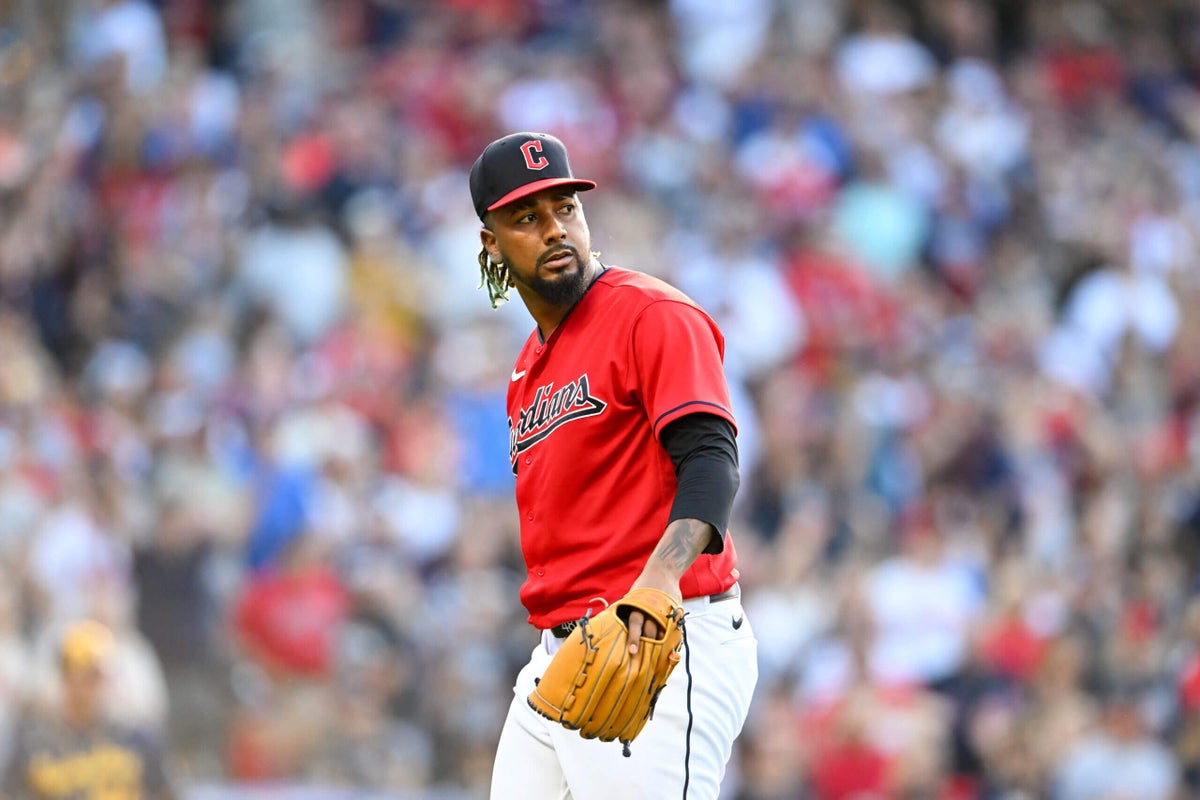
It’s just a ball. It’s just one pitch.
When Emmanuel Clase allegedly threw balls in the dirt on purpose and decided to put his current and future earnings on the line for a relative pittance in dirty money, maybe he was thinking along those lines. It’s just a ball. It’s just one pitch. How much could it matter? Who would notice?
Tracking how much that one pitch matters tells us a lot about the precipice baseball stands in front of. Because, as it turns out, one seemingly meaningless pitch can actually be worth a lot.
Let’s start with something simple: count leverage. It’s obvious that hitters do better when they’re ahead in the count, but the difference between a count of 1-0 versus 0-1 is stark. In 2025, after a 1-0 count, batters hit .255 with a .375 on-base percentage and a .431 slugging percentage. After an 0-1 count, those numbers plummeted to .216, .253 and .344, respectively.
Throwing a ball instead of a strike to begin an at-bat in 2025 effectively turned the batter at the plate from last season’s version of Mike Trout into Luis Rengifo.
That seems like a huge deal.
There are other ways to describe what happened that make it seem like a less of a big deal. In the indictment, six particular pitches by Clase are pointed out by screen shot. By taking the particulars of each pitch, and figuring out how much each cost the Guardians in terms of win probability, we can figure out how much each pitch alone cost the team in a more comprehensive manner.
For example, Clase is accused of turfing a first pitch to Ryan Jeffers in the ninth inning with the Guardians leading 4-2. Win probability analysis looks at the likelihood that all teams in that certain situation won the game. Before the pitch, according to this calculator and using the years 2000 to 2024 as the basis, the Guardians were likely to win 92.6 percent of the time.
After that pitch, the Guardians were likely to win… 92.0 percent of the time.
The Guardians were still going to win after that ball one pitch, and Clase cost them less than one percentage point of win probability. That doesn’t even factor in that it was Clase pitching, assuming he’s trying at his normal level after that pitch. He’s been the most valuable reliever in baseball over the last five years and has averaged fewer than six blown saves a year. You could argue that this episode was largely insignificant to the game’s outcomes when viewed through this prism.
However, it becomes a big deal in the aggregate.
Do this over and over again, and it will eventually cost a team a win. A win in free agency cost more than $10 million last offseason. Even using just the six highlighted pitches in the indictment, Clase cost his team a combined 3 percent win probability. Using $10 million as the value of a win, that means he cost his team over $300,000 on those six pitches.
Again, you might argue that this is pennies for a team valued near $1.5 billion. But we don’t know if this was the extent of the illicit activity, and we’re ignoring two huge costs either way.
Should these allegations be proven true, the Guardians will lose the services of Clase and his purported accomplice, Luis L. Ortiz. In terms of projected performance over the life of their contracts, the Guardians could be losing between four and five future wins from Clase, who has a track record that makes him easy to evaluate.
Ortiz has been a below-average pitcher through 327 career innings, but he has above-average stuff for a starter and had been showing the best strikeout rate of his career this season before the suspension. A conservative value would be another four-to-five wins of worth until he became a free agent after the 2029 season. Did the Guardians just lose $100 million of production from these two?
Of course, the team would also have to pay them for this production if they were still playing, so in terms of surplus value, losing the two pitchers (and their salaries) changes that number. We know that Clase would get another $26.4 million in pay for his services based on the contract he’d signed, but projecting pay for a pitcher like Ortiz who’s still pre-arbitration eligible is basically impossible. If you look at pitchers who had similar numbers to Ortiz through similar ages, you get comparative examples that run the gamut from reliever Alex Colomé to one-time Cy Young Award winner Rick Porcello. Regardless of what Ortiz’s future earnings would have been, it’s still true to say that losing these two would cost the Guardians tens of millions of dollars in lost surplus value.
And that doesn’t even get to the real cost of the whole thing.
This behavior by Clase was alleged to have begun sometime in early 2023. He was caught mid-season in 2025. Baseball fans are left to wonder why an operation so brazen and haphazard-seeming — the pitchers are accused of making phone calls from the bullpen, and even leaving tickets for their co-conspirators — took two years to catch. Are there other players in the middle of doing something similar, but who are executing it more professionally? What’s the cost of that doubt that’s now in a fan’s mind as they watch a pitch in the dirt?
Every number in this analysis pales in comparison to the value of a clean game.