

Call it counterintuitive, but even though it will cost more to sign Brandon Woodruff if he turns down the qualifying offer from the Brewers by Tuesday, it would feel more worthwhile to do so. The big question around Woodruff isn’t his talent level; it’s about health and durability. When he’s on the mound, Woodruff is likely to be a solidly mid-rotation starter, with upside from there. Unfortunately, given the way his last three seasons have gone, it’s hard to count on him being on the mound very often. If he has the confidence to turn down $22.025 million on a one-year deal, it’s a signal that his shoulder is essentially intact, for now.
However, if he does turn down that contract, Milwaukee is more likely to move on than to re-engage with him. As much as the whole franchise loves Woodruff, they have lots of upside in their projected 2026 rotation as it is. What they need is volume—the very reliability that is the missing ingredient for the veteran righthander. Besides, if they let Woodruff depart after he turns down this offer, they reap a draft pick to deepen their 2026 class, which would make it easier for them to retain Freddy Peralta. If they re-sign him, the price tag is likely to increase the pressure to trade Peralta, and they’ll need to find another way to improve their depth on the farm.
Letting Woodruff depart would leave an open spot in the rotation, but it would also mean considerable flexibility with which to fill it. The Brewers are never going to wade into the market for the top-end starting pitchers in free agency, but this year, there’s a fairly robust second and third tier of them. In particular, two right-handed starters who will be available without the loss of draft compensation stand out as viable options.
Merrill Kelly
After being traded from the Diamondbacks to the Rangers in July, Kelly hits the market as he heads toward his age-37 season. Despite getting old, though, he’s been one of the league’s sturdier workhorses for the last half-decade—nearly always taking the ball, often working relatively deep in games, and consistently pitching better than an average starter.
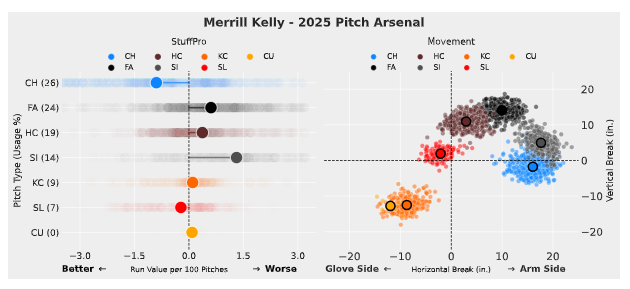
Though he only has one plus weapon, in his changeup, Kelly has a kitchen-sink repertoire and uses all three fastball varieties. He’s a rich man’s Colin Rea, and while Rea departed for the Cubs last winter, he’s still very much the style of pitcher the Brewers like for the middle of their rotation. Projections for Kelly’s next contract are considerably higher than what the Cubs paid Rea, or what they will pay him in 2026. He’s expected to make north of $30 million on a two-year deal. Because his age will keep the term of the contract short, however, he could be in the Crew’s price range.
Nick Martinez
Whereas Kelly is coming off a strong season, Martinez hits the market after taking the qualifying offer from the Reds last fall—and probably wishing he hadn’t. Though his stuff remained essentially intact, Martinez’s strikeout rate against righties declined sharply, and with that went some of his effectiveness. The Reds leaned on him to start more than he had the previous few years, and it seemed to stretch him too thin.
Martinez won’t make what Kelly will this winter. He’s in line for something closer to $22 million over two years, making him reasonably priced. The key question for him will be whether he can get back to the clever sequencing and great command that made him so good from 2022 through 2024. As with Kelly, the only truly plus pitch Martinez throws is his changeup, but his arsenal is deep and balanced.
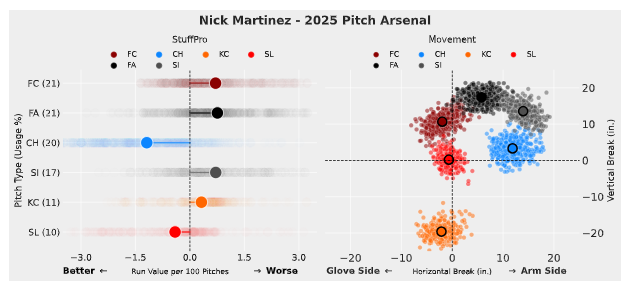
The last time Martinez spent time on the injured list in the majors was 2017. He’s been a swingman, rather than a full-fledged starter, but like Kelly, he provides ample value by being available when needed.
If Woodruff takes the qualifying offer, the Brewers’ winter pitching plans will have to be low-cost and low-wattage. If he doesn’t, though, they’ll have significant money to spend—and several ways to go about doing it.