
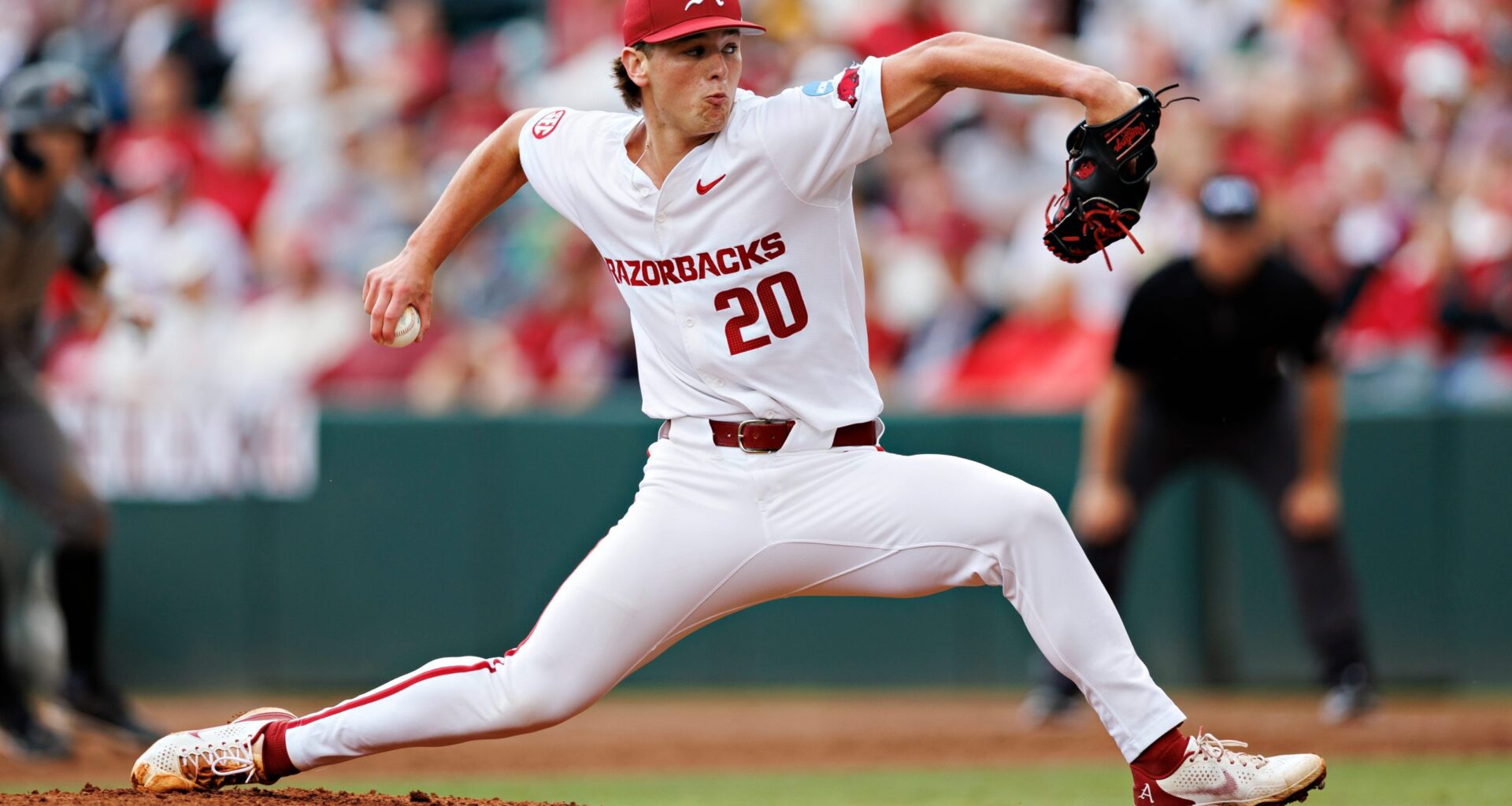
Today, we present the latest installment in our ongoing look at 2026 MLB Draft-eligible college data standouts. After opening the series with top-tier bats and sleeper hitters, we now shift the focus to pitchers with an analysis of 10 arms from our Top 100 draft rankings for 2026 whose TrackMan samples provide the clearest look at how their arsenals perform.
Using only the data captured in front of TrackMan, we have evaluated fastball traits, secondary metrics and rate statistics most predictive of future success to build a sharper understanding of each pitcher’s strengths and developmental priorities heading into the spring.
Liam Peterson, RHP, Florida
2026 Draft Ranking: No. 4
Peterson enters the spring as the most complete data-driven pitching evaluation in the class, and the intrigue begins before examining a single pitch.
Peterson’s delivery is uniquely vertical. Among Top 100 pitchers, he posted the third-highest average release height in 2025 and the highest among righties, trailing only lefties you’ll find in the story below: Trey Beard (Florida State) and Cole Carlon ( Arizona State). Peterson’s operation became even steeper this fall as added lower-half strength allowed him to stride more efficiently, pairing that elevation with roughly average extension. The combination of height and reach creates an unusual entry angle that separates Peterson from typical collegiate arms.
Peterson’s pitch mix is equally distinctive. He owns excellent feel for spin across his arsenal, a trait that shapes his mix. His four-seam fastball averaged 2,420 rpm last season with 21 inches of induced vertical break and natural armside run, giving it real swing-and-miss carry. The vertical approach angle itself is modest due to the steep release, but he generates nearly two degrees of separation between his fastball and changeup. The changeup features both fade and tumble, and the separation, in action, mirrors the visual separation created by his slot.
Both breaking balls grade out cleanly in the data. His slider and curveball each show plus spin characteristics, and the consistency of his axis manipulation reinforces the broader observation that his spin proficiency is not tied to one grip or shape.
The addition of a running two-seam fastball this offseason gives Peterson a fifth differentiated offering and more flexibility in fastball usage.
Between the operation, verticality, spin traits and completeness of his mix, Peterson brings one of the deepest data foundations of any recent college pitcher. The industry views him as the early favorite to be the first arm selected because the metrics support every part of the profile.
Cameron Flukey, RHP, Coastal Carolina
2026 Draft Ranking: No. 10
Flukey cracked the top 10 in our most recent draft update after evaluators across the country made it clear the rankings gap between him and Peterson needed to shrink. He was a foundational piece of Coastal Carolina’s 2025 staff, helping pitch the Chanticleers to Omaha while logging 101.2 innings, a 3.19 ERA, a 28.5% strikeout rate and a 5.8% walk rate across 18 appearances. At 6-foot-6 and 210 pounds, he presents a long, lean look on the mound with a high leg lift, deep arm action and a three-quarters slot.
Flukey’s fastball is the backbone of his profile. He averaged 95 mph and touched 98 while his movement data drove substantial industry interest. The pitch averaged 20.3 inches of induced vertical break and has a well-above-average approach angle that plays well at the top of the zone. His extension is solid, but not extreme, given his height, and he does not rely on release height to manipulate shape, but the consistency of his fastball axis and command made it one of the more reliable heaters in the country. The dramatic drop in walk rate from his freshman year reflects meaningful improvement in fastball location.
Flukey supports that foundation with three usable secondaries. His mid-70s curveball shows true 12-to-6 action, while his mid-80s gyro slider is his go-to breaking option against righthanded hitters. Both offerings benefit from his ability to generate late movement from a consistent release window. Flukey also mixes a mid-80s changeup to lefties, a pitch he deploys sparingly but effectively to reduce predictability.
With a fastball that carries, improved command and a four-pitch mix that works against both sides, Flukey possesses the ingredients needed to be the top pitcher in the class. The movement traits, strike-throwing gains and physical projection explain why clubs increasingly view him as one of the top arms available for 2026.
Jackson Flora, RHP, UC Santa Barbara
2026 Draft Ranking: No. 17
Flora is the next arm to emerge from UCSB coach Andrew Checketts’ pitching factory, a lineage that recently produced multi-million dollar signee Tyler Bremner and has consistently turned out some of the most data-forward pitchers on the West Coast.
While early draft attention has centered heavily on Peterson and Flukey, Flora belongs firmly in that same conversation. His data indicates the tools of an arm who could be the first pitcher selected in July if the spring performance matches the metrics.
The foundation of Flora’s arsenal is his fastball, and it’s a standout offering thanks to its movement profile and sheer power. The pitch is explosive, regularly touching triple digits with huge carry that spikes into the low 20s of induced vertical break to make it one of the most high-octane heaters in the class. UCSB refined the pitch this fall to eliminate occasional dead-zone characteristics. Early feedback suggests it has even more carry and a cleaner movement profile now—an impressive development given how strong the pitch already graded last year. Flora’s -4.6-degree vertical approach angle is strong out of a low three-quarters slot and could tighten further following the fastball adjustments.
Flora’s feel for spin is advanced. He routinely snaps off pitches that exceed 2,700 rpm, and that spin expresses itself in multiple breaking shapes. His sweepy slider, the headliner of his mix, and a tighter slider both show plus movement, and Checketts added a curveball this offseason to sit neatly between those two shapes.
Flora also began throwing a kick changeup this fall. While it does not yet have in-game TrackMan readings, Checketts told Baseball America the pitch has looked outstanding in scrimmages and separates cleanly from the fastball.
Flora gets solid extension, which helps amplify the carry and angle characteristics of his arsenal. With true velocity, elite carry, multiple high-spin breaking balls and emerging changeup separation, Flora’s data package sits comfortably alongside the top arms in the class. If the refinements hold in 2026, he has every tool to pitch himself into discussion for first arm off the board come July.
Joey Volchko, RHP, Georgia
2026 Draft Ranking: No. 25
Volchko enters 2026 with premium raw material. At 6-foot-4 and 225 pounds, he has long shown the frame and arm strength associated with a frontline evaluation, yet his first two seasons at Stanford revealed how much separation existed between the tools and the execution. Over 113 innings, he logged a 5.89 ERA with a 20.6% strikeout rate and 10.5% walk rate—outcomes tied to difficulty repeating his delivery and producing competitive strikes. The inconsistency led him to seek a reset.
He found that at Georgia with Wes Johnson, a coach known for structured pitch design work and individualized development. The goal for Volchko was straightforward: Consolidate a powerful but erratic mix into something with more predictable shapes, steadier command and a delivery that holds from inning to inning.
Volchko arrived in Athens with a 95 mph fastball that touched 99 and showed natural cut. He paired it with a low-90s slider with real bite, a mid-80s power curveball, a low-90s cutter and a low-90s changeup. He’s also brought exceptional feel for spin. His breaking pitches regularly operate in the upper 2000s and can reach 3000 rpm, giving him the foundation to manipulate shape and create multiple looks off similar cues. Georgia worked to tighten the four-seam fastball by creating more carry at the top of the zone without losing velocity. They added a high-80s sweeper to diversify his breaking shapes and introduced a true changeup to create cleaner separation across his velocity bands.
Strength and direction work lowered Volchko’s arm slot by 3-4 inches and was intended to correct the below-average approach angle on his cut-ride fastball while improving consistency of release. The adjustments were aimed at giving him a fastball that plays truer at the top of the zone and allowing his high spin secondaries to work in more defined lanes.
The power in the arsenal has never been the question. The determining factor is whether the strike-throwing stabilizes and the movement profiles hold their new form. If those gains carry into the spring, Volchko has the ingredients to push into the upper tier of the 2026 class.
Gabe Gaeckle, RHP, Arkansas
Gaeckle arrived at Arkansas with a reputation for rare arm speed and pure stuff. His first two seasons have reinforced that evaluation. Across 114 innings, Gaeckle has produced a 3.63 ERA with a 30.7% strikeout rate, showing the ability to miss bats in volume even as the delivery and strike-throwing remain inconsistent.
At roughly 6 feet and 190 pounds, Gaeckle attacks with a drop-and-drive operation from a high three-quarters slot and creates surprising force for his size. The fastball sits in the mid 90s and has reached 99 mph at peak with ride that plays well at the top of the zone.
Gaeckle’s pitch characteristics behind that heater help explain the bat-missing ability. His release height is low for a righty with his velocity, and the flatter attack angle he generates pairs cleanly with the carry. That combination gives hitters a difficult look when he accesses the top of the zone.
Gaeckle’s slider is his most advanced secondary offering, as it averaged 2,682 rpm in front of TrackMan in 2025 and produced a 41% whiff rate with a 36% chase rate. The pitch has sharp action and shows late depth when he stays on top of it. His changeup offers a different challenge. The pitch features significant run and creates nearly two degrees of separation from his fastball while generating a 47% whiff rate in his TrackMan sample, giving him a legitimate weapon against lefties.
Gaeckle also mixes a power curveball and maintains enough feel to spin both breaking shapes. The question centers on efficiency. His strike-throwing has been below average and the effort in the delivery introduces volatility from outing to outing.
The raw ingredients are clear and the pitch data supports a high-octane pitch mix. If Gaeckle can stabilize the command and hold his shapes more consistently, he has the arsenal to factor prominently in the 2026 class.
Cole Carlon, LHP, Arizona State
2026 Draft Ranking: No. 55
Carlon has been one of the more significant year-over-year risers in the class after transforming himself from a low-leverage reliever in 2024 into one of the top strikeout arms in college baseball last spring. His sophomore season produced a 3.33 ERA with a 38.7% strikeout rate across 54 innings, good a top-five mark nationally among pitchers with at least 50 innings. At 6-foot-5 and 230 pounds, he presents a large, downhill look on the mound and works primarily off a fastball and gyro slider.
Carlon’s release height is among the highest in the Top 100, trailing only Florida State’s Trey Beard (see below). That vantage point helps create angle even though his extension is modest. The fastball averaged 94 mph in 2025, reaching 98 and generating sufficient ride to stay above barrels despite the steeper release. The pitch plays best when elevated and has enough life to avoid the dead-zone look that can accompany a tall lefty without elite extension.
The slider is Carlon’s defining pitch. It operates in the mid 80s with a true gyro profile, and he leaned on it heavily, throwing it close to half the time. Hitters managed a 56% miss rate against it and batted .163, making it one of the most effective breaking balls in the country on a rate basis. The shape is firm, late and consistent, which explains the reliance. Carlon also has a slower curveball and a mid-80s changeup, but he deploys both sparingly, and neither has yet shown the predictability or depth required for a full starter’s mix.
For Carlon to move from high-octane relief arm to viable rotation piece, he will need more breadth in the arsenal. The fastball and slider form a powerful foundation, and the delivery and release point give him a look that many lefties cannot replicate. The next step is adding a secondary he can land and trust early in counts, which would allow his two plus weapons to hold their performance deeper into outings.
Trey Beard, LHP, Florida State
2026 Draft Ranking: No. 75
Beard was one of the most effective starters in the country last spring, and his data places him among the most unique arms in the 2026 class. He delivered a 3.14 ERA across 16 appearances with 118 strikeouts in 86 innings, good for a 34.4% strikeout rate and one of the highest bat-missing outputs in Division I. Now at Florida State, the lefthander brings an operation and release profile few college pitchers can match.
Beard’s delivery works from a straight-over-the-top slot and produces a 6-foot-9 release point, which is the highest among all Top 100 pitchers. That angle is especially unusual for a lefty and creates a visual challenge that hitters rarely see. His fastball sits in the low 90s, yet the pitch plays significantly firmer due to the combination of carry and entry angle. Beard averaged 20.8 inches of induced vertical break, a standout measure for a pitcher whose slot would typically create a steeper plane. Hitters struggled to pick it up, whiffing at a 28% rate in TrackMan games with a 35% chase rate.
Beard’s changeup is the separator. He maintains full arm speed and generates roughly 2.5 degrees of separation off the fastball. The pitch produced a 46% whiff rate with late tumble and has the characteristics of a true plus offering. It is a difficult change of pace for hitters because the slot and arm speed disguise it until late.
He complements it with a mid-70s curveball that shows depth and downward action and a distinct slider in the upper 70s with more lateral movement than the curve.
Beard’s arsenal is unconventional but highly effective. The missing ingredient is velocity, yet the pitch shapes, deception and release traits create a package that grades out as one of the most intriguing lefthanded profiles in the class. If the velocity climbs even marginally in 2026, Beard has a chance to pitch himself into a much higher tier.
Ricky Ojeda, LHP, UC Irvine
2026 Draft Rankings: No. 82
Ojeda has been one of the most relied-upon relievers on the West Coast since he arrived at UC Irvine. Across two seasons, he has logged 118 innings over 54 appearances with a 3.51 ERA and a 31.3% strikeout rate, operating almost exclusively in leverage situations for the Anteaters. His 2025 workload continued into the summer, as he dominated in the Cape Cod League and for Team USA, striking out 20 in 10 scoreless innings across the two stops.
Ojeda is undersized at roughly 5-foot-11 and 185 pounds, yet his fastball is one of the most deceptive offerings in the class. The pitch comes out with carry and a flat approach angle that plays at the top of the zone, and he has touched 96 mph with more consistent low-90s velocity this fall. He generated the highest fastball whiff rate in TrackMan environments among Top 100 college pitcher—a data point that reflects how well the shape and angle work together despite modest physical stature. The heater forms the core of his attack, and he leans on it heavily because it continues to generate misses even when hitters know it is coming.
Ojeda has the ability to manipulate spin off the same release. He throws a soft curveball in the low 70s with defined shape and a harder slider around 80 that shows later action. Both pitches serve primarily as change-of-pace looks off the fastball window. He also mixes a split changeup near 80 mph with tumbling life that gives him a neutralizer against righthanded hitters. His strikethrowing has held at an adequate level for two seasons, and the delivery is repeatable enough that starting is not out of the question even though his usage has been almost entirely in relief.
UC Irvine plans to give Ojeda a shot at its Friday night role in 2026. If the fastball shape holds over longer outings and the secondary consistency improves, he has the pitch characteristics to move well up draft boards in the spring.
Aidan Knaak, RHP, Clemson
2026 Draft Ranking: No. 85
Knaak has been a steady presence in Clemson’s rotation for two seasons and has already handled one of the heavier workloads in the ACC. He was dominant as a freshman with a 3.35 ERA and 108 strikeouts in 83.1 innings, then followed with a 4.18 mark and 110 strikeouts over 90.1 innings in 2025. The strike-throwing has remained consistent, and the pitch usage reflects a clear understanding of how his arsenal works.
His fastball grades out closer to average in pure quality. The pitch shows solid carry with a more neutral approach angle and does not generate the type of whiff volume seen from the upper tier of fastballs in the class. It functions more as a tone setter than a bat-misser. The shape, however, creates ideal contrast for his changeup, which is the defining pitch in his mix.
Knaak produces roughly three degrees of separation between his fastball and changeup, and the offspeed comes with late fade and tumble. He uses the pitch with advanced feel, and it generated a 50% whiff rate and 36% chase rate in TrackMan games. It is one of the most reliable changeups in the class because he locates it with intent and maintains arm speed.
Knaak also mixes a curveball and a slider, though both sit behind the changeup in consistency and shape. Each pitch flashes utility, but neither has yet developed into a true third offering that can be relied on in leverage counts. Continued progress in one of those offspeeds will be important for his long-term profile given how changeup-centric the current mix is.
The delivery holds up, the strike-throwing is stable and the changeup is a legitimate separator. If Knaak can firm up one of the breaking balls, he has the potential to make a sizable jump in 2026 because the foundation built around the changeup is already in place.
Ryan Marohn, LHP, NC State
2026 Draft Ranking: No. 93
Marohn, who was added to our 2026 Top 100 in October, pairs one of the cleanest strike-throwing records in the class with a well-sequenced four-pitch mix. At 6-foot-2 and 185 pound, he works from a three-quarters slot with a delivery that repeats and allows him to attack the zone.
His low-90s fastball has solid carry and generated a 31% chase rate and a 22% whiff rate despite modest velocity. The offering is helped by the angles he creates even without standout extension.
Marohn supports the heater with three viable swing-and-miss secondaries. His low-80s changeup shows fade and tumble and produced a 47% chase rate in TrackMan games. His upper-70s curveball has depth and created a 37% miss rate, while his mid-80s slider flashes lateral action.
The mix is balanced and the strike-throwing is already in place. Marohn may not have the premium velocity of the top arms in the class, but he sequences cleanly, keeps all of his pitches in the zone and misses enough bats to profile as a legitimate starter.