
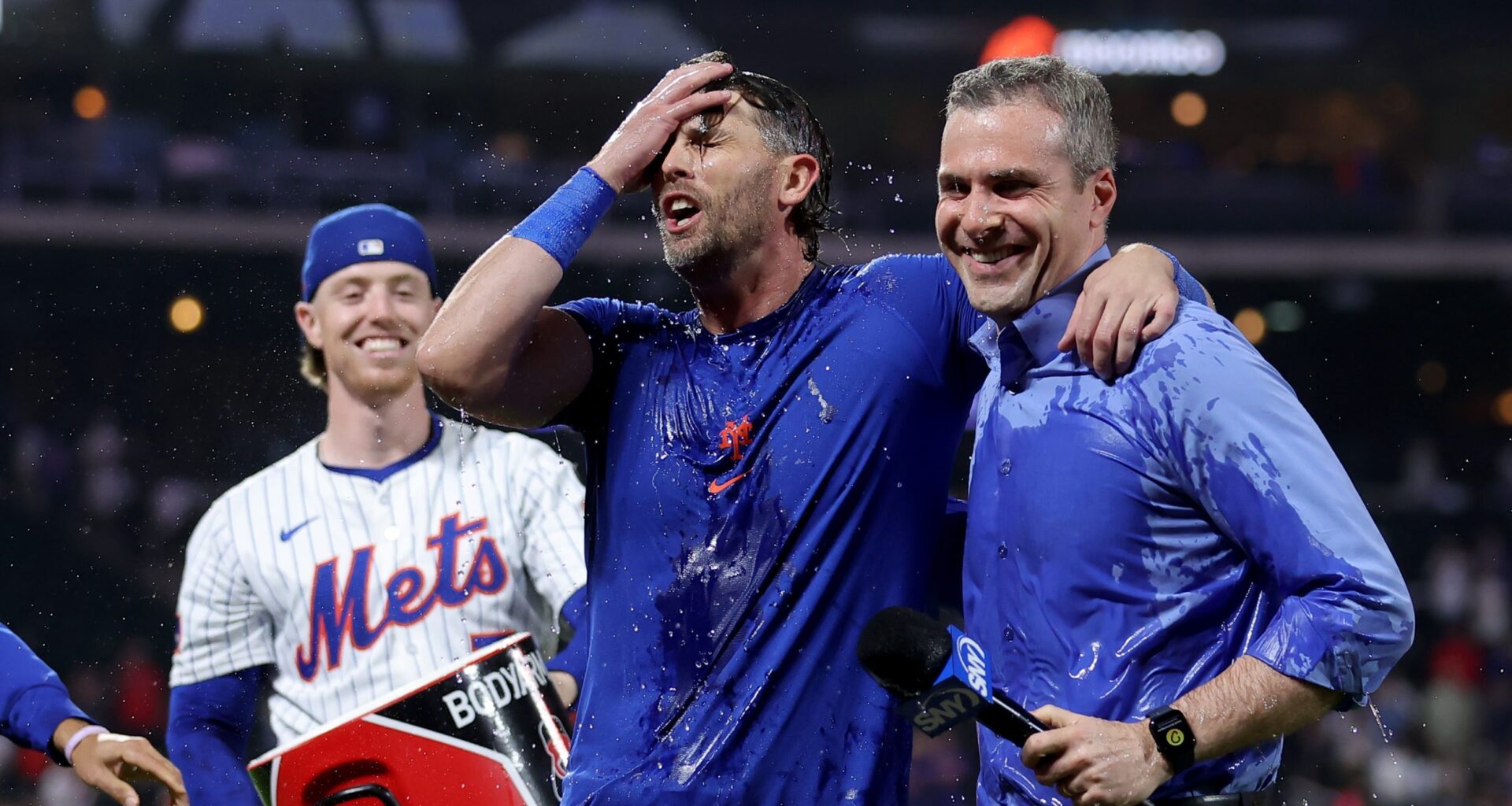
Steve Gelbs convinced himself his brain didn’t work the way a play-by-play announcer’s brain needs to work.
For years, the Mets sideline reporter declined every invitation from Gary Cohen, Howie Rose, and SNY executives to try calling games. He had built an entire mental wall around the idea based on one disastrous attempt as an 18-year-old college freshman. When he tried making a tape that day, his brain malfunctioned. He would see things happening on the field and couldn’t say them out loud.
“It’s really out of character for me, and if I could go back and change one thing in my life, it would be that, but I gave up on it,” Gelbs said during a recent appearance on the Awful Announcing Podcast. “I was like, ‘You can’t do this. You’re going to focus on hosting and reporting, and that’s your lane.’”
That one failure as a teenager shaped his entire approach to his career. Gelbs spent years telling himself he wasn’t built for play-by-play work. Cohen and Rose kept asking him to try. Executive producer Curt Gowdy Jr. and SNY president Steve Raab pushed him to do spring training games. Gelbs said no every time. Wayne Randazzo was doing play-by-play work alongside the radio team and doing it well. There was no reason for Gelbs to step outside his comfort zone.
Then Randazzo left for the Angels after the 2022 season.
The pressure from SNY leadership intensified immediately. They told Gelbs it was ridiculous at this point. The fanbase knew him. He was already on the broadcast. He could do this. Gelbs remained adamant he wouldn’t do it until Raab sat him down for lunch and asked him to explain why he wouldn’t even consider it.
After hearing Gelbs out, Raab told him it sounded like he was scared to take a risk. Gelbs looked at him and eventually agreed. They made a deal. Gelbs would do one spring training game. If he got through it without disaster and felt like he had been decent enough to improve, he’d do 10 spring games the following year. If those went well, he’d fill in for Cohen during the regular season.
His first regular-season game came in Cincinnati. Howie Rose met him in the broadcast booth before first pitch and handed him a Depends adult diaper, just in case. Gelbs still has it.
“I couldn’t have been more nervous,” Gelbs said.
The pressure of filling in for Cohen felt worse than anything he experienced replacing Kevin Burkhardt on the sideline years earlier. Gelbs had never done play-by-play before. He had one reference point: literally seizing up as an 18-year-old freshman, unable to speak English. If that happened in New York while calling a Mets game, his career would be defined by the disaster.
But another element held him back. Gelbs didn’t think he deserved the opportunity. People work for decades and put in tens of thousands of hours to craft play-by-play skills. What gave him the right to step in because SNY needed someone?
Cohen and Rose told him he had put in the time. He’d been on the broadcast every single day doing reports and calling plays in the middle of them. He had a bond with the fanbase. They told him he shouldn’t put himself on a pedestal where he had to spend 10 years in the minors to be worthy of giving it a shot.
So he did it. And Cohen watched every single out.
“What an amazing gift that Gary on his time off — and he takes so little time off — he watches every single second of every out, and then he calls me up and he’s like, ‘Alright, you want some feedback?’” Gelbs said.
Cohen treats Gelbs’ development like a ladder. One time in spring training, Cohen called him up and told him his challenge for the next game would be never to use the word “count.” Gelbs had gotten into a pattern of saying “strike one” and then “the count’s 0-1” and repeating the count unnecessarily. So Gelbs went out the next day and didn’t use the word once. Then Cohen gave him another challenge. Then another. Each game, Gelbs gets a little better.
“It’s all long-winded, but I was much more nervous to do that,” Gelbs said about replacing Cohen compared to Burkhardt. “And, now, I am just obsessed with the challenge of it. Now I’m watching all these other games and I’m picking out ‘Okay, this I like. This is more me.’ Gary and I have a different style, so ‘OK, take this, but don’t try to do Gary’s broadcast totally. Do some things from here and some things from there. It’s just been a really cool challenge at this stage in my career.”
Everyone has a different path into play-by-play. Gelbs’ path is unique. Most broadcasters spend years in minor league baseball calling games in front of 500 people before getting a shot at the majors. Gelbs went from sideline reporter to backup play-by-play announcer for one of baseball’s biggest markets without ever working his way up through smaller roles.
But he’s doing it. Each game, he gets a little better. Cohen continues to watch every out and provide feedback. Gelbs continues to study other broadcasters and figure out what feels natural for his style. The mental wall he built as a teenager is gone.
“To anyone that’s listening, it’s a lesson: don’t make walls up for yourself,” Gelbs said. “You can do anything you put your mind to.”
The challenge now is to continue improving while maintaining his sideline reporting duties. Gelbs isn’t trying to become Gary Cohen. He’s trying to become the best version of himself as a play-by-play announcer while respecting that Cohen is one of the best in the business. That means taking elements from Cohen’s style, borrowing from other broadcasters he admires, and blending them into something that works for him.
The fear that defined his approach for years is gone. The mental block that convinced him his brain didn’t work the right way disappeared once he actually tried doing the work. Now he’s obsessed with getting better. Cohen keeps giving him challenges. Gelbs keeps meeting them. The Depends diaper Rose gave him sits somewhere as a reminder of how nervous he was walking into that booth in Cincinnati for the first time.
He was terrible that day. He’s slowly getting better. And he’s glad he finally said yes.