
Image credit:
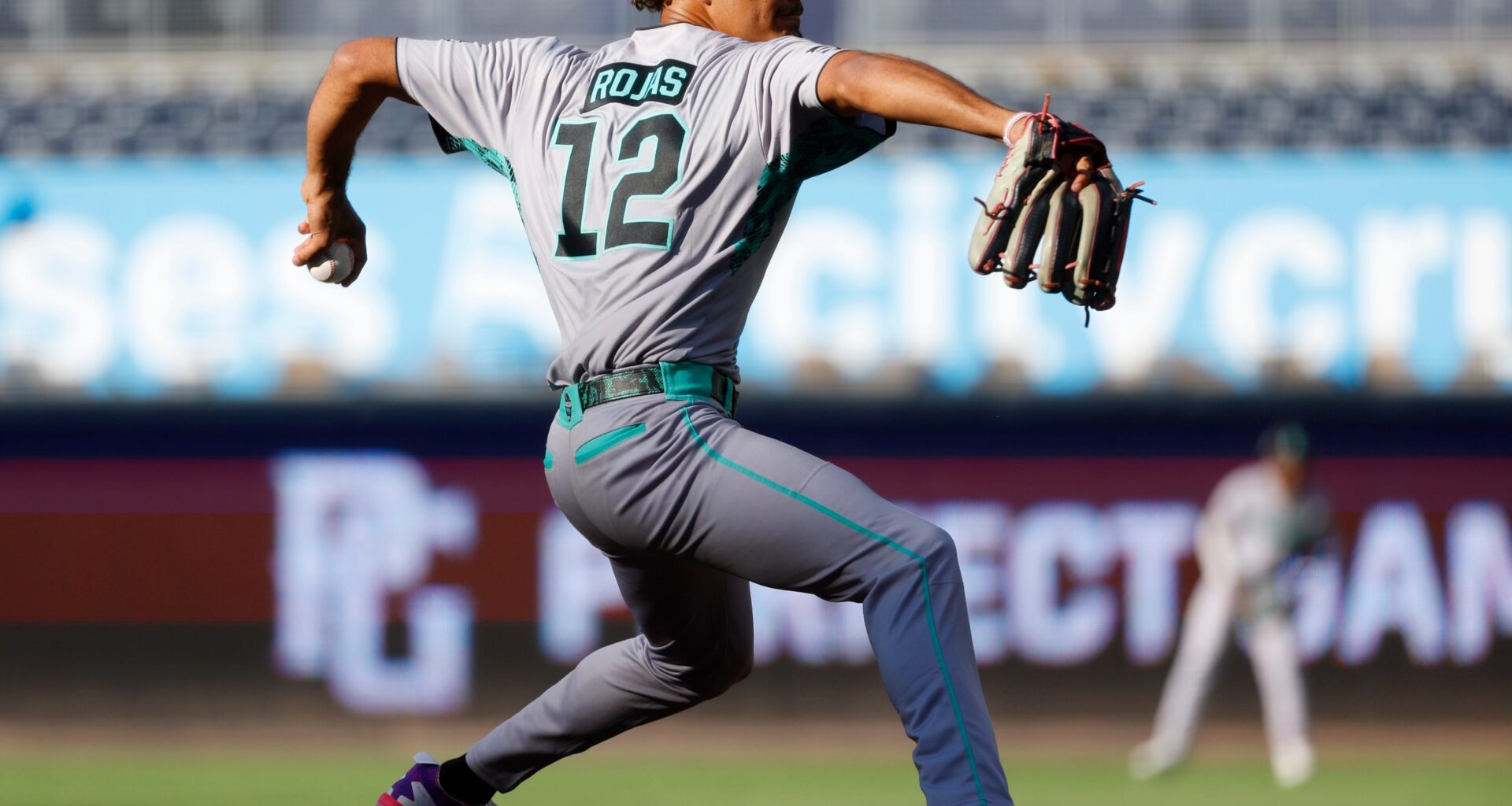
LHP Gio Rojas (Photo by K.C. Alred/San Diego Tribune via Getty Images)
Welcome back to our offseason scouting series for the 2026 draft class. In this series, we’ll be examining some of the top players in the class by getting into the weeds with video, data and reporting as we prepare for the 2026 spring season. You can find all of our previous offseason scouting installments here. Today, we’re taking a look at Florida high school lefthander Gio Rojas.
Rojas is the top-ranked prep pitcher in the 2026 class and hails from one of the most prominent high school programs in the country: Stoneman Douglas High in Parkland, Fla. The school recently won its fifth straight state championship, in no small part because of Rojas’ efforts on the mound. He posted a 0.72 ERA over 14 appearances and 68 innings, with 120 strikeouts to just 16 walks. Rojas is also a talented hitter high school hitter and was among the team’s offensive leaders. He’s committed to Miami, but is viewed as a consensus first-round talent and might never reach campus.
Body & Delivery
Rojas has an athletic frame at 6-foot-4, 190 pounds with wide shoulders and a lean build throughout his frame that portends plenty of strength and mass coming in the future. He’s an excellent mover on the mound and works with a quick delivery. He typically sets up in the middle or the first base side of the rubber.
Rojas throws from a lower three-quarters slot that will drop down to a fully sidearm look at times. He whips his left arm to the plate with some of the best pure arm speed in the class. His arm can be deceptively fast at times because he doesn’t throw with a significant amount of effort, though he does have a slight crossfire landing and falls off to the third base side in his finish.
While he might not always land in the ideal fielding position, Rojas’ athleticism is clear in situations where he needs to bounce off the mound and react to a rolled over ground ball with quick, deft footwork and impressive reactions. There’s some depth in his arm action, but not an extreme amount, and overall his delivery is simple and fluid enough that he should be able to repeat it consistently and throw quality strikes.
Fastball
The fastball is currently the main event for Rojas. As you might expect given his tremendous arm speed, he’s able to generate a tremendous amount of velocity. With a fastball that’s already been up to 98 mph, Rojas is in an elite group of prep southpaws who have thrown a fastball in the upper 90s at this stage.
In reporting how rare Jack Bauer’s 100-mph fastball velocity is in the 2025 draft cycle, we found just six high school lefthanders from the 2018-2024 draft classes who had reached at least 98 mph. Without even digging further into fastball shape or command, Rojas is among an elite group of southpaws:
2025, Jack Bauer — 102 mph
2022, Brandon Barriera — 99 mph
2024, Cam Caminiti —98 mph
2023, Cam Johnson — 98 mph
2023, Alexander Clemmey — 98 mph
2022, Noah Schultz — 98 mph
2026, Gio Rojas — 98 mph
Like most of the fastballs on this list, Rojas’ projects as an easy 70-grade offering. He works with a four-seam grip and will make adjustments with the width of his fingers and the pressure in order to elicit more ride, cut or tail. It’s natural shape tends to be more of a sink and ride pitch that aligns with his lower arm slot. That shape might cut down on his ability to generate whiffs against more advanced hitters at the top of the zone, but the power and movement should always allow it to be a highly effective pitch and potential groundball-heavy offering.
Rojas has added nearly four ticks of velocity on average from the 2024 summer to the 2025 summer. Across nine Synergy-logged games in 2025, he averaged 94.4 mph with the pitch and at the East Coast Pro showcase he touched 98 mph five different times in one outing.
He pitches heavily off the fastball now, and has more feel for the heater than the rest of his arsenal. Batters hit just .175/.294/.193 against it with a 34% miss rate and a 17.4% swinging strike rate.
Slider
In addition to a potential 70-grade fastball, Rojas has a slider that could become a plus offering. Like the fastball, the slider is a pitch that has added velocity over the last few seasons and now consistently sits in the low 80s.
It’s a big, sweeping breaking ball with high spin rates in the 2,600-2,800 rpm range and lots of movement to his glove side. In our nine-game Synergy sample from 2025, Rojas threw the slider 17% of the time against righties and 31% of the time against lefties. It accounted for just under a quarter of his usage overall.
The pitch is a clear swing-and-miss and chase offering for lefties, who have to combat with the pitch moving away from them in addition to the low angle Rojas creates on the mound. But against high school hitters, Rojas can use the slider to miss barrels of hitters on either side of the plate. Overall he used the pitch to generate a 62% miss rate but just a 15.1% swinging strike rate.
When Rojas is able to put the slider in the zone and force hitters to contend with it, it’s a clear weapon. Getting the pitch over the plate with more frequency will be a key development goal with him moving forward. His slider is currently his least reliable in-zone offering and he threw it for strikes just 43% of the time.
While Rojas does tend to throw the pitch in the 80-84 mph range with sweeper shape, he did flash a harder variant at the ECP event, in the 85-87 mph range. At that velocity, Rojas’ slider looked more like a typical cutter, and adding a shorter, tighter breaking ball could be a useful piece for him in the future; both to attack righties with more frequency and give him a non-fastball that finds the zone a bit more often.
Changeup
Rojas rounds out his repertoire with an 80-85 changeup that currently sits as a clear No. 3 offering for him. He uses a circle-change grip and almost exclusively throws it in opposite-hand matchups—leaving the fastball/slider combo as the complete attack plan against lefties.
While Rojas does have a decent feel to land the changeup for strikes, it is currently a pitch that gives lower-level hitters a chance to catch up to him more than anything. While it’s an extremely small sample of just 24 pitches, batters hit .714/.714/.1.000 against his changeup in the 2025 Synergy-logged sample we have available. It generated just a 20% miss rate and 8.3% swinging strike rate.
While Rojas will at times have nearly a 15-mph velocity gap between the changeup and fastball, he gets to that difference often by visibly slowing his arm speed, which advanced hitters will be able to pick up on. The pitch doesn’t have an exceptional movement profile at the moment, but some scouts think there’s enough here for him to get to an average changeup that will be enough to keep hitters off-balance and help him work deeper into games.
Control & Command
Rojas established a reputation as an advanced strike-thrower as an underclassman, but he was a bit more scattered than many scouts expected to see in 2025. Like almost all high school pitchers, his fastball control is better than his fastball command, and he will need to sharpen that area of his game to maximize the effectiveness of the pitch.
At his East Coast Pro outing, for example, Rojas left his fastball over the middle of the plate in neutral or pitcher’s counts too frequently and allowed a handful of hits because of it. He’ll also need to be more consistent with the release of his slider and challenge hitters with the pitch more frequently in and around the strike zone. He tends to miss with the breaking ball down and to his glove side.
It’s possible that Rojas is one of those pitchers whose arm speed is so fast that it’s difficult for him to repeat his release point with elite consistency, making him more of a control over command pitcher with power stuff. Despite all this, his low-maintenance operation and athleticism should give him every opportunity to develop solid-average control in the future.
In Summary
Rojas is a power-armed lefthander with some of the best pure arm talent in the class that gives him obvious upside potential. That upside comes with some clear question marks—mostly the development of a third pitch and improved command—and a timeline that many teams might not want to stomach in the first round.
High school pitchers can do more than high school hitters in their spring draft seasons to influence their draft stock, and the same will be true of Rojas in 2026. A strong spring that sees him improve his weaknesses could vault him into the top-half of the first round, while a failure to do so—or regression in other areas—could see him fall further into a deep and strong high school pitching demographic.
Rojas stacks up nicely with some of the best high school lefties we’ve seen in recent years. He belongs in the same sort of tier as players like Brandon Barriera (23rd overall), Noah Schultz (26th) and Robby Snelling (39th) from the 2022 class; Thomas White (35th) in the 2023 class; Cam Caminiti (24th) and Kash Mayfield (25th) in the 2024 class; and Kruz Schoolcraft (25th) in the 2025 class.
A comparison to Barriera makes a lot of sense in some ways: both are lightning-armed South Florida lefties with exceptional fastball velocity to go with high-spin sliders as their primary off-speeds—though Rojas has a taller, leaner and more projectable frame at the same stage.