
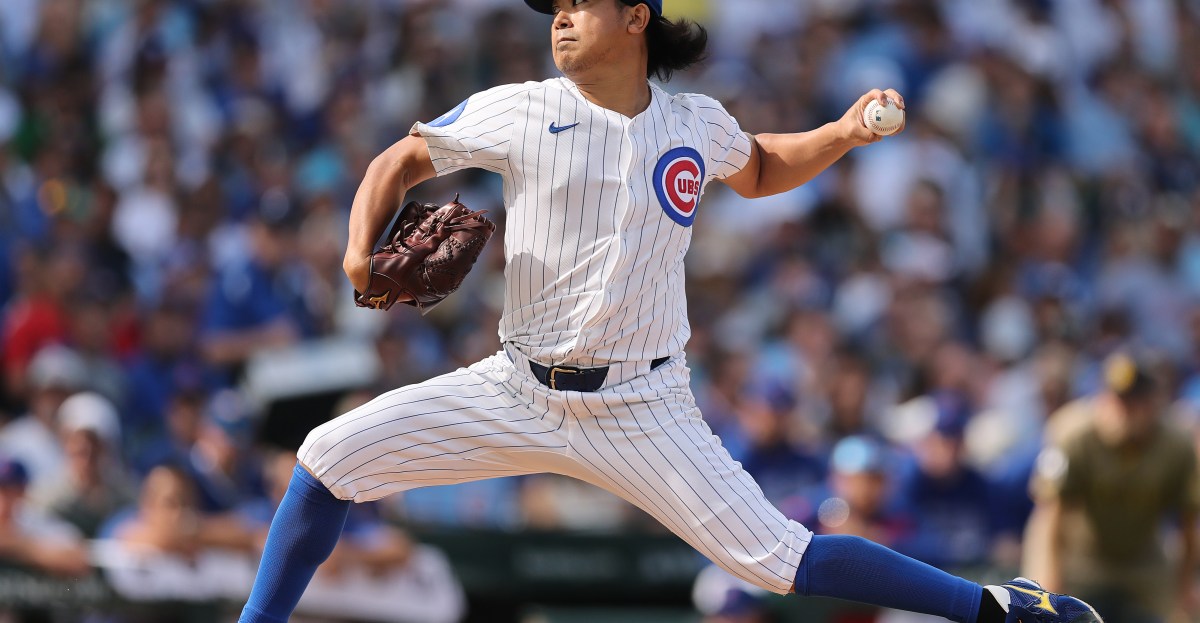
The stove is hot and Tuesday was the day we learned if players were going to take the qualifying offer or not. There was a bit of suspense for the Cubs on this one because while it was pretty much a lock that 2025’s blockbuster trade addition, Kyle Tucker, would decline the qualifying offer and test free agency it was substantially less clear what 2024’s biggest signing, Shōta Imanaga, would decide. For fans of Shō Time at the Friendly Confines, there are some reasons to cheer, with Shōta accepting a one-year, $22.025 million deal to remain a Cub for the 2026 season. Let’s dig into the numbers behind that decision.
The qualifying offer just happened to be in the sweet spot for Shōta in terms of contract value. The 32-year-old pitcher who joined the Cubs after pitching in the NPB in Japan had mixed results during his first two seasons, and MLB Trade Rumors projected that if he declined the qualifying offer he would likely get a contract offer worth three-years and $45 million. By taking the one-year contract, Imanaga locks in a higher AAV for a single season in the hopes of boosting that number next offseason.
In looking at Shōta’s results in his first two seasons in MLB, it’s clear why he’d want to take that risk. You can see key stats from his first two seasons in the US below:
The Shōta who took the league by storm in 2024 is certainly worth more than a three-year, $45 million deal, but that isn’t as clear for the Shōta who pitched in 2025. There were more strikeouts and fewer walks across more innings in 2024. There was also a notable increase in home runs per fly ball, which was one of the concerns about Shōta’s ability to be an effective pitcher stateside. After more than 300 innings, that still appears to be an open question that could limit his value as a starting pitcher in MLB.
Shōta gave up four more longballs in just under 30 fewer innings in 2025 than he did in 2024 (and three more in 6.2 innings in the 2025 postseason). It’s worth noting that Wrigley Field played more hitter friendly overall in 2025 after a outlier season that was incredibly pitcher friendly in 2024. According to Statcast park factors, Wrigley Field’s single year park factor for home runs was 85 in 2024 compared to a 111 in 2025. Park factors are normed to 100, so that’s a 26 percentile flip year over year. Admittedly, we generally look at park factors in three-year rolling averages to smooth out precisely these types of spikes, but when it comes to an individual pitcher performance changing substantially between seasons, it’s worth looking to see if the underlying structural environment might be part of the change.
It wasn’t just home runs, though. Shōta missed fewer bats and walked more hitters in 2025. You can see those changes numerically in the table above, but it’s also clearly represented in these two Statcast summaries of his performance by season:
You can clearly see the difference. Batters had a higher average exit velocity against Shōta in 2025. They made more contact and that contact was more likely to be barreled. There’s been speculation that was the result of dealing with the injury that cost him time last season, there were reports that in some of his worst starts he may have been tipping his pitches. Either way, it looks like Shōta will need to adapt to how the league approached him last year to try and regain some of the magic from 2025.
That said, $22 million for a starting pitcher who will keep you in most games and deliver 25-30 starts over a season is absolutely worth it. That 3.73 ERA and 4.07 xERA are both better than the 4.16 marks the league put up over the course of the 2025 season. And while the xERA is closer to the league average marker than the 3.73 ERA, that difference is likely the result of the Cubs above average defense backing up their pitchers. That defense should still be in place for 2027 so it’s not unreasonable to expect Cubs pitchers to continue to overperform their expected numbers.
Honestly, the biggest risk with accepting the qualifying offer probably rests with Shōta, considering the 2027 season may be delayed by negotiations on the new Collective Bargaining Agreement. It might have been in his better interest to take the lower AAV but guaranteed years, especially if games are lost in the 2027 season. That said, Shōta clearly decided that was a risk he was willing to take. He has basically placed a bet on himself that he’ll be worth more than $15 million each of the next three seasons and is starting out approximately $7 million ahead of where he might be on the open market. The real winners of that bet are probably the Cubs fans who have come to enjoy Shō Time as much as any part of the baseball season.