
Friday is the deadline for the Minnesota Twins to tender 2026 contracts to their seven arbitration-eligible players. Three others — relievers Michael Tonkin, Génesis Cabrera and Anthony Misiewicz — were already released earlier this month.
Here are the seven remaining arbitration-eligible players, along with their projected 2026 salaries, via MLB Trade Rumors:
Ryan Jeffers, Joe Ryan, Bailey Ober, Royce Lewis and Cole Sands are all but certain to be retained at those projected salaries, but the statuses of Trevor Larnach and Justin Topa are up in the air as the deadline nears.
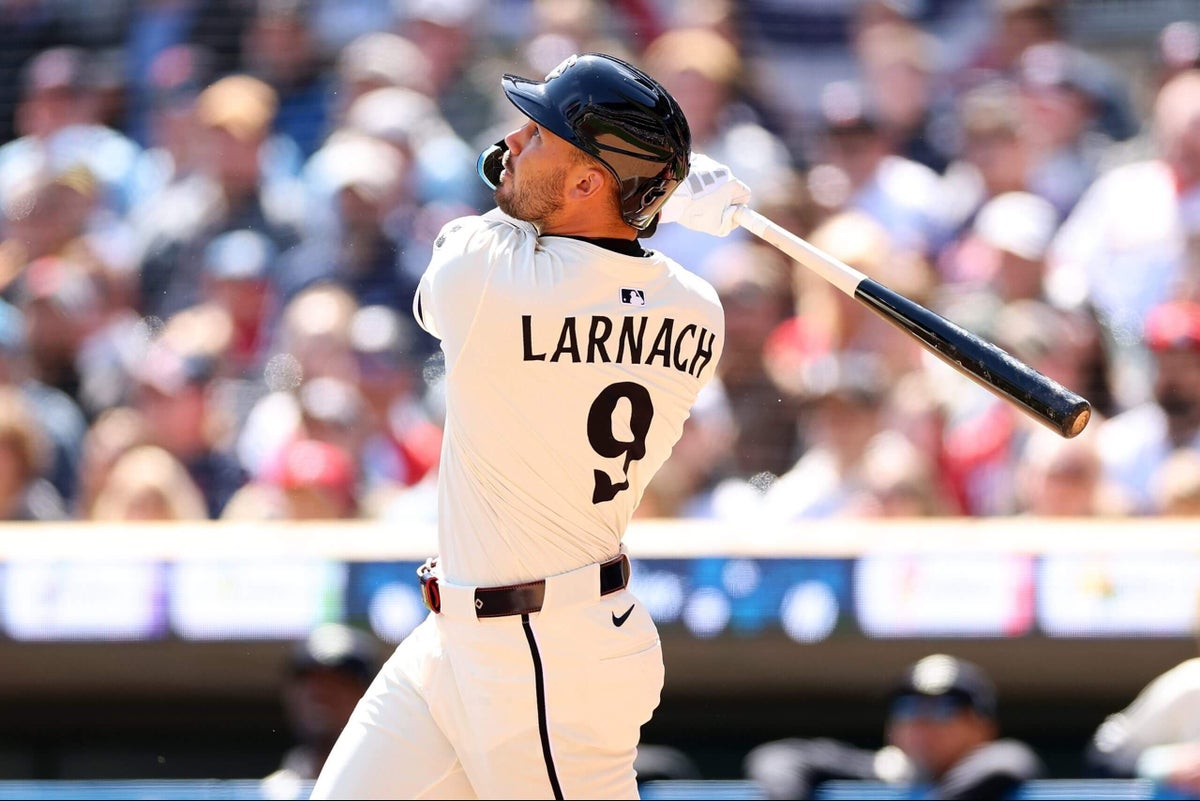
Larnach’s development has seemingly stalled at age 28. Once viewed as a potential middle-of-the-order slugger, he has hit .241/.323/.403 in five seasons and 442 games with the Twins, producing a 101 OPS+ that’s below average for a corner outfielder with limited defensive value.
He’s coming off his healthiest season, leading the Twins in games (142) and plate appearances (567), but Larnach hit just .250/.323/.404 with 17 homers and a 99 OPS+ while seeing most of his action at designated hitter. Players such as Larnach need to hit, and he simply hasn’t done so consistently.
Larnach is best suited to fill a platoon role as a left-handed batter shielded from most left-handed pitchers, against whom he’s hit just .216 with a .585 OPS for his career. But the problem is that he has also hit .247 with a .759 OPS against righties, which is nothing special from a bat-first platoon player.
Self-imposed spending restraints and a stockpile of younger, cheaper left-handed-hitting corner outfielders in the majors (Matt Wallner, Alan Roden) and minors (Walker Jenkins, Emmanuel Rodriguez, Hendry Mendez) might convince the Twins to move on from Larnach via trade or non-tender.
Trevor Larnach’s two-run shot is the first homer allowed by Paul Skenes since June 3, seven starts and 35+ innings ago.pic.twitter.com/a1f5dBLoaO
— Aaron Gleeman (@AaronGleeman) July 12, 2025
It’s a different situation with Topa because his projected $1.7 million salary is barely more than the $780,000 league minimum, and the Twins are in dire need of bullpen help after trading their top five relievers in the deadline fire sale. Topa sits no lower than No. 3 on their bullpen depth chart.
Topa is 34 and has a lengthy injury history that includes missing nearly all of 2024 and ending 2025 on the shelf. But he logged 60 innings for the Twins last season with a solid 3.90 ERA, making up for a poor strikeout rate by inducing lots of grounders and allowing just three homers.
Topa is ill-suited for a high-leverage role, but he’s a competent major-league reliever with a low price tag. If the Twins were to non-tender him, it would stem from their lack of faith in his durability, because freeing up an extra $1 million wouldn’t buy much on the free-agent reliever market anyway.
Payroll starting points
As the offseason begins, FanGraphs projects the Twins’ current payroll at $96 million, which ranks 23rd out of 30 teams.
Trading or non-tendering Larnach would slice roughly $4 million from that figure and drop them to 25th.
Nearly a quarter of the Twins’ current payroll is Pablo López and his $21.5 million salary. As trade rumors continue to swirl around López, it’s worth noting that without him on the books, the payroll would drop to 27th, ahead of only the Chicago White Sox, Pittsburgh Pirates and Miami Marlins.
Just three seasons ago, the Twins had a $160 million payroll that ranked in the middle of the MLB pack. From there, the payroll dropped into the $135 million range for 2024 and 2025. And seemingly everything suggests Twins fans should brace themselves for another drop in 2026.
During the Twins’ final five seasons playing at the Metrodome, from 2005 to 2009, their combined payroll was 77 percent of the MLB average. And they returned to that level of spending in 2024 and 2025, with a combined payroll that was 77 percent of the MLB average.
And now even that Metrodome-era spending relative to the other 29 teams is wishful thinking. It’s safe to assume MLB’s average payroll for 2026 will be at least $180 million, 77 percent of which is $139 million. Without adding $43 million in payroll, the Twins will fall below Metrodome-era spending.
Here’s a more realistic over/under for the 2026 payroll: $113 million.
That was the Twins’ payroll in 2011, their second season playing at Target Field. Now it’s 15 years later, during which time the average MLB payroll has nearly doubled, and the Twins would need to avoid trading more core veterans and add $20 million in salaries just to match the 2011 figure.
Rule 5 adds fill 40-man roster
There were no surprises among the six prospects the Twins added to the 40-man roster Tuesday to protect them from the Rule 5 draft.
Last week, I ranked the top Twins prospects eligible for the Rule 5 draft, and they added the first five names on my list — Connor Prielipp, Kendry Rojas, Gabriel Gonzalez, Andrew Morris and Hendry Mendez — plus eighth-rated John Klein, whose stock jumped during a breakthrough 2025 season.
Everyone except Mendez finished this past season at Triple-A St. Paul, and Mendez looks ready to join the Saints’ lineup after arriving in the Harrison Bader trade and hitting .324/.461/.450 at Double-A Wichita. It’s reasonable to expect all six players to see big-league time for the Twins in 2026.
Double-A corner outfielder Kala’i Rosario and Double-A right-hander C.J. Culpepper are the most prominent Twins prospects left unprotected. And though 26-year-old outfielder Kyler Fedko lacks their long-term upside, it’s not hard to envision another team poaching him as a backup outfielder.
Mr. 20-20 in @WindSurgeICT cracks his first home run at Triple-A. Kyler Fedko crushes this solo homer to left. He now has 21 homers and 30 SB combined between Double-A & Triple-A. pic.twitter.com/3TplIev44L
— St. Paul Saints (@StPaulSaints) August 9, 2025
After adding six prospects and trading for Tampa Bay Rays reliever Eric Orze, the Twins have a full 40-man roster. That means any acquisition this offseason — including a possible Rule 5 pick of their own next month at the Winter Meetings — would require dropping someone to make room.
At this stage of past offseasons, the Twins have typically left multiple spots open. However, there are still a handful of players on the 40-man roster who could be dropped without much pain whenever necessary. It was somewhat surprising their initial round of roster housecleaning didn’t have more cuts.