
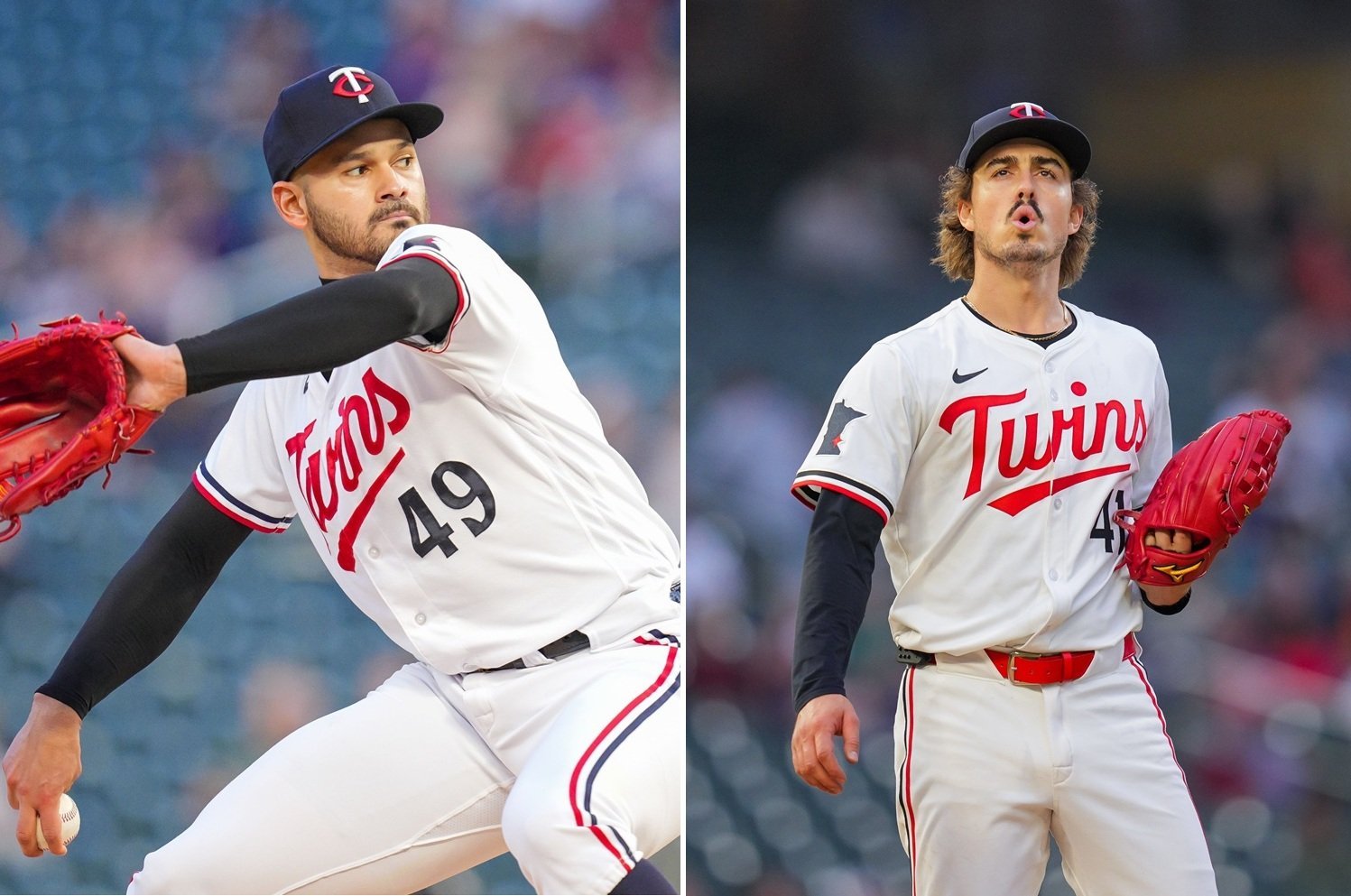
The offseason has barely begun, but the Minnesota Twins already find themselves at the center of some of the most complicated pitching rumors in baseball. With the team coming off another frustrating finish and the front office operating under unclear ownership direction, insiders have turned their attention toward the future of Minnesota’s top starters. Joe Ryan and Pablo Lopez remain foundational pieces, but the possibility of a major rotation shakeup is gaining traction.
What makes this situation particularly unique is the number of external factors influencing the Twins’ decision-making. Injuries, contract considerations, labor uncertainty, and an ownership transition have collided, and Derek Falvey was standing at the intersection where they did so. The result is an offseason outlook that feels more unpredictable than any Minnesota has faced in recent memory. As national reporters continue to weigh in, the picture around the Twins’ rotation becomes more complex.
Pablo López Appears More Likely To Be Moved
Joel Sherman of the New York Post reported that the Twins are “more likely” to trade Pablo López than Joe Ryan as the club explores ways to reshape its roster. López is owed over $43 million through 2027, and his recent performance complicates the picture. A forearm issue limited him to just 14 starts in 2025, and he threw 75 2/3 innings with a strong 3.19 FIP but a middling 17 K-BB%.
He had been one of baseball’s more reliable arms during his early Twins tenure, but his performance has seen peaks and valleys. At age 30, López still carries name value, but his trade stock is at its lowest point with the Twins, forcing the club to deal from a position of weakness.
Passan Says One Co-Ace Could Go, But Not Both
National attention intensified with ESPN’s Jeff Passan writing that “the Twins will deal one of their co-aces but not both.” He noted that both pitchers’ circumstances will be influenced by the possibility of a lockout, because their team control runs through the 2027 campaign. That uncertainty is muddying the market, as teams attempt to calculate risk before giving up premium prospects.
If front offices are afraid to commit significant resources before labor clarity arrives, the Twins may be forced to accept an offer that falls short of internal expectations. It places the front office in a difficult position as they attempt to balance long-term value with short-term roster needs.
Rosenthal Highlights Falvey’s Balancing Act
The Athletic’s Ken Rosenthal painted a picture of a front office trying to stay upright in heavy winds. Derek Falvey emphasized that he remains committed to improving a roster that has fallen short in back-to-back seasons. The message from the GM Meetings was clear.
“I remain personally committed to figuring out what are the ways we can add to this group to make it better,” Falvey said in Las Vegas. “That is my goal. It was my stated goal before and remains my stated goal until I’m told otherwise. … My focus for now is figuring out ways we can add to the group.”
Falvey wants to add talent and believes the core can still be supplemented in meaningful ways. The urgent question is whether ownership shares that sentiment. At the trade deadline, Falvey was instructed to dismantle rather than reinforce, and that disconnect remains a central storyline. With two new groups of investors awaiting league approval, the chain of command could shift. Until that happens, both Ryan and López remain possible trade candidates as the front office waits for clearer marching orders.
A Fan Base Left In Limbo
For Twins fans, the throughline in all these reports is uncertainty. López might be the more likely trade chip, but his value is depressed. Other clubs covet Ryan, but dealing him would create a massive hole in the rotation. National reporters suggest that only one will be moved, but a potential lockout clouds the market. Above it all stands an ownership group that has not yet finalized its internal transition.
Falvey has acknowledged that the Twins may not have a firm direction until minority ownership approval is completed. That delay could stall major trade talks and limit the team’s ability to pursue meaningful free agents. Minnesota’s offseason will ultimately hinge on clarity from the top. Until that arrives, the front office, the players, and the fan base remain stuck in a holding pattern.
The Twins are navigating an offseason marked by more uncertainty than resolve. Trade conversations involving Ryan and López remain fluid, and the market is affected by conditions beyond baseball operations’ control. If ownership does not provide direction soon, the window for transformational additions could close quickly. Minnesota still has a chance to strengthen its roster, but the path forward will depend on decisive leadership and a clear organizational vision.
Should the Twins trade one of their top starters or hold firm until the ownership situation settles? How much should the looming lockout impact trade decisions? Share your thoughts and join the discussion below.