
The final chapter in our data-forward look at the 2026 MLB Draft college class turns back toward the mound. After highlighting top-end hitters, profiling a group of sleeper bats and taking a look at hitters ranked in the BA Top 100, we’ll wrap things up by examining 10 unranked college pitchers whose TrackMan samples revealed underlying traits that merit closer attention ahead of the spring.
Each pitcher in this group showed at least one defining data marker, such as release traits, fastball shape, spin quality or swing-and-miss indicators that pushed evaluation beyond surface performance.
By isolating TrackMan environments, we focused solely on the measurable traits most predictive of future gains and identified arms whose underlying profiles suggest clearer upside than their current draft status reflects.
Tyler Albanese, RHP, San Jose State
Albanese broke out in 2025 as one of the more interesting late-inning arms on the West Coast, and he carried his momentum into a strong showing in the Cape Cod League. The 6-foot-6, 237-pound righty delivered a 2.97 ERA with 56 strikeouts and 19 walks over 39.1 innings for San Jose State while collecting eight saves. He then posted a 2.45 ERA with 20 strikeouts and seven walks in 22 Cape innings, reinforcing the quality of his stuff in a wood bat environment.
Albanese’s release traits set the foundation. He was one of just 33 Division I pitchers with at least 100 pitches in front of TrackMan to create more than seven feet of extension. He also worked with a relatively flat -5.0 degree attack angle. Those traits paired well with a low-to-mid-90s fastball that carried through the top of the zone and spun at an average of 2,413 rpm in TrackMan games. The pitch generated a 29% miss rate and 34% chase rate, marks placing it well-above-average for a college fastball.
Albanese’s curveball was a legitimate swing-and-miss weapon. It showed two-plane action with roughly 10.5 inches of vertical drop and more than 16 inches of horizontal movement. He also manipulated the pitch by taking velocity off in the low 70s to create more vertical action. He supplemented it with a tighter slider that performed well as another breaking look.
The combination of extension, fastball shape and high-quality breaking balls gives Albanese clear draft appeal. With a large frame, strong movement traits and the ability to generate chase across multiple pitches, he enters 2026 as an arm with a chance to climb if he continues to sharpen his command and hold his shapes over a larger role.
Thomas Burns, RHP, Texas
Burns made a strong first impression in the SEC after transferring from Arizona State, finishing the year with a 3.71 ERA and 40 strikeouts to 16 walks over 26.2 innings. The line would have tightened even further if not for a single rough outing against Arkansas in early May in which he allowed five of his 11 earned runs in 1.1 innings. Over the rest of the season, he worked with one of the most explosive fastballs in the conference.
The 6-foot-3, 240-pound righty shows premium velocity. His fastball averaged 95.1 mph in TrackMan settings, touched 100 and paired speed with 21.2 inches of induced vertical break. The pitch produced a 34% whiff rate and carried a -5.41 degree vertical approach angle, which is solid given his 6-foot-7 release height.
Burns’ heater performed at an elite level when it cleared two key thresholds, as, at 95 mph or above with at least 20 inches of carry, it generated a 67% strike rate and a 57% whiff rate. Hitters recorded only one hit against the pitch when it met those conditions, which placed Burns in rare company.
He supported the fastball with a tight, mid-80s slider and a low-80s changeup. The changeup showed fade and late tumble with roughly a degree and a half of separation off the fastball, giving him a workable speed and movement contrast. Both secondaries flashed enough to suggest progression as he continued to gain feel.
Burns’ profile was built around the fastball, and the data pointed to a pitch that could anchor a high-leverage role at the next level. If he maintains the high-end characteristics that drove the miss rate and continues to sharpen his slider and changeup, he has a chance to establish himself as one of the country’s more formidable relief arms with early-round potential.
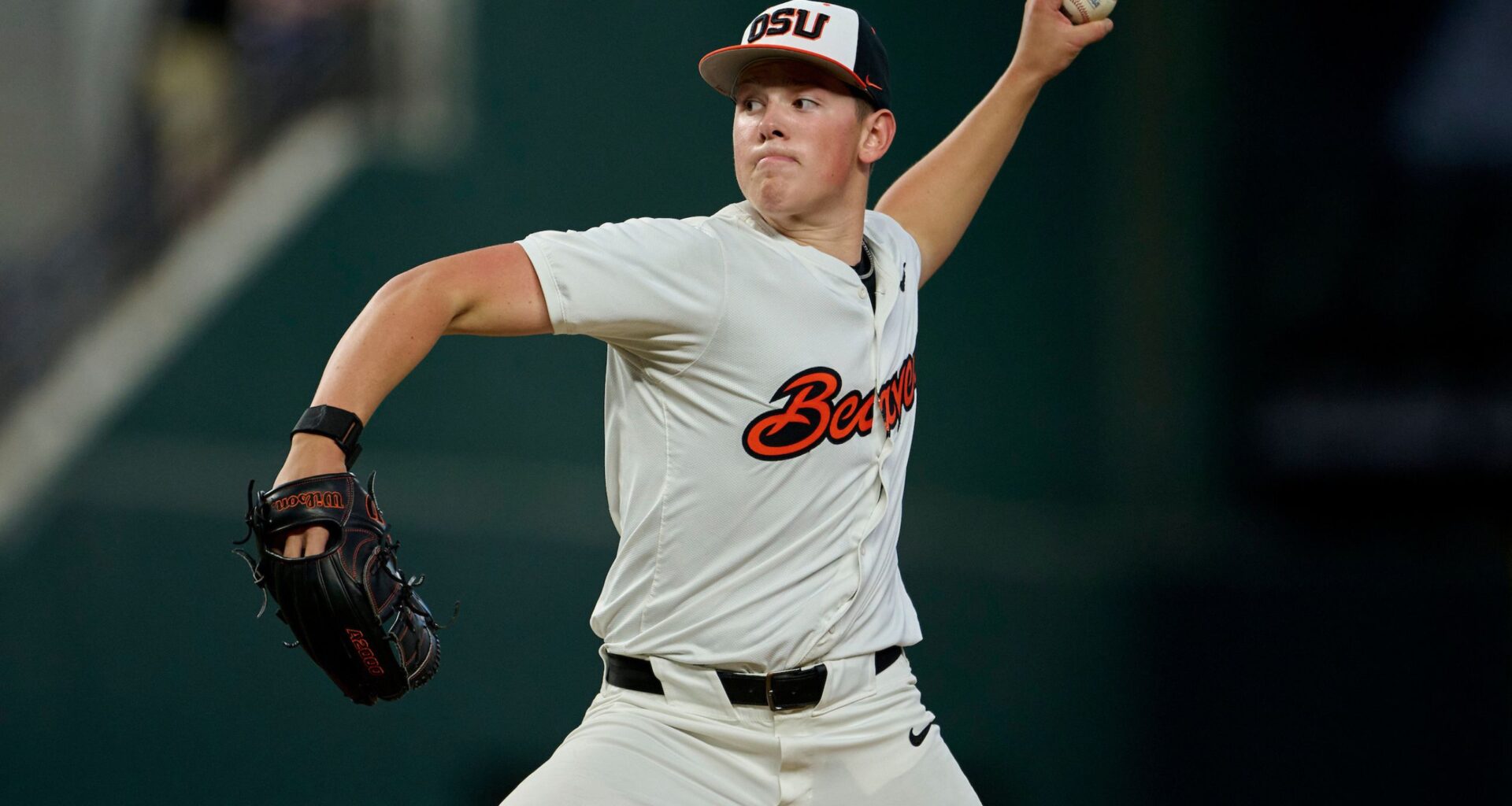
Ethan Kleinschmit, LHP, Oregon State
Kleinschmit emerged in 2025 as one of the premier No. 2 starters in the country and gave Oregon State a frontline pairing behind 2027 draft class star Dax Whitney. He logged a 3.56 ERA with 113 strikeouts and 36 walks over 91 innings and carries a 6-foot-3 frame that still offers room for physical growth. Performance and underlying measurements placed him on the cusp of the Top 100 entering his draft season with a profile built more on polish, feel and shape quality than raw velocity.
His fastball sat at 90.4 mph in TrackMan games and reached 94, yet the pitch played with far more utility due to its movement characteristics. He averaged 19.3 inches of induced vertical break with steady armside run—a combination that helped him work above barrels despite average velocity. The attack angle trended flatter than average, and his extension was solid, which allowed him to create advantageous entry points at the top of the zone.
Kleinschmit’s offspeed mix separated him. His sweeper averaged 18.5 inches of horizontal break with a 34% miss rate and 30.2% chase rate in TrackMan environments. The pitch had late action and paired cleanly with the fastball.
His changeup appeared markedly less often than his fastball and sweeper but showed above-average fade, consistent tumble and nearly 2.5 degrees of separation relative to the heater. The shape and action gave him a legitimate third offering with real carryover against righthanded hitters.
Kleinschmit repeated his delivery, was generally around the zone and held his mix over longer outings. The combination of strike-throwing, shape traits and an offspeed foundation that consistently produced chase gave him clear Top 100 potential. If the fastball continues to firm as he adds strength to his frame, he projects as one of the more complete lefthanded starters in the class.
Brett Lanman, LHP, Abilene Christian
Lanman enters 2026 with a chance to follow the path set by former Abilene Christian righty Dominick Reid, who this past July became the program’s highest draft pick since 2000 after a breakout junior year.
At 6-foot-5 and 235 pounds, Lanman showed that level of promise as a freshman when he delivered a 3.48 ERA with 79 strikeouts and 32 walks in 72.1 innings. His sophomore season, however, brought significant regression. He finished 2025 with a 6.25 ERA and 84 strikeouts to 34 walks in 72 innings before finding a partial reset on the Cape, where he managed a 3.60 ERA with 11 strikeouts and four walks in 10 innings.
The underlying data from 2025 still pointed to meaningful upside. His low-to-mid-90s fastball carried through the top of the zone with 19.4 inches of induced vertical break in TrackMan settings, and he paired that movement with elite extension (about seven feet) and a -5.19 degree vertical approach angle. Those traits created a difficult entry point for hitters. The fastball produced a 23.6% whiff rate and a 23.2% chase rate, and it held its shape even when his command wavered, which kept him competitive despite the surface line.
Lanman supported the heater with a low-80s slider that showed two-plane tilt, a high-70s curveball with deeper vertical action and a seldom-used changeup that flashed late tumble. All three pitches had the raw shape to grow into reliable offerings.
The runway for advancement is clear. If Lanman translates his improved summer performance into more consistent strike-throwing and leverages his fastball traits more efficiently, he has the ingredients to push back toward early-round territory. The combination of size, extension and fastball metrics make him a pitcher to follow closely this spring.
Luke McNeillie, RHP, Florida
McNeillie enters 2026 as one of the more volatile yet intriguing arms in the class. He has a realistic chance to secure the Sunday role in a Florida rotation fronted by No. 1 overall 2026 pitching prospect Liam Peterson and 2027 top prospect Aidan King—a scenario that would give him the innings volume evaluators have wanted to see.
His first two seasons showed meaningful progress. He lowered his ERA from 7.07 as a freshman to 4.82 in 2025 and struck out 72 with 24 walks over 52.1 innings, almost all of them in relief. His command backed up in a short Cape Cod League sample with eight walks in 12.2 innings, which kept the control question firmly in place heading into the spring.
When his delivery synced, McNeillie’s pure stuff was difficult to square. His fastball sat at 94 mph and touched 98 in TrackMan environments with nearly 20 inches of induced vertical break and a -4.71 attack angle that played above average for his release slot. The pitch averaged 2,400 rpm and produced miss and chase rates around 25% in those settings. He paired it with a mid-to-high-80s slider that showed two-plane action, including roughly four inches of vertical bite and spin north of 2,600 rpm. His changeup carried real armside life, averaging about 15 inches of horizontal movement with roughly two degrees of separation from his heater.
The central variable was strike-throwing. McNeillie’s 10.4% walk rate in 2025 reflected the inconsistency that has defined his early career and could ultimately push him back into a bullpen role at Florida. That outcome would limit his ability to rise into the earlier rounds. If he holds a rotation job and shows stable fastball command for longer stretches, his raw stuff is strong enough to change the conversation entirely, especially with a projectable frame.
Ethan Norby, LHP, East Carolina
Norby established himself as one of the most advanced spin artists in college baseball. Few lefthanders showed a more distinct or reliable feel for manipulating the baseball, and his entire arsenal rested on that strength. Although undersized at 5-foot-9 and 200 pounds, he’s consistently produced, carrying a career 3.80 ERA with 182 strikeouts and 47 walks over 149.1 innings through two seasons at East Carolina.
Norby’s fastball sat in the low to mid 90s, and he paired that velocity with an unusual shape profile. The pitch averaged 13.5 inches of armside run, carried an average spin rate above 2,500 rpm in TrackMan games and benefited from nearly 6.5 feet of extension. His 5-foot-1 release height helped him create a remarkably flat -4.19 degree attack angle, which contributed to a 26.4% whiff rate and a 27.4% chase rate. When he located the pitch particularly well, he reached close to 20 inches of run—a premium figure for a college lefty.
His sweeper functioned as his trademark offspeed pitch. Over a 290-pitch TrackMan sample, it averaged 15.5 inches of horizontal break and spun above 3,000 rpm while producing a 48% whiff rate and 34% chase rate. His mid-80s changeup added another look with strong fade and almost 2.5 degrees of separation from the fastball which allowed him to neutralize right handed hitters without abandoning his strengths.
Norby’s feel for spin and his ability to command and manipulate multiple pitches makes him one of the more consistent lefthanders on the board. Entering his third year as a starter at East Carolina, he is well positioned to maintain that trajectory and has a clear path into the early rounds if the performance holds as expected.
Jack Radel, RHP, Notre Dame
Radel made steady gains over his first two seasons at Notre Dame, trimming his ERA from 4.58 to 3.58 while improving his strikeout rate from 16.7% to 20.8% and cutting his walk rate from 8.1% to 6.2%. He carried a heavier rotation workload in 2025 with 70.1 innings and showed enough refinement to put himself firmly on the draft radar.
The appeal lies in the underlying traits. A 6-foot-5, 210-pound righty with long levers, Radel delivered more than seven feet of extension—a premium marker that pushed his fastball on hitters earlier than the velocity alone would suggest. The pitch sat in the mid to high 90s in TrackMan environments, and he paired that speed with quality shape, including an 18.2 inch induced vertical break average and a -4.96 degree vertical approach angle. Those characteristics gave the pitch the foundational attributes commonly seen in early round arms, even if the raw bat-missing numbers have not yet reached that tier.
Radel complemented the fastball with a sweepy slider that flashes lateral finish and a changeup with fade and tumble. The changeup showed roughly two degrees of separation from his fastball, giving him a legitimate third look and a pathway to more consistency against lefthanded hitters.
Even without the swing-and-miss totals that define many peers in the early rounds, Radel’s data profile fits comfortably within the top 200 and could climb higher if he continues to improve. The fastball metrics, extension and secondary traits give him more ceiling than his already-solid surface numbers might indicate.
Bo Rhudy, RHP, Tennessee
There is usually at least one pitcher each year whose draft case is built around a single elite offering, and Rhudy looks like an early candidate for that label. The 6-foot-4, 225-pound righty transferred from Kennesaw State to Tennessee after a strong sophomore year in which he logged a 3.16 ERA with 44 strikeouts and only five walks across 37 innings. He carried that momentum to the Cape Cod League, where he posted a 2.45 ERA with 12 strikeouts and two walks in 11 innings while saving five games in nine appearances.
Rhudy’s fastball is wicked. In TrackMan settings, it averaged 90 mph with a peak of 93.3 yet played far beyond the velocity because of an unusual set of traits. The pitch generated 18.4 inches of induced vertical break with an average spin rate of 2,722 rpm and came from a low 5-foot-4 release height with a -4.27 degree vertical approach angle. That combination made his heater extremely difficult to pick up, and hitters chased it 38% of the time, which is well above average. The pitch functioned as a true outlier, one that created late carry and unexpected life at the top of the zone, considering its velocity range.
Across the 2025 college season and his Cape workload, Rhudy went to his fastball 88% of the time, a staggering usage rate that reflected how dominant the pitch was in both environments. He also showed a high-70s slider with enough bite to miss bats when he executed it, although the feel and consistency lagged behind the fastball.
Rhudy’s elite spin characteristics open the door for significant development. With his ability to impart that level of spin, it is easy to envision a professional staff broadening his offspeed mix and helping him build shapes that complement the fastball.
If the velocity climbs and the secondary offerings take hold, he has a chance to move quickly. Rhudy is a name to track very closely heading into the spring. The raw material on his fastball alone places him firmly on the radar.
Cal Scolari, RHP, Oregon
Scolari entered the 2026 cycle with unfinished business. He ranked No. 247 on the final BA 500 in 2025 yet went undrafted despite showing promise at San Diego as he logged a 4.22 ERA with 77 strikeouts and 39 walks across 70.1 innings. He honored his transfer commitment to Oregon, where he is expected to compete for the Friday role in what should be his final college season.
The appeal lies in how Scolari’s raw traits have come back online after a lengthy recovery from Tommy John surgery. A 6-foot-4 righthander, he sat 91-93 mph and reached 96 in 2025. The fastball showed life at the top of the zone with an 18-inch induced vertical break average, nearly 2,400 rpm spin, 6.35 feet of extension and a relatively flat -5 degree attack angle. The combination allowed the pitch to play above its velocity band when he located it.
Both secondaries carried viability against righties and lefties. His low-80s slider showed two-plane tilt with 7.2 inches of horizontal break, and his firmer changeup offered fade and tumble with roughly a degree and a half of separation from the fastball. There is room for the changeup separation to grow, but the underlying movement cues give him a workable third pitch.
Oregon coach Mark Wasikowski expressed real optimism this fall, telling Baseball America that Scolari has continued to show improvement in both velocity and pitch shape definition. If the command tightens and the fastball regains more consistent shape after a full healthy offseason, Scolari has a legitimate chance to pitch his way into the early rounds.
Cole Tryba, LHP, UC Santa Barbara
Tryba enters 2026 as one of the more reliable profiles on the West Coast after two highly effective seasons at UC Santa Barbara and a dominant summer on the Cape. He posted a 3.64 ERA with 65 strikeouts and 14 walks across 47 innings in 2024, then returned from a brief injury absence in 2025 to deliver a 3.48 ERA with 46 strikeouts and 12 walks in 31 innings. His Cape League summer with Orleans reaffirmed the quality of his arsenal. He logged a 1.07 ERA with 28 strikeouts and seven walks in 25.1 innings and looked like one of the most polished bullpen arms in the league.
Tryba’s operation carried more violence than his size suggested. His fastball averaged a five-foot release height with just over six feet of extension—a combination that created a challenging approach angle even without premium velocity. The pitch sat in the low 90s and showed heavy armside life, averaging 17 inches of run in TrackMan settings. It held its plane well enough to draw consistent early-count swings and positioned hitters to protect against two secondaries that both project as comfortably above average.
His upper-70s-to-low-80s sweeper was his separator. It averaged roughly 15 inches of horizontal break. The changeup showed similar promise with nearly 18 inches of fade in TrackMan environments, an outrageous metric for a college lefty and one that helped it play as a legitimate weapon against righties.
Tryba’s combination of a deceptive release, two miss-generating secondaries and a consistent strike-throwing track record gave him the look of a lefty who could move quickly in pro ball. He profiles as one of the more complete arms in the class with a chance to climb if the fastball ticks up or holds velocity more consistently over longer outings. He’s expected to try his hand at starting in the spring.