
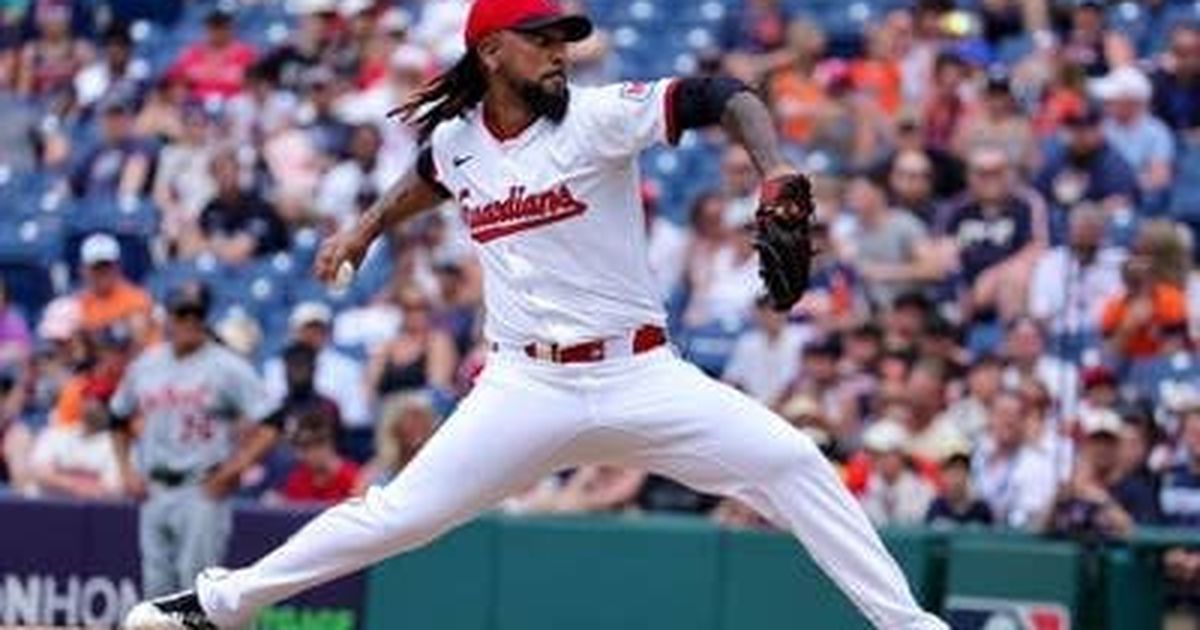
For five seasons, the Cleveland Guardians summoned Emmanuel Clase and his 100-mph cutter to handle the ninth inning of any game in doubt. A camera operator would trail behind him as he strolled down the steps to the bullpen door in center field, then display his dramatic entrance on the scoreboard, which lit up with digital flames.
Clase would reach the mound, turn his back to home plate, place his glove to his face and recite a prayer to express his gratitude for the opportunity. Stitched onto that glove, in gold script, was “La Kabra,” or “The Goat.” If anything, he had confidence.
When he recorded an out, he circled the mound like a lion stalking its dinner. He was the final boss. He had closer aura. One glance at Clase and you could surmise that he threw hard and wanted to extinguish hitters’ souls.
He usually did.
Clase, who pitched for the Spokane Indians in 2018, led the American League in saves for three consecutive seasons. He registered a career ERA of 1.88. He made three All-Star teams and received the ninth-inning assignment in the two he attended. In 2024, he achieved the best Cy Young Award finish for a reliever in 16 years. He twice won the Mariano Rivera Award as the AL’s top reliever.
But beyond the hardware and gaudy numbers, members of the organization felt they barely knew the second-longest-tenured Guardian. He was too lax about timeliness, too difficult to reach during the offseason and too disconnected to get to know on a deep level.
On the mound, he was a menace. Off the field, he was an enigma.
On Nov. 13, Clase was arrested by the FBI upon landing at JFK Airport after traveling from the Dominican Republic. A few hours later, he entered a plea of not guilty in a Brooklyn, N.Y., courtroom on charges of wire fraud and several counts of conspiracy for allegedly rigging pitches to profit bettors, a controversy that also ensnared his teammate, Luis Ortiz, and sent shockwaves through Major League Baseball.
Clase was crafting a Hall of Fame resume while allegedly spiking purposeful 57-foot sliders.
He was breezing through ninth innings while supposedly staking himself to an early disadvantage.
He was earning millions while allegedly risking it all to procure thousands.
There’s a lot we don’t know about why or how Clase ended up being involved in all of this. There are things we may never know.
But over six major-league seasons, we have gained some insights about Clase, the all-world closer at the center of a maelstrom of controversy.
Clase grew up in the countryside in Río San Juan, on a farm full of cows, chickens and horses on the north coast of the Dominican Republic. He threw rocks, climbed trees and ran along the beach. He swam in the scenic Laguna Gri-Gri, home to a bird sanctuary and boat tours.
And he pitched.
“The guy was born to throw a baseball,” his former bullpen coach, Brian Sweeney, once told The Athletic.
As a teenager, Clase showed up to local baseball games without an invitation. He stood near a field, a tall, wiry kid waiting for someone to call upon him to fill an empty spot.
He usually wound up pitching a game in the morning and another in the afternoon. His arm never tired. He chucked heater after heater. By the age of 13, he could touch 82 mph, each fastball zipping away from his arm side because of the way he gripped the ball with his long, flexible fingers that he could bend to nearly touch the back of his hand.
Clase signed with the San Diego Padres at 16 years old for $125,000. He was never a top prospect, but each year, his velocity jumped.
When he shifted to a relief role in A-ball in 2018 – when he played in Spokane – after a trade to the Texas Rangers, Clase started to study Mariano Rivera, and not just because Rivera also almost exclusively relied on a devastating cutter. Clase was enamored with how Rivera projected calmness in the tensest of moments. Rivera was at his best in October, pitching in pinstripes to win a championship for a Yankees club that never accepted anything less. Clase yearned for that pressure, that moment.
“That,” he told The Athletic last year, “is everything I dream of.”
A few days after the Winter Meetings in December 2019, Cleveland flipped longtime staff ace Corey Kluber to the Rangers for outfielder Delino DeShields Jr. — a stopgap outfield solution — and Clase, a relatively unknown reliever with a mesmerizing right arm.
During his first spring training with Cleveland, questions surfaced about his maturity and effort. He sometimes arrived late to the facility or to meetings, more nonchalant than malicious, but frustrating nonetheless. He quickly landed on the shelf with an upper back strain. And before he ever threw a big-league pitch for the Guardians, Clase was suspended for the entire 60-game 2020 season for failing a PED test.
That summer, the team barely communicated with him, citing Clase’s spotty cell phone service in rural Río San Juan. That remained an issue over the years: During the offseason, the club would set up a weekly call between Clase and pitching and strength coaches. His attendance was inconsistent.
They just hoped he showed up to spring training ready to fire more of what Terry Francona lauded during Clase’s first camp as “100 mph bowling balls.”
Clase’s stuff was undeniable, tantalizing enough to make a team tolerate some headaches. The delivery looked effortless. The pop sounded different. Teammates were spellbound by the thwack of that cutter nestling into a catcher’s mitt.
When Clase arrived for spring training in 2021, those around him saw someone who looked ready to embrace responsibility. Guidance from veteran reliever Oliver Pérez helped pave the way. That summer, Clase seized the closer role. He never relinquished it.
Before Opening Day 2022, Clase signed a team-friendly extension with the Guardians that guaranteed him $20 million over five years, with the opportunity for another $18 million via two club options. In the ensuing three seasons, he pitched in 13 more games than anyone else and racked up 30 more saves than anyone else.
Midway through that run, according to a 23-page federal indictment, he began to intentionally bury first-pitch sliders in the dirt.
Minutes after the Guardians’ theatrical Game 3 win against the New York Yankees in the 2024 American League Championship Series, Clase power-walked through the service level of Progressive Field, hustled up a flight of concrete steps and exited a door to the players’ parking lot. The pitcher who was nearly perfect during the regular season had imploded against Aaron Judge and Giancarlo Stanton.
As his teammates showered, changed into street clothes and watched and re-watched the highlights of Jhonkensy Noel’s last-gasp blast to the bleachers and David Fry’s walk-off homer in Cleveland’s 7-5 10th inning win, Clase retreated home to post a video to Instagram documenting the hardware he had collected over the years. All-Star Game rings. Reliever of the Month and All-MLB Team plaques. The trophy the Guardians awarded him when he recorded his franchise-record 150th save.
A pitcher who rarely had to reckon with being mortal on the mound was grappling with it on the grand stage, and doing so on his own.
Clase typically kept to himself, aside from the times José Ramírez would occasionally provoke his teammate by sizing him up and light-heartedly challenging him to a fight. Clase, who stands six inches taller, would laugh off his teammate’s antics.
Many afternoons, Clase would sit alone at his locker, glued to a no-headphones FaceTime call with people back home in the D.R., and with chickens squawking in the background.
If teammates didn’t know Clase intimately, they knew his credentials. Catcher Austin Hedges and manager Stephen Vogt regularly referred to Clase as the best pitcher on the planet, especially in 2024.
There’s no mention in the indictment of Clase’s 2024 campaign, in which he logged a 0.61 ERA, the second-lowest mark in league history for a pitcher with at least 70 innings in a season. Instead, there’s evidence of nine first pitches, split between the 2023 and 2025 seasons, in which prosecutors allege Clase collaborated with bettors to pre-determine what he would throw.
In June 2025, the scheme allegedly grew to involve Ortiz, who Cleveland acquired in a trade in late 2024. He and the reserved Clase became fast friends in spring training, with adjacent lockers and daily chats about their chickens and horses in the D.R.
Ortiz is said to have participated in the pitch-rigging ploy twice before the league launched an investigation into the operation: one pitch on June 15 and another on June 27. Both times, he yanked a slider low and away, which allegedly won his bettors at least $60,000 in wagers. According to court documents, Ortiz made $12,000 for throwing the pitches; Clase made $12,000 for serving as liaison. The closer received nearly 30 times that sum in bonuses in 2024 for making the All-Star team, winning the Mariano Rivera award and finishing third in the Cy Young Award balloting.
Instant revenue streams weren’t new to Clase, though. In addition to the below-market deal he signed in 2022, he also partnered with a company, Finlete, in 2024, in which investors could pay for a cut of his future earnings.
Those future earnings are now in jeopardy. As The Athletic reported last week, MLB would prefer to discipline Clase and Ortiz by spring training so the Guardians know whether they are on the hook for Clase’s $6.4 million salary in 2026.
That’s one of many questions those in the organization have about Clase. It’s one of the few about which they might get an answer.