
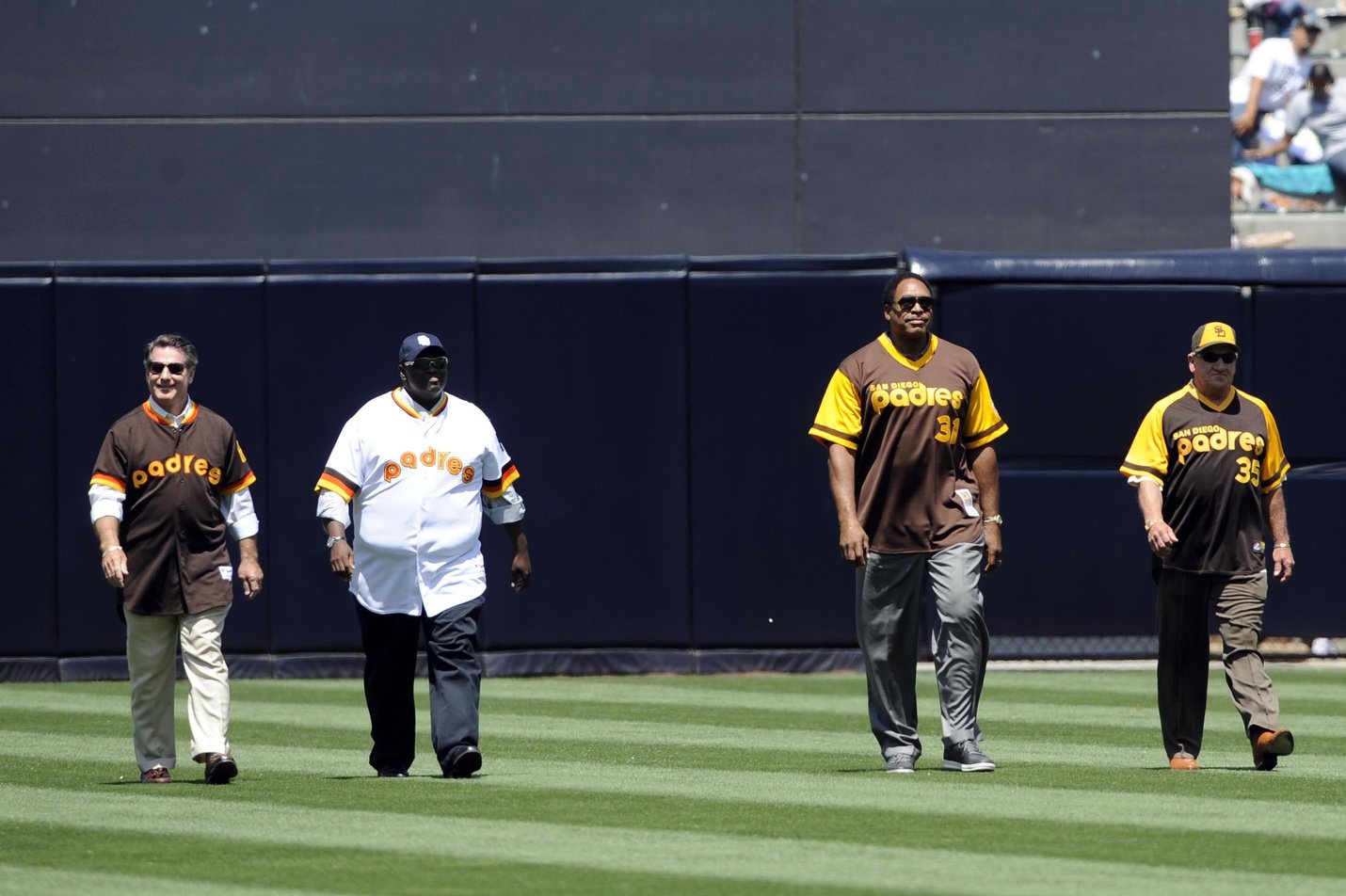
Randy Jones’ Early Career
Jones was drafted in the fifth round of the 1972 MLB Draft out of Chapman University. He was a standout in college, earning the Panthers’ most valuable pitcher award in both 1970 and 1972. Jones led the Panthers to the NCAA Far West Regionals and, in doing so, broke the school strikeout record with 155. The southpaw never overpowered opposing batters, instead being a control artist. Jones suffered an arm injury in high school that severely diminished his velocity. This eventually earned him the nickname “The Junkman”. Jones’ repertoire showed this as well, throwing a sinker, slider, a slow curve, and a rising fastball.
With deep sorrow and heavy hearts, the Padres mourn the passing of our beloved left-hander, Randy Jones. Randy was a cornerstone of our franchise. The CY Young Award winner, Padres Hall of Famer, and tremendous community ambassador, was a giant in our lives and will be greatly… pic.twitter.com/AwXWb92aCD
— San Diego Padres (@Padres) November 19, 2025
After Jones was drafted, he got off to a fast start in the minors. In two partial minor league seasons, he posted a 2.38 ERA in 23 career games. It wouldn’t be long till Jones got the call to the majors, and he never looked back. He made his major league debut in 1973, pitching in relief against the New York Mets. While his debut didn’t go well, giving up two runs, Jones would take off from there. He would start the rest of his games in ’73 and pitch to the tune of 3.16 ERA. Jones showed in his rookie year what tools he brought to the table. He sported a 13.2% K rate and a 6.3% walk rate.
For any younger readers, Randy Jones was a more extreme version of Kyle Hendricks. Unfortunately, 1974 didn’t go as well for Jones, at least on the surface. He tied for the league lead in losses in ’74 with 22. His 4.45 ERA was also significantly higher than the league average of 3.16 at the time. His 3.58 FIP, however, told a different story. This is backed up by an article by the Associated Press in 1975 that stated, “Randy Jones was shut out seven times. The Padres provided him with only one run in four setbacks and just two in six others – a whopping total of 16 runs in 17 losses.”
Jones himself said, in this same article reflecting on his 1974 season, “I don’t even like to think about last year.” Luckily for him and the Padres, his fortune was about to change.
Becoming a Cy Young Winner
The ’75 season was impeccable for Jones. That season, he went 20-12 with a league-leading 2.24 ERA. While the Cy Young eluded him in 1975, Jones did win the Sporting News Comeback Player of the Year. On top of that, he was an All-Star for the first time in his career and was the first 20-game winner in Padres franchise history. Jones achieved this while striking out fewer batters than ever, with only a 9.2% K Rate. A sterling 5% walk rate, though, kept this from being a problem. While it is true that the ’70s era of baseball was generally a lower-strikeout era, the average was still around 14%. As mentioned above, Jones didn’t win the Cy, ultimately finishing in second place behind future Hall of Famer Tom Seaver.
At the time, Jones believed that he didn’t get the Cy Young because of his lack of exposure to New York media. Regardless of whether this was true, he would not be denied in 1976. Jones posted a 2.74 ERA and finished with 22 wins. That year, Jones had 25 complete games, along with five shutouts. This is astounding and would be completely unheard of nowadays. Jones ended up pitching 315 innings that year. Reflecting on his Cy Young win to The Charleston Daily Mail, he had this to say:
“It’s like a boyhood dream come true. It shows I’m for real. It hasn’t really sunk in yet.” Jones then went on to say, “I felt all along that I would win, but I thought it would be very close… Last year, I knew I had to beat Tom Seaver. This year, I felt they had to beat Randy Jones. Randy made more history this season, as the first Padre to ever win the award. He also set the first-half win record, winning 16 games. Jones’ walk rate shrank even further, down to 4%, which allowed him to tie the NL record for consecutive innings without allowing a walk. (68)
The End of the Padres Era
Jones, unfortunately, never reached those heights again. He was still an effective pitcher throughout the rest of his Padres tenure, though. In 1977, Jones posted a 6-12 record with a 4.58 ERA. He only pitched 147 1/3 innings that year, as he was recovering from an offseason arm injury. Jones would make even more history in a Padres uniform, though. On May 4, 1977, Jones was a part of the shortest game in franchise history. The game lasted only 1 hour and 29 minutes, and the Padres ended up winning 4-1.
Over the next three seasons in a Padres uniform, Jones settled in at around league average. During that span, he went 29 – 39 with a 3.41 ERA. In a fun little fact, his FIP was also exactly 3.41. Jones, of course, would still soak up innings, pitching over 670 innings in those years combined. This led to a trade on December 15th, 1980. San Diego dealt Jones to the Mets for José Moreno and John Pacella.
Jones never got it going in a Mets uniform, but this wasn’t from a lack of enthusiasm. He had this to say about the trade: “I was somewhat surprised, but I’m enthusiastic… Overall, I’m really happy. I’m going to a ballclub that’s building and heading in the right direction. I’m really kind of excited about it.” Unfortunately, his on-field results didn’t match this enthusiasm. In Jones’ time with the Mets, he went 8 – 18, with a 4.69 ERA and 5.15 FIP.
In the end, Randy Jones finished his career with a record of 100-123 and an ERA of 3.42. Jones finished with 21.9 bWAR, striking out 735 batters, and only walking 503 in 1,993 innings pitched. The Padres retired his uniform number 35 on May 9th, 1997. In 1985, Jones was inducted into the Orange County Sports Hall of Fame and enshrined by the San Diego Hall of Champions into the Breitbard Hall of Fame in 1996. Randy Jones was also in the inaugural class of the San Diego Padres Hall of Fame in 1999.
We here at LWOS wish the best for the Jones family in this time of hardship.
Main Photo Credit: © Christopher Hanewinckel-Imagn Images