
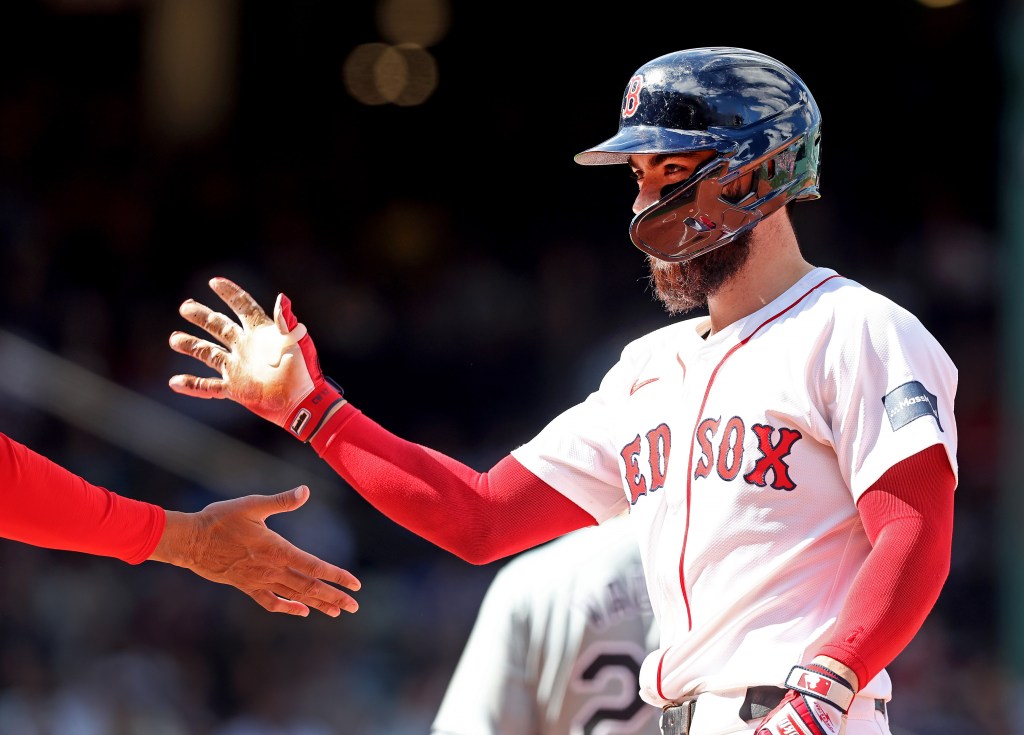
Tuesday was an unexpectedly chaotic day for the Red Sox, who swung four trades, designated two players for assignment and added three pitching prospects to the 40-man roster ahead of that evening’s Rule 5 protection deadline.
With all that business taken care of, plus Thursday’s announcement that the Red Sox reached a deal to avoid arbitration with catcher Connor Wong, fans can expect a much quieter day Friday.
Friday marks the deadline for MLB clubs to tender contracts to players under team control who don’t already have long-term deals. For most players this is a fairly routine process, but occasionally a team might decide not to offer a contract to a certain player, either because they don’t think they’re worth the money they’d be in line to make or because they want to free up a roster spot.
When that happens, the player is “non-tendered” and immediately becomes a free agent.
Will the Red Sox non-tender any players this year? And who do they have to make decisions on? Here’s a look at where things stand heading into Friday’s deadline.
Big decisions made
Entering the offseason the Red Sox’s only obvious non-tender candidate was Nathaniel Lowe. The first baseman is entering his final year of arbitration, and according to MLB Trade Rumors’ arbitration projections Lowe is projected to earn $13.5 million in 2026.
Given his underwhelming season and the expected return of Triston Casas, the Red Sox were never going to bring back Lowe at that price.
The Red Sox effectively made the call on Lowe early when they designated him for assignment on Tuesday to clear space on the 40-man roster for newly acquired utility man Tristan Gray. They similarly moved on from right-hander Josh Winckowski, who they designated for assignment to clear space for the Rule 5 additions, and left-hander Brennan Bernardino, who was traded for utility man Braiden Ward. Both were among the club’s nine arbitration-eligible players.
Between those moves and the deals the Red Sox recently reached with Jarren Duran and Wong to avoid arbitration, the club has four arbitration-eligible players left. Those are right-hander Tanner Houck (projected $3.95 million), right-hander Kutter Crawford ($2.75 million), infielder Romy Gonzalez ($1.8 million) and Casas ($1.7 million).
The only logical non-tender candidate of that group is Houck, who is expected to miss the entire 2026 season as he recovers from Tommy John surgery. But according to MassLive’s Chris Cotillo, the Red Sox are expected to offer him a contract.
Lefty relievers needed
By the end of last season the Red Sox had more left-handers available out of the bullpen than just about anyone, but now with Justin Wilson and Steven Matz both free agents and Bernardino and Chris Murphy traded, the Red Sox suddenly have a major area of need.
As it stands now, the only proven lefty remaining in the Red Sox bullpen is Aroldis Chapman, who will be the club’s closer. The only other pure lefty reliever on the 40-man roster is Jovani Moran, who only made two appearances in the big leagues this past season and who will likely be on the chopping block if the Red Sox need to clear space for a future pitching addition this offseason.
The Red Sox could potentially move one of Payton Tolle, Connelly Early, Kyle Harrison or Rule 5 addition Shane Drohan to a relief role, but all project as starters entering spring training.
With so little depth remaining, the Red Sox figure to be players in the left-handed relief market. In addition to Wilson and Matz, other potential free agent options include Hoby Milner, Sean Newcomb, Caleb Thielbar, Danny Coulombe and Gregory Soto, among others.
Meet the new guys
The Red Sox acquired four new players on Tuesday in utility men Gray and Ward and minor league catchers Ronny Hernandez and Luke Heyman. None are big names, but all could factor into the equation for the Red Sox down the road and will help improve the club’s overall depth.
The most immediate contributor figures to be Gray, who was acquired in exchange for right-hander Luis Guerrero from the Tampa Bay Rays.
The 29-year-old Gray is on the 40-man roster and is coming off a season in which he batted .231 with a .693 OPS over 30 big league games while appearing at every infield position beside pitcher and catcher. He also batted .270 with an .805 OPS in 72 games at Triple-A, and overall he has three seasons of MLB experience.
Ward, who has never appeared in the majors, has a similar profile. The 26-year-old had an excellent showing following his call-up to Triple-A last season, batting .331 with a .906 OPS in 44 games, and he has played second, third, shortstop and outfield as a professional.
Gray and Ward join an already crowded field of infielders vying for a spot on Boston’s bench, a group that also includes Gonzalez, Nick Sogard, Nate Eaton, David Hamilton, Vaughn Grissom and Kristian Campbell, though his situation is different given he already has a long-term contract.
Gonzalez is a lock to make the team, but it wouldn’t be a shock if any of the others were squeezed out as the club continues to make additions.
How do Rule 5 guys fit in?
All three prospects the Red Sox added to the 40-man on Tuesday, David Sandlin, Tyler Uberstine and Drohan, are starting pitchers who would have been poached in the Rule 5 Draft had they been left unprotected. None project as obvious candidates to start the season on the Opening Day roster, but all should give the club additional rotation depth.
As we saw last season, even the guys further down the depth chart could make meaningful contributions if enough guys ahead of them get hurt.
Of the trio the most likely to impact the club earlier in the season is Sandlin. The 24-year-old right-hander is the best prospect of the bunch, currently ranking No. 10 in the Red Sox system according to MLB Pipeline, and though his transition to the bullpen in Triple-A late last season did not go well, he has the kind of arsenal that would theoretically play well in a relief role.
Sandlin boasts a high-90s fastball that has been clocked as high as 101 mph in an offseason workout along with a filthy slider. He possesses mid-rotation upside, so the Red Sox aren’t going to be in a hurry to move him to the bullpen permanently, but if the club is happy with its rotation depth and decides Sandlin could step into a mid-to-high leverage relief role right away, don’t be surprised if we see Sandlin pitching in some big spots by early summer.