
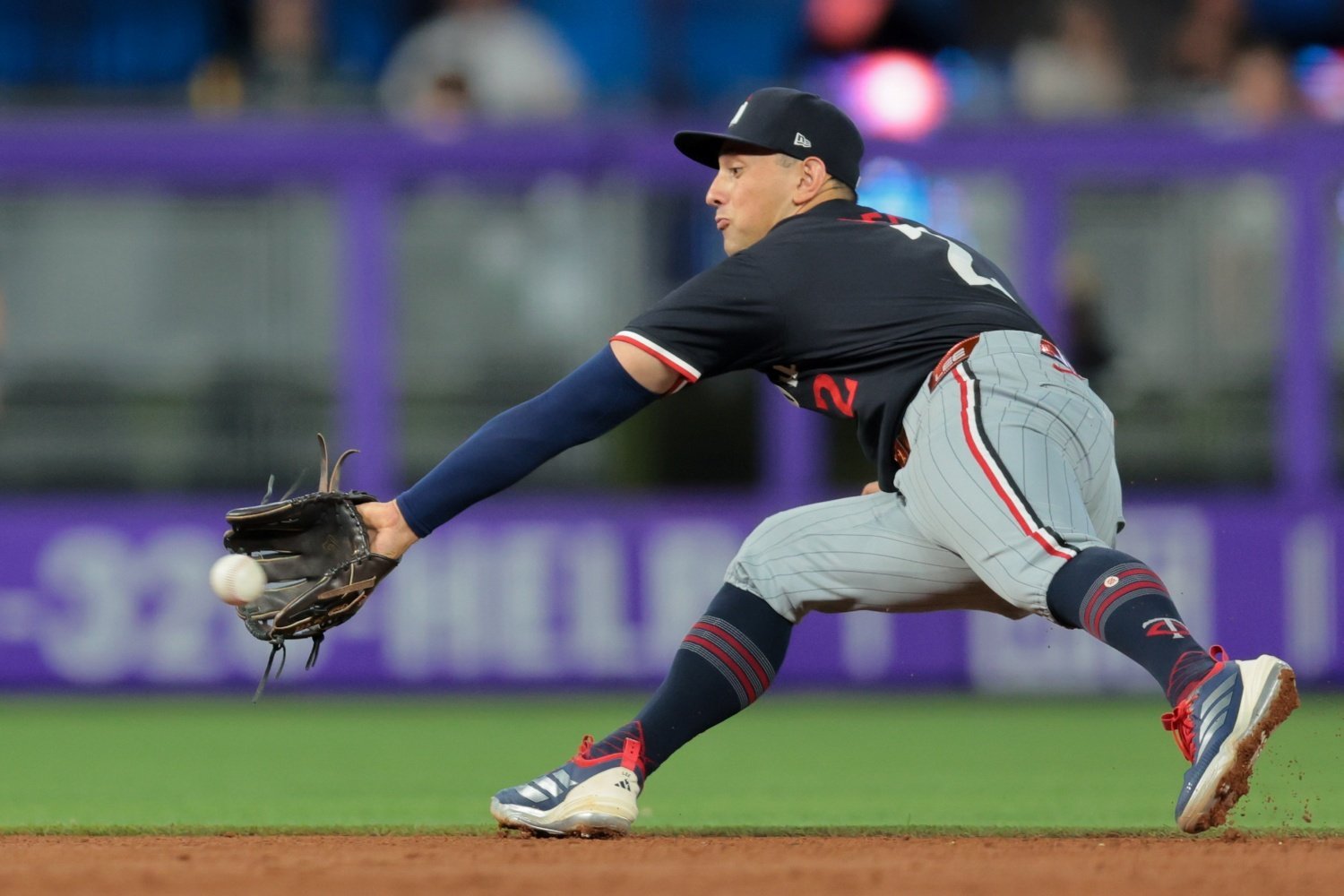
The Twins have entered recent winters with plenty of questions, but this winter brings a particularly uneasy one. After last summer’s shocking decision to trade Carlos Correa at the deadline, Minnesota suddenly went from having a franchise cornerstone at shortstop to hoping a former top prospect can carry one of the most demanding positions in baseball. That is a dramatic shift for a team on the fringes of contention, even while operating under the tightest budget constraints of the Derek Falvey era.
Minnesota can’t afford a superstar to steady the position. It simply needs more certainty. Right now, shortstop is the thinnest spot on the organizational depth chart, and that is a dangerous way to start the winter.
A Depth Chart Built on Hope
Brooks Lee sits atop the depth chart after being thrust into the starting job after the Correa trade. In 139 games, he hit .236/.285/.370 (.654) with a 79 OPS+. The front office believes in his tools and maturity, but even talented young players rarely sprint through their early big-league career without bumps. Depending solely on Lee to handle 162 games is the definition of risky roster construction.
Behind him, the depth gets frightening in a hurry. Ryan Kreidler arrived as a waiver claim earlier this offseason, and while he brings defensive value, his major league track record does not suggest everyday reliability. Last season, he played most of the year at Triple-A and posted a .751 OPS in 99 games. Ryan Fitzgerald could crack the team’s Opening Day roster as a backup infielder after combining for an .837 OPS with the Saints last year. Few inside or outside the organization view him as a long-term solution as a starting option, but he’s earned an opportunity to fill a role.
In the minor leagues, Kaelen Culpepper flew up prospect rankings in 2025, but he is yet to sniff Triple-A. He might be ready at some point in 2026, but that is far from a guarantee. Last year’s first round pick Marek Houston could reach the high minors this year, but he likely won’t crack the big leagues for multiple seasons. Both players are part of the team’s long-term plan. Neither can be counted on for significant time in 2026.
Minnesota also needs a strong defense behind a rotation expected to include multiple young pitchers. Lee showed improvements at shortstop in the second half but is still considered a below-average defender. For a team on the outside of contention, that is a razor-thin safety net behind Lee.
The Bargain Bin Reality
Since ownership’s maddening decision to slash payroll after the 2023 season, the Twins have spent just eighteen million dollars on free agents across two full winters. Six players. All one-year deals. None above $6.25 million. It is not a shopping strategy; it is an economic philosophy, and it has left the front office combing the discount bin for meaningful upgrades.
That reality shapes their shortstop search. The free-agent class is barren, making the problem even harder to solve. Minnesota does not have the financial flexibility to target even the middle tier of the market.
That scarcity is precisely why a player like Orlando Arcia becomes relevant in conversations he never would have entered a few years ago. Arcia, now 32 years old, hit free agency after a rough stint in Colorado and has been one of the worst hitters in baseball over the last two seasons by nearly every advanced measure. In fact, he has been the worst hitter in baseball by both wRC+ and xwOBA with 800+ PAs over the past two seasons. As a right-handed hitter, his OPS was 50 points higher against lefties, so there may be a role for him to platoon. His glove keeps him employable, but only in a limited role, and only on a team willing to accept the offensive tradeoff.
He is the type of player the Twins might be forced to consider. Not because he solves anything, but because the market offers so few alternatives. He could be signed to a minor league deal to offer organizational depth, because he is the sort of player who fills roster spots rather than stabilizes them.
A Problem Minnesota Cannot Ignore
The Twins have to add more protection behind Lee, even if that means a smaller move that brings competence rather than upside. A veteran shortstop who can defend, handle 40 to 60 starts, and keep Lee fresh is not a luxury for this roster. It is a requirement.
Minnesota can get by with creativity at several positions, but shortstop is not one of them. The front office saw what happened when injuries piled up in 2024 and 2025, and this roster cannot survive another season where the infield defense erodes because the club ran out of viable options.
With budget limits and a barren market, the Twins may need to get uncomfortable or get creative. What they cannot do is stand still. Shortstop is too essential, and the depth chart is too thin. The Twins need to act before this winter gets away from them.
How should the Twins upgrade their shortstop depth? Is Arcia an option? Leave a comment and start the discussion.