
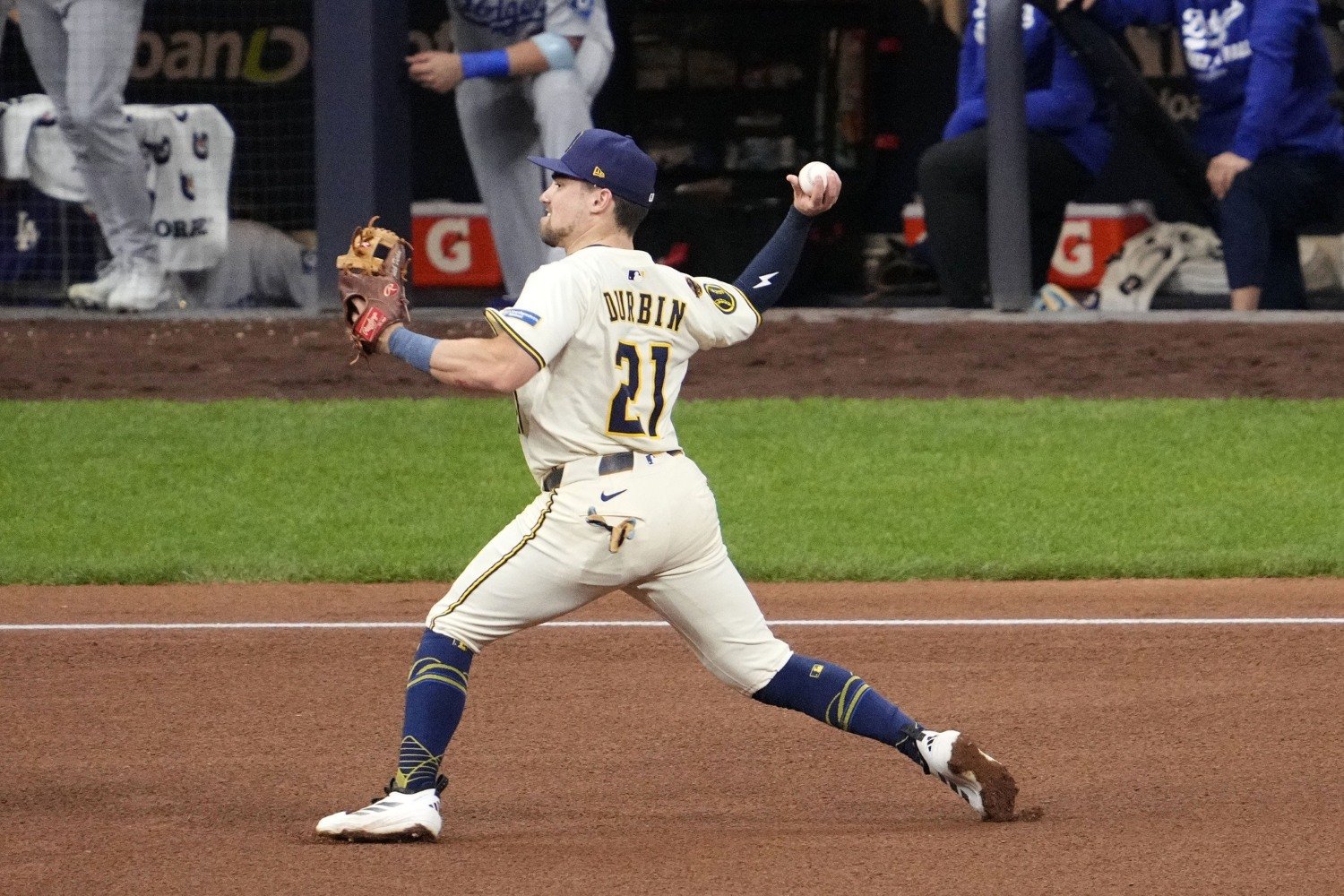
Since the departure of Luis Urías in 2023, third base has been a bit of a revolving door for the Brewers. Brian Anderson and Joey Ortiz served as the main starters in 2023 and 2024, respectively, and other names like Andruw Monasterio, Owen Miller, Oliver Dunn, and even Mike Brosseau served as understudies.
After some success converting a lifelong middle infielder (Ortiz) to a third baseman, the Brewers decided to try again with Caleb Durbin in 2025, and the results were mostly positive. Durbin posted a 105 wRC+ across 506 plate appearances and had 5 Defensive Runs Saved at the position, giving him a total of 2.6 fWAR for the season.
However, despite his admirable efforts, he could use some backup. His production at the plate steadily slipped as the regular season progressed, and the most telling sign that fatigue was starting to set in was his decrease in bat speed. This, along with other weaknesses in his game, indicate that the Brewers may need to rely on some of their other depth pieces a little more in 2026.
In second place for time spent at third base in 2025 was Anthony Seigler. Seigler was a call-up whom many doubted, especially as he continued to receive playing time despite posting a 50 wRC+. Realistically, he proved his ability to put up quality at-bats and actually did certain things very well.
In addition to playing solid defense, he had a walk rate of 11% and an elite chase rate of just 18%. Expected stats may lead you to believe he got unlucky, and in a sample of just 73 plate appearances (many of which came in pinch-hit situations), it’s difficult to make any definite conclusions. If the team continues to place their trust in him and his approach, he could see an elevated role in 2026 with more opportunities against right-handed pitching.
Andruw Monasterio spent most of his playing time covering for an injured Ortiz at shortstop or riding the pine, but found himself playing third base on a few occasions. He continues to be a reliable utility infielder and could cover the position as a platoon option. He had an .837 OPS against left-handed pitchers in 2025 and has performed better against southpaws across his career.
Interestingly, Isaac Collins is also listed on the Brewers depth chart under third base, but he has played just 1 ⅓ innings at the position, so it’s safe to say that he’ll remain in the outfield for the foreseeable future.
So what are the Brewers still missing? The most glaring gap is power. Typically, third basemen are characterized by having great arms, good defensive abilities (without the same mobility as a shortstop), and some decent pop. In fact, Durbin and Ernie Clement were the only players within the top 10 third basemen by fWAR who had slugging percentages under .430.
Now, it’s important to acknowledge that the game has become modern enough to do away with the shackles of positional archetypes. Otherwise, Durbin shouldn’t even be playing in the majors, given his 5-foot-7 frame. However, Milwaukee is already in dire need of some thump in the lineup. Christian Yelich (29) and Jackson Chourio (21) were the only players to eclipse the 20-home run mark, and the Brewers were 22nd in total home runs (166). They got by with their own brand of fast-paced hustle baseball, but in the postseason, it seems like the odds dig the long ball.
Given this need, what are the internal and external options? Within the farm system, the Brewers’ top third base prospects were all in Double A. Brock Wilken and Luke Adams had strong showings with the Biloxi Shuckers, while Mike Boeve—who only played first base, anyway—struggled quite a bit. All three have work to do before they’re big league-ready, and don’t seem like they’d be worth roster spots barring an injury emergency.
Externally, there are a handful of options that each come with different financial expectations and risk. It’s safe to say that Alex Bregman and Munetaka Murakami, both of whom are expected to cost north of $100 million this winter, are in the “if only” category. Kazuma Okamoto is on the older side and is projected to sign a deal in the realm of $68 million over four years, which is still on the pricier side, especially for someone with no MLB experience. This leaves Eugenio Suárez, who (after a brutal second-half slump that extended into the postseason) would seem like an overpay even for $55 million over three years.
Miguel Andujar is an affordable possibility that showed some promise last year. Across 341 plate appearances with the Athletics and Reds, he slugged .470 with 17 doubles and 10 homers. He’d be a defensive liability, especially when compared to Durbin and Seigler, but his bat could make him useful in certain situations.
Even if Milwaukee stays the course with what they have at third base in 2026, it’ll still be a position of strength. It’s not a critical issue that must be patched as soon as possible, but it does present an opportunity to improve on the margins—something the organization loves to do. Don’t expect the landscape of the role to change significantly heading into next season, but do keep an eye out for potential sleeper acquisitions making their way to Milwaukee.