
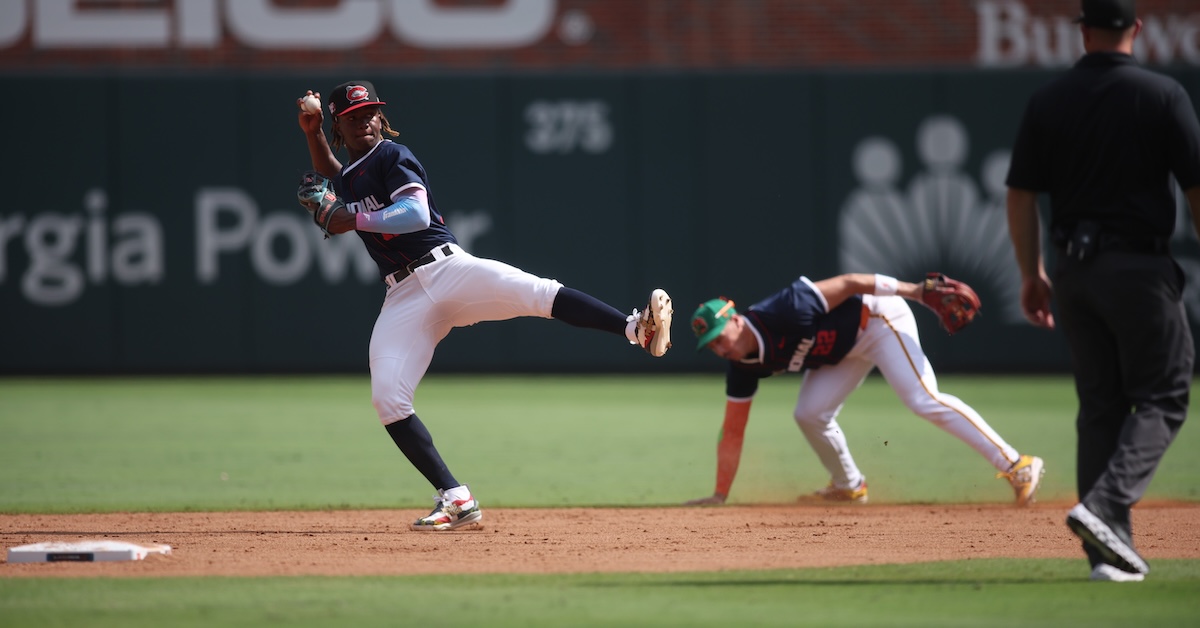
 Jesús Made Photo: Brett Davis-Imagn Images
Below is an analysis of the prospects in the farm system of the Milwaukee Brewers. Scouting reports were compiled with information provided by industry sources as well as our own observations. This is the sixth year we’re delineating between two anticipated relief roles, the abbreviations for which you’ll see in the “position” column below: MIRP for multi-inning relief pitchers, and SIRP for single-inning relief pitchers. The ETAs listed generally correspond to the year a player has to be added to the 40-man roster to avoid being made eligible for the Rule 5 draft. Manual adjustments are made where they seem appropriate, but we use that as a rule of thumb.
A quick overview of what FV (Future Value) means can be found here. A much deeper overview can be found here.
All of the ranked prospects below also appear on The Board, a resource the site offers featuring sortable scouting information for every organization. It has more details (and updated TrackMan data from various sources) than this article and integrates every team’s list so readers can compare prospects across farm systems. It can be found here.
Other Prospects of Note
Grouped by type and listed in order of preference within each category.
Recent Later-Round High School Arms
Tyler Renz, RHP
Jayden Dubanewicz, RHP
Chase Bentley, RHP
Ma’Kale Holden, RHP
Hayden Robinson, RHP
Griffin Tobias, RHP
Renz, a St. John’s commit who signed for $852,500, is a skinny, modestly athletic righty who gets to a due north vertical position on release. He only sits in the upper-80s right now, but at times he generates 20 inches of vertical break, so he needs to be monitored for a velo spike. The rest of his ingredients are currently below average. Dubanewicz already has impressive touch and feel, and his slider flashes above average. He also has some physical projection left, which he’ll need to realize, because his low-90s fastball doesn’t have bat-missing traits and his change is a work in progress. Bentley is a bigger-bodied righty with a plus slider and a low-90s fastball who was signed away from a Texas A&M commitment with a $757,500 bonus. Holden singed for $410,000 rather than go to Alabama. He’s a quick-armed likely relief prospect whose fastball crept into the mid-90s during instructs. Robinson ($347,500 bonus, Nicholls State commit) was a 2023 draftee who had TJ in 2024 and returned for the second half of 2025 with a 90-93 mph fastball and improving changeup. He looks like he’s making a big effort to get way down the mound and it cost him any modicum of command, at least upon return from the surgery. Let’s see how that trends in 2026. Tobias ($247,500 bonus, Indiana commit) is a more physically mature 6-foot righty sitting 92 with a cutter and slider, the latter of which has plus potential.
Potential Spot Starters
Travis Smith, RHP
Wande Torres, LHP
Enderson Mercado, LHP
Manuel Rodriguez, RHP
After walking too many hitters in college, a cleaner delivery in pro ball has helped Smith throw more strikes. His sinker/slider/cutter mix is too soft to miss bats in a length role; he could be an up-down guy if everything ticks up in shorter stints. Torres is a low-three-quarters lefty with a simple, if stiff, delivery. He’ll touch 95 in his starts, and it’s worth seeing if he can develop an average fastball/slider combination in shorter stints. He’d be an interesting flier for teams that can enhance flexibility and lower-half strength. Mercado is an 18-year-old lefty with average stuff but below-average athleticism and projection. Rodriguez’s touch and feel has stood out since his complex days, but he’s still sitting in the upper-80s. With plus command and average secondaries, he projects as a depth starter.
Relief Ceilings
Stiven Cruz, RHP
Jarrette Bonet, RHP
Enniel Cortez, RHP
Quinton Low, RHP
Cruz has touched 97, but it’s his funky, up-tempo delivery that stands out. Think Hisashi Iwakuma’s leg kick, but sped up. The stuff itself is on the average-fringy continuum, but he draws plenty of ugly swings from guys who can’t get him timed up. Bonet popped up during instructs, an undrafted relief prospect from San Jacinto JC who looks like a potential sinker/slider middle reliever. Cortez and Low (a former position player) were hurt in 2025 but have thrown hard when healthy.
Light on Power
Mike Boeve, 1B
Dylan O’Rae, 2B
Juan Ortuno, 2B
Pedro Ibarguen, OF
Josiah Ragsdale, OF
Juan Baez, INF
Boeve’s best trait is his barrel feel, but that might also be his only trait. O’Rae is a tiny Canadian speedster who missed all of the 2025 regular season, then played the equivalent of a couple weeks worth of games in the Fall League, where he only played second base and not center field. Ortuno is a stout 18-year-old second baseman who walked a ton on the complex. Ibarguen is a well-made corner outfield prospect with a pretty swing but fringe bat speed. Ragsdale is a lefty-hitting outfielder from Boston College who hit well on the Cape and in a small pro sample after the 2025 draft. He has a pretty, if only modestly explosive, swing, but he lacks the physicality of a typical corner outfield prospect. Baez had a promising 2023 rookie ball season when it looked like he might develop special contact ability, but in the two years since, he’s struggled to hit for any power, slid down the defensive spectrum, and been injured. We still like his bat-to-ball skill enough to monitor him in 2026.
Projectable Young Hitters
Frederi Montero, 1B/3B
Kevin Garcia, C
CJ Hughes, SS
Engel Paulino, OF
Isais Chavez, C
Cristopher Acosta, SS
Montero hasn’t slugged much in his first two pro seasons, but he’s a big-framed kid who swings hard from the left side and he should be monitored for more actualized power. Garcia is a physical teenage catcher with an average accurate arm and above-average bat speed that he has to swing out of his shoes to attain. Hughes, a $700,000 high school signee, is a plus athlete who needs to get much much stronger if he’s even going to be an upper-level minor leaguer. Paulino has huge raw power for his age, but he struck out a ton in 2025. Chavez is a hard-swinging DSL catcher. Acosta signed for just over $1 million in January, but he hit just .172 in his DSL debut.
System Overview
The Brewers once again have one of the best and deepest systems in baseball, and though it’s a familiar story, it’s worth highlighting how and where this organization is clicking. The obvious place to start is Latin America, where the Brewers have established a best-in-class scouting and decision-making apparatus. From a strategy perspective, they’ve internalized the importance of diversity as well as anyone: This isn’t an org that’s going to burn $5 million on Robert Puason. Instead, they spread their bonus pool around and give themselves several cracks to sign high-impact talent. In an environment where most of the big deals are agreed to with young teenagers who may or may not have finished developing physically, that approach makes a lot of sense.
More importantly, they’re signing the right guys. Even though they’re staying out of the deepest end of the signing pool, they have no trouble finding good, twitchy athletes and projectable frames. Even their low-dollar signees tend to have intriguing bat-to-ball skills or a promising pitch characteristic. Every system has a couple of guys on the back of its complex rosters who are just there to fill space, but the Brewers seem to have fewer of them than just about anyone else.
One of the things that sets Milwaukee apart is where and how the team spreads its resources. The details are probably worth a piece by itself, but the Brewers are well-known for their attention to detail in the region. Club officials do their homework, and document statistical and demographic information in places where such intel is tough to come by. Their scouts file thorough reports that require a level of familiarity with the talent beyond what is normal for the industry. The organization also prioritizes teaching and upskilling their coaches, which gets the developmental funnel functioning quickly. They don’t leave stones unturned outside the normal hotbeds: You may have noticed that a couple of the names above were tiny-dollar signings from Nicaragua. And of course, they’re doing quite well in Venezuela. With Jackson Chourio in tow and Quero, Lara, Antunez and others on their way, their success in that country looks particularly notable in an era where many teams were marshaling resources elsewhere. This group isn’t perfect — no one is — but they give themselves a ton of opportunities to make good decisions and they’re reaping the rewards.
The domestic scouting and development system is also humming along nicely. Milwaukee’s hit rate in turning college relievers with control issues into viable starter candidates is remarkable. We don’t know yet whether Hardin, Wichrowski, DeBerry, or Kuehner can crack a big league rotation, but that there’s a chance even one of them could is a big win for a small-market team.
If you’re looking for an Achilles heel, it might be in strength and conditioning. Writing this list, we came across an abnormal number of injuries, particularly upper-body tendon and soft tissue problems among the position player group. And it’s also striking how many of their players, pitchers in particular, are very lean, particularly in their lower halves. Building leg strength is a good way to coax a little extra velo out of a guy, and there are a lot of flier arms with promising control and movement traits here who haven’t taken that step. For teams that reliably develop this sort of thing, this is a good place to sniff around for talent.