
As we head into the final stretch of 2025, we’re launching a new draft preview series taking a closer look at some non-Power Four conference college players who currently fall outside our Top 100 rankings for the 2026 MLB Draft class.
We’ve touched on a number of these under-the-radar prospects at various times over the course of the offseason, but this series will serve as helpful resource for in-depth reports on intriguing players who don’t necessarily rank in the most prominent spots on our draft board. While that means you won’t find top-ranked mid-major stars like Cameron Flukey, Jackson Flora and Ricky Ojeda, we should hopefully uncover some exciting new draft gems along the way.
Max Bayles, RHP, Santa Clara
Bayles enjoyed immediate success as a freshman in 2024, posting a 3.40 ERA with 50 strikeouts to 16 walks across 42.1 innings. His first three appearances this spring came in relief, but he proceeded to join the weekend rotation and pitched to a 4.46 ERA with 105 strikeouts across 66.2 innings en route to a Team USA selection.
Bayles starts his motion with his body turned toward the third base side. His small sidestep leads into an average leg lift, and he attacks out of a high three-quarters slot with a bit of a head whack.
His bread-and-butter offering is his low-to-mid-80s slider. It’s the most-used pitch in his arsenal, and he’s comfortable throwing it in any count to both righthanded and lefthanded hitters. Bayles threw his slider 48% of the time last season, and it’s a pitch for which he has an advanced feel. He’s shown the ability to manipulate its shape—and oftentimes it takes on a sharp, gyro look—but he can back-foot it to lefties and also have it take on more of a two-plane look with a bit of lateral break against righties. It generated a mighty impressive 52% miss rate last spring and held opposing hitters to a minuscule .156 average.
For as impressive as his slider is, Bayles’ fastball is more of a work in progress. It sits in the low 90s, but it’s not a bat-misser and doesn’t generate empty swings. It’s a high-spin pitch that will flash some life in the top third in the zone, as well as run and sink at times. His above-average extension and average spin rate over 2,400 rpm are two positive traits, but Bayles will need to refine—and subsequently optimize—his heater’s shape.
Bayles’ fastball-slider combination made up for 90% of his pitches thrown last season. He doesn’t have a true third pitch, but his mid-80s changeup flashes late tumble at times and looks the part of a potentially serviceable offering to round out his arsenal.
Tre Broussard, OF, Houston
Broussard began his career at junior college powerhouse San Jacinto (Texas) before transferring to Houston. He served as a spark plug atop the Cougars’ lineup and hit .292/.371/.458 with 20 extra-base hits and 31 stolen bases. Broussard’s success didn’t stop this spring, though, as this summer in the Cape Cod League he posted a .296/.363/.324 line and took home All-Star Game MVP honors.
Broussard has a wiry, athletic frame, and he stands fairly tall in the box with a slightly-open front side and ear-high handset. He has quickness in his hands to go along with plus bat-to-ball skills and a sound approach. He’s undoubtedly a hit-over-power profile, but his comfortably-plus speed enables him to take an extra base on a ball hit down the line or in the gap.
Defensively, Broussard looks every bit the part of a professional center fielder, and his exciting combination of speed and athleticism allow him to cover plenty of ground on the grass. He has great instincts to go along with a quick first step, and he routinely takes crisp, efficient routes to the baseball.
A classic top-of-the-order tablesetter, Broussard this spring will be the straw that stirs the drink for Houston. It would not surprise me if he’s selected inside the first 3-4 rounds this July.
Jonathan Mendez, 2B/SS, UC Santa Barbara
Mendez showed flashes as a freshman, but he took his game to the next level this spring and hit .314/.392/.559 with 17 doubles, 11 home runs and 40 RBIs. At 6-foot-1 and 200 pounds, he has an average build with particular physicality in his lower half. He has an upright stance and wiggles his bat above his back shoulder pre-swing, which leads into a barrel tip as the pitcher breaks his hands. Mendez has thunderous bat speed and a pull-oriented approach, and he absolutely feasts on fastballs. Last season, he posted a .351/.442/.586 line and a 92% contact rate against all heaters.
For as well as he fares against fastballs, Mendez struggles to pick up spin out of the hand, something that leads to both miss and chase against secondaries. He’s most susceptible to whiff against right-on-right sliders, particularly when they’re located down and/or away.
He’ll need to improve his hit tool, but Mendez’s batted-ball data is intriguing. He posted a 90th percentile exit velocity just under 105 mph (104.7) to go along with solid hard-hit (45%) and air-pull (42.6%) rates. He’s flashed above-average pullside thump, and getting more aggressive on pitches in his “nitro zone” will serve him well.
Mendez got some run at shortstop both during the spring and summer, and he showed solid hands and a serviceable arm. However, his actions likely profile best in pro ball at second base, where he has a chance to be an average defender.
Tyler Minnick, 3B/OF, Connecticut
In the wake of a productive freshman season and all-star summer in the New England Collegiate League, Minnick was a popular breakout pick heading into 2025. To say he “broke out” would be a drastic understatement, as last spring he hit .350/.433/.729 with 11 doubles, 22 home runs, 74 RBIs and 22 stolen bases.
Listed at 6-foot and 205 pounds, Minnick has a strong, athletic frame with present physicality. He stands fairly tall in the box with a slightly-open front side, high handset and a leg lift that leads into a small stride. Minnick possesses big-time bat speed. His bat-to-ball skills are just average, but he hammers the baseball all over the yard, and his batted-ball data jumps off the page.
Minnick has plus power to all fields, and he doesn’t need to sell out to get to it in games. He’s consistently on the barrel and regularly generates high-quality contact. Last season, his 90th percentile exit velocity and hard-hit rate were 106.7 mph and 55%, respectively, and he also showed a knack for pulling the ball in the air. Minnick was all over pitches in his “go zone,” and he also boasts optimal launch angle data.
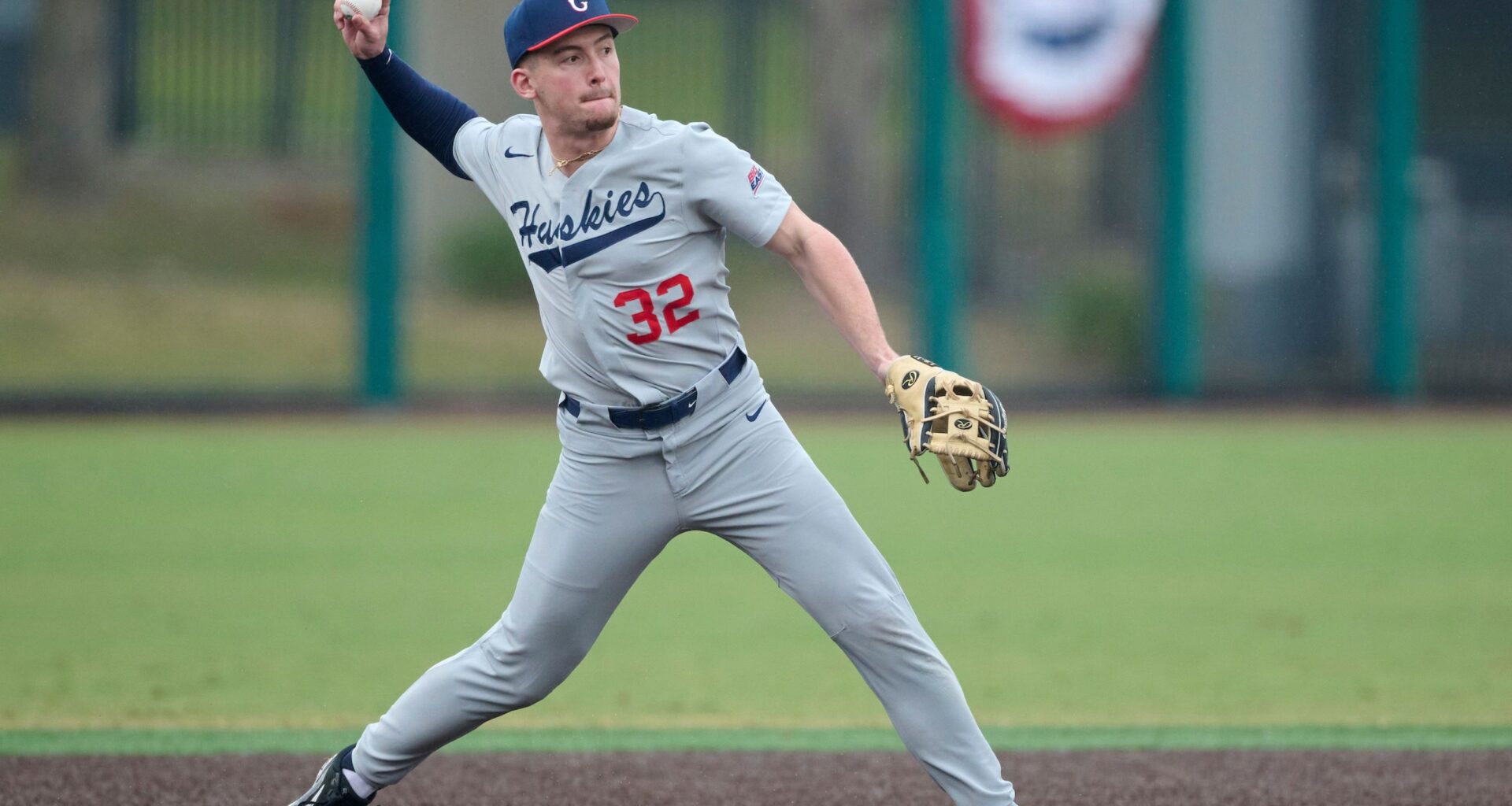
On the dirt, Minnick is a solid athlete capable of handling either corner infield spot. This fall, however, he’s gotten plenty of run in the outfield and could be the Huskies’ starting center fielder on opening day. As a cherry on top, Minnick picks his spots on the basepaths and is an effective base stealer.
Ethan Norby, LHP, East Carolina
The younger brother of current Marlins infielder and former East Carolina superstar Connor Norby, Ethan is in the midst of his own standout career in Greenville. The younger Norby had a productive 2024 season to the tune of a 3.79 ERA with 63 strikeouts across 59.1 innings before enjoying immense success this past spring as ECU’s Friday starter. Across 90 innings, Norby pitched to a 3.80 ERA with 119 strikeouts to just 22 walks.
Norby is an undersized southpaw who has an up-tempo operation and attacks from a low three-quarters slot. His fastball has been up to 93 mph with carry in the top half of the zone, which is also where it generates the majority of its whiffs. He possesses above-average command and control, and he consistently locates his heater in the quadrants of the zone where it’s most effective. While its movement profile fits into the “deadzone” bucket, Norby’s heater plays higher than its velocity band. It’s a high-spin pitch, and with above-average extension for his size and a flat vertical approach angle, it gets on hitters quick.
Norby pairs his fastball with a high-spin, upper-70s-to-low-80s sweeper that flashes long, lateral life. He routinely spins it in the 3,000 rpm range and has also shown the ability to manipulate its shape. It’s a super uncomfortable look for lefthanded hitters and looks the part of a true sweeper, while against righthanded hitters it has more of a two-plane shape. Norby completes his arsenal with a mid-80s changeup that projects as an average third pitch. He uses it exclusively against righthanded hitters, and it flashes both tumble and fade.
Ryan Oshinskie, RHP, Brown
While Oshinskie this spring posted a modest 6.06 ERA across 16.1 innings, this summer served as a coming-out party for the 6-foot-3 righthander. Across 13 appearances (two starts) on the Cape spanning 28 innings, he pitched to a 1.93 ERA with a strikeout-to-walk ratio of 38-to-7.
Oshinskie has a projectable, reasonably high-waisted frame and works exclusively out of the stretch. He has a slightly deep arm stroke and attacks out of a three-quarters slot. Oshinskie’s high-spin fastball sits in the low 90s and has been up to 95 mph with both run and ride, especially in the top half of the zone.
Oshinskie’s calling card is his high-70s-to-low-80s changeup, which was one of the best of its kind on the Cape and is a no-doubt plus pitch. He’s comfortable throwing it against both righthanded and lefthanded hitters, and this summer it garnered gaudy miss and chase rates of 54% and 42%, respectively. Oshinskie’s confidence in the pitch is evident, and it routinely flashes ample tumble and fade.
He rounds out his arsenal with a pair of distinct breaking balls in a high-70s curveball and a mid-80s slider. The curveball flashes both depth and some sharp, downward break, while his slider is shorter in shape with late and effective gloveside life.
An above-average strike-thrower with a true four-pitch mix, Oshinskie will have the chance to prove himself as a starter professionally.
Cole Tryba, LHP, UC Santa Barbara
If one were to come up with superlatives for the UC Santa Barbara pitching staff, Tryba would almost certainly win the “most underrated” award. He was fantastic in relief last season and pitched his way to a 3.64 ERA with 65 strikeouts to just 14 walks across 47 innings. Though slightly undersized, he has an appealing degree of explosiveness in his operation. He has a slightly up-tempo delivery and attacks out of a low three-quarters slot, though he’ll drop down to a borderline sidearm slot when delivering his slider.
Tryba’s fastball sits in the low 90s, but it plays up thanks to its run and ride through the zone paired with a relatively flat vertical approach angle. His command of the pitch is advanced, and he consistently locates it in the top half of the zone on his arm side to generate whiffs.
His best secondary is undoubtedly his upper-70s-to-low-80s sweeper. It lacks sharpness, but it routinely flashes long, lateral life. Unsurprisingly, it’s a particularly tough look for lefties, who hit just .125/.125/.125 against the pitch last spring.
Tryba rounds out his three-pitch mix with an upper-70s-to-low-80s changeup that looks the part of an effective third offering. It flashes both fade and late tumble, and last season it garnered a 45% whiff rate across a fairly limited sample. He used it almost exclusively against righthanded hitters and was able to avoid hard contact.
I alluded to it when discussing his heater, but Tryba’s high-level command of his entire arsenal allows him to optimize the traits of each of his three offerings. It will be interesting to see how UC Santa Barbara uses him this spring. All but one of Tryba’s 38 appearances have come in relief, but there’s a chance he slides into the rotation in 2026.