
Get a daily rundown of the top stories on Urban Milwaukee
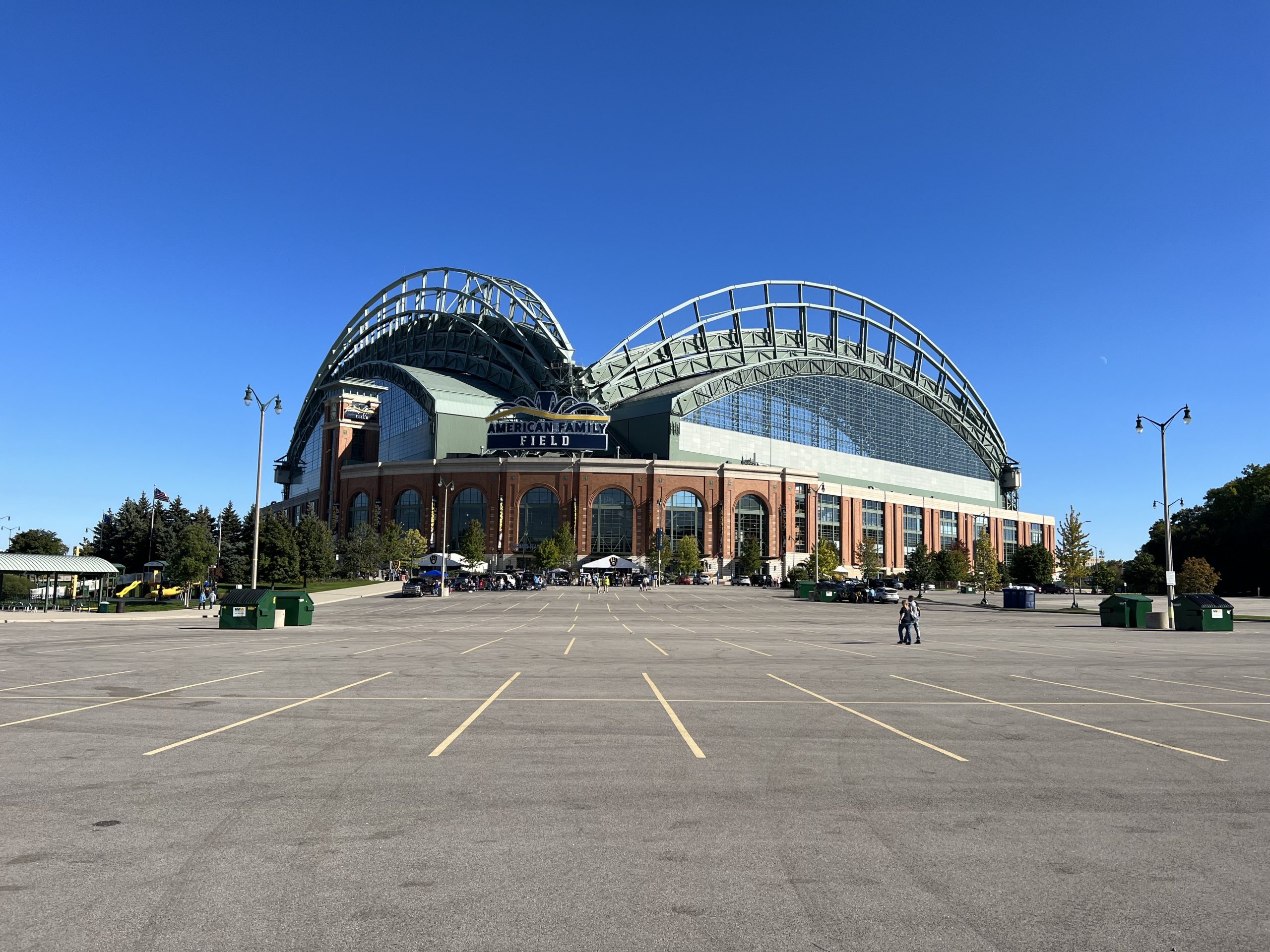
American Family Field. Photo by Jeramey Jannene.
On November 6 we learned that a report done for the Wisconsin Professional Baseball Park District found there is market demand for a huge, $800 million development on the land surrounding the Milwaukee Brewer stadium. It outlined a project built on up to one-quarter of the Brewers parking lots that would include 600 to 1,000 apartments; a 150- to 200-room hotel; 38,000 to 52,000 square feet of retail space, and 20,000 to 50,000 square feet of office space.
The report was largely done by Brailsford & Dunlavey, whose vice president Bill Mykins told the stadium board that “Everyone wants to see something happen other than parking lots that sit empty.”
Everyone? What about the Milwaukee Brewers, who own the land? Rick Schlesinger, Brewers business operations president declined to comment to Journal Sentinel reporter Tom Daykin, saying it would be premature because club officials haven’t yet seen the report. That was nearly three weeks ago, and the Brewers still haven’t said a word about this.
In the early years after Mark Attanasio purchased the Milwaukee Brewers, such a development would have been prohibited. The original 1990s legislation funding the Brewers stadium included a land swap that barred the team from developing the land used for parking lots, but that provision expired in April 2011, as Urban Milwaukee has reported.
So Attanasio has had more than 14 years to develop the parking lots and has never moved to do so, despite the fact that any such development would be an incredible sweetheart deal, as it would be exempt from all property taxes, as Urban Milwaukee reported in 2022. The state law funding the stadium includes a property tax exemption that “is very broad,” noted Ryan LeCloux, of the nonpartisan Legislative Reference Bureau. The property that is exempted “includes but is not limited to: ‘parking lots, garages, restaurants, parks, concession facilities, entertainment facilities, transportation facilities, and other functionally related or auxiliary facilities and structures,’” LeCloux explained. Also exempt from taxation would be a hotel or apartment complex, he noted.
This is as good as it gets, a top local developer told Urban Milwaukee: no tax incremental financing (TIF) plan or other such deal would compare to a total property tax exemption: “If you can develop without any tax liability, that is the best-case scenario,” the developer said.
Get a daily rundown of the Milwaukee stories
This would hardly have escaped Attanasio, an “accomplished investment management executive” who made his money with the investment firm Crescent Capital Group before buying the team. “He’s very successful in his money-management business” and has been a savvy overseer of the team’s business, Brewers president Schlesinger told the Sports Business Journal.
“He’s been a very successful entrepreneur. He’s good at seeing undervalued assets in ways that others might not. And he’s a risk-taker,” Milwaukee-area businessman Cory Nettles said.
And Attanasio could easily afford to finance or seek financing for ancillary development around the stadium. The team he bought for about $220 million back in 2004 is now worth $1.6 billion, Forbes has reported, while estimating Attansio’s net worth at $1.9 billion.
But when it comes to investing, Attanasio clearly has other priorities. As Schlesinger told the Sports Business Journal, Attanasio has invested in analytics analysis for the Brewers, on upgrading facilities for their minor league team, the Class A Wilson Warbirds and creating a player development complex in the Dominican Republic.
Even as the Brewers were demanding a new subsidy deal for the stadium, Attanasio was getting involved as an investor with a new team. In 2022 he became a minority owner of the English soccer team Norwich City and gradually began increasing his share until his Norfolk Holdings group became the team’s majority owner. Attanasio is also an investor in Strategic Sports Group, a group of sports team owners that in 2024 made a deal to invest $3 billion in the PGA golf tour.
In short, Attanasio is passionate about investing in sports, but has never shown any interest in ancillary real estate development. It was Milwaukee Mayor Cavalier Johnson who pushed for such development, decrying the “sea of parking” surrounding the stadium and calling for major development project. “I’d like to challenge the Brewers,” he said, “to really consider, really push out, this idea of building a district around American Family Field.”
The challenge came as the state Legislature considered the bill to provide $500 million in funding, with much of it coming from the the City of Milwaukee and Milwaukee County. Schlesinger was not about to sour the mayor and other political officials by shooting down the idea. He said the idea might work but “the devil is in the details.” But he also emphasized the importance of tailgating and noted that all that parking (some 12,000 spots on 160 acres) is entirely full during more popular games.
The stadium legislation included a provision calling for the study of developing the parking lots, but Attanasio never offered a word of encouragement. When asked, Johnson’s spokesperson Jeff Fleming confessed to Urban Milwaukee that “The Mayor has not spoken to Mark Attanasio about development around the stadium.”
Johnson’s goal to was get some property tax return for a subsidy that has burdened the city and helped to nearly bankrupt Milwaukee County. He has pushed for the Brewers to make payments in lieu of property taxes on the new development he hopes will happen. But if Attanasio didn’t want to build when he would have paid not a dollar in taxes on any development, why would he be tempted by a deal that would be much more costly?
And why would he want to set a precedent for taking away some of the Brewers lucrative tax exemption?
This whole sideshow about a development plan the Brewers have never requested was created by a colossal misunderstanding by then-County Supervisor Peter Burgelis, who began pushing the idea of using a city TIF to help the Brewers build a “large entertainment, commercial, and mixed-use area around American Family Field.” As he later admitted to Urban Milwaukee, he never consulted with the baseball park district or the Brewers before floating the idea. Nor was he aware the Brewers pay no property taxes on its parking lots and would pay no taxes on any development, meaning the TIF deal wasn’t needed and couldn’t be repaid. But his proposal was enough to generate a story by Daykin, with a headline saying the district “could bring cash to help finance the ballpark’s upgrades.”
That in turn generated stories by Fox 6, WUWM and the Business Journal on the idea.
All of which has led to yet another round of media excitement about the idea of development around the stadium, generated by a report the Brewers management and Attanasio never requested. Only the team itself seems unexcited and unwilling to even comment on it.
More about the Miller Park Stadium Tax
Murphy’s Law: Why Attanasio Has Never Developed Around Brewers Stadium – Bruce Murphy – Nov 25th, 2025
See Brewers’ Options To Develop Land Around Their Stadium – Jeramey Jannene – Nov 12th, 2025
Stadium Authority Seeks Study to Redevelop Brewers Parking Lots – Jeramey Jannene – May 28th, 2025
$54.9 Million in Upgrades Approved for Brewers Stadium – Evan Casey – Jan 28th, 2025
MKE County: Brewers Ballpark Subsidy Stings County Budget – Graham Kilmer – Jul 28th, 2024
Governor Signs Brewers Subsidy Agreement At American Family Field – Evan Casey – Dec 5th, 2023
Gov. Evers Signs Bills to Keep Milwaukee Brewers, Major League Baseball in Wisconsin Through 2050 – Gov. Tony Evers – Dec 5th, 2023
Council, Mayor Bickered On Brewers Deal – Jeramey Jannene – Nov 29th, 2023
Brewers Stadium Deal Passes the Legislature – Shawn Johnson – Nov 14th, 2023
County Executive David Crowley’s Statement on Bipartisan Bill to Keep Brewers in Milwaukee – David Crowley – Nov 14th, 2023
Read more about Miller Park Stadium Tax here