
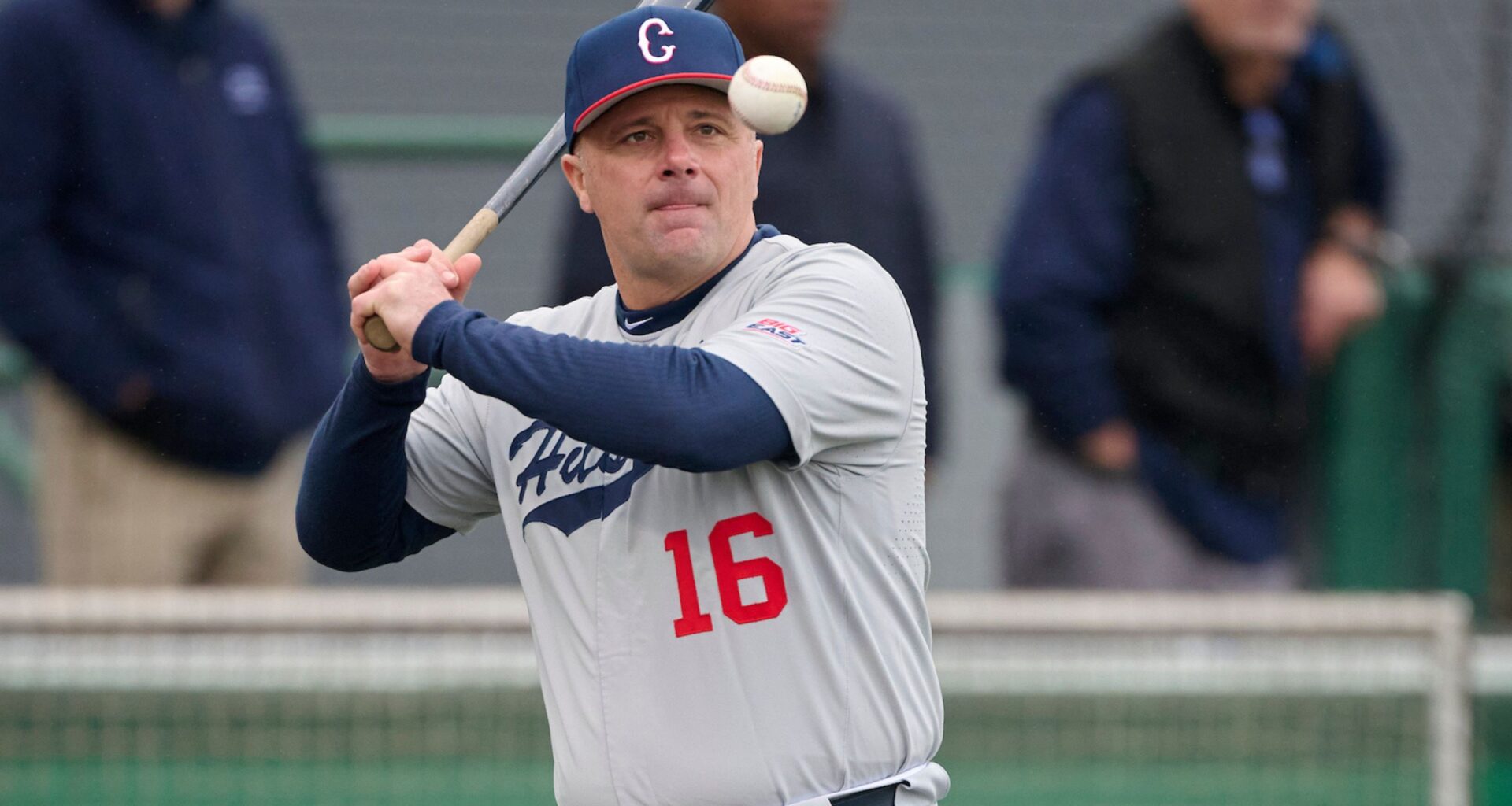
Baseball America continues its series of fall baseball updates with a look at Connecticut’s retooled roster as it attempts to return to the NCAA Tournament, Clemson’s revamped fall process and more.
Connecticut Using Tournament Snub As Fuel For 2026
Connecticut coach Jim Penders still describes the Huskies’ 2025 NCAA Tournament miss as a kind of live virus vaccine, something unpleasant he willingly reintroduces into his system to prevent a relapse.
Saved on his phone is the antidote—a short clip of former NCAA Baseball Committee Chair Jay Artigues explaining why UConn, slotted at No. 41 in RPI with a 38-21 record, became the highest-ranked team excluded from the field.
“If you look at UConn, the Big East after the top three, it doesn’t have another team in the top 100 of RPI, and that kind of hurts them,” Artigues said. “UConn started out 13-7, then they won 25 of the last 29, but only seven of those games were against top 100 RPI teams … and UConn was 3-6 against the top teams in that conference.”
Penders listens to the clip every few weeks.
“I need to put the virus back in my body,” he said.
Penders has made sure his players have absorbed it too. He opened fall practices by playing the clip on Elliott Ballpark’s video board so returners and newcomers alike could feel the sting that accompanied their omission.
“We never want to feel it again,” Penders said.
That urgency guided an offseason defined by recalibration. That’s especially so on the mound, where UConn posted a 5.62 ERA and struggled to control the running game. This fall became a return to fundamentals rather than an exercise in advanced analysis. If a pitcher could not throw 12 of 20 fastballs for strikes in a bullpen session, he did not pitch in a scrimmage. A new throwing program to build arm stamina occupied the start of every practice. Staff members painted leadoff-distance markers into the infield dirt. According to Penders and pitching coach Joshua MacDonald, the results showed up quickly on both sides of the ball.
UConn expects to lean heavily on a trio of lefthanders.
Junior Charlie West endured a statistically rough Northwoods League summer with a 7.23 ERA over 18.2 innings, but those numbers were tied to a deliberate effort to reestablish his breaking ball. He rediscovered the pitch this fall and dominated with a 0.53 ERA, 21 strikeouts and nine walks in seven innings while holding opponents to a .107 average. His fastball jumped to 89-91 mph after sitting 86-88 last season, and he paired it with a quality changeup, a high-80s slider and a low-70s curveball.
Sophomore Cayden Suchy, whom Penders and MacDonald consider to have some of the best pure stuff on the roster, was initially a medical concern after experiencing elbow discomfort over the summer. A doctor cleared him for a carefully paced fall, and he responded with 11 strikeouts over seven innings. Suchy showed a fastball he can shape for ride or sink depending on location, plus a cutter and changeup that expand his attack.
Redshirt junior Oliver Pudvar did not match the sharpness of the other two this fall, though Penders and MacDonald noted he may have been fatigued after throwing a career-high 70 innings with a 3.60 ERA last spring. He’s expected to return to the Huskies’ weekend rotation in 2026.
The bullpen picture includes several meaningful contributors:
Righty Sean Finn is the leading candidate to close with low-90s velocity that can reach 96-98.
Righty Greg Shaw returns after a solid fall and will be a durable arm in relief.
Righty Charlie Hale, a transfer from Endicott College, threw strikes, competed aggressively and showed a good slider. He posted 11 strikeouts, six walks, a 1.20 ERA and a .245 opponent average in 15 fall innings.
Righty Rob Gilchrist arrived from Pace with a low-90s fastball and what the staff called “pretty good breaking stuff.”
Righty Garret Garbinski built on a strong Futures League summer in which he pitched to a 0.59 ERA in 30.1 innings with a steady fall while impressing with his athleticism.
Righty Justin Lessing threw only 1.1 fall innings but flashed a strong arm and a good breaking ball.
Righty Paxton Meyers did not pitch this fall but was Brown’s ace two years ago before undergoing Tommy John surgery.
Righty Tristan Aasland added a splitter, carries a high-spin fastball in the upper 80s to low 90s and is expected to give quality innings.
Behind the plate, UConn has more depth and versatility than it has fielded in years. Five catchers could feasibly see time. Connor Lane had a blood clot during the Big East Tournament and thoracic outlet syndrome that required the removal of a rib and a half, but he had a full fall and threw the ball well. Gabriel Tirado was challenged to improve his receiving and made significant progress while maintaining a strong bat. Steve Thomas, a transfer from Catholic University, brought high energy and catch-and-throw reliability and profiles as a bat-first option. Chris Cancel is a well-rounded catcher who can fill multiple needs. And freshman Cam Righi is a massive athlete with a “very bright future” who can also play outfield and first base. Penders called him a prime example of keeping the best in Connecticut home.
At first base, Jackson Marshall brings “light-tower power” at 6-foot-8. He spent the fall learning to pull the ball more consistently after previously living inside-out and now lifts the ball with greater authority. He will play first or DH every day.
Third base features several options. Maddix Dalena is moving there full time after playing third last year. He has a strong arm, a productive summer behind him and middle-of-the-order potential. He was the Big East preseason Player of the Year last spring before a hand injury slowed him. Bryce Detwiler also threatens for the job with the most consistent exit velocities on the team, though he is still learning to handle pitch mixes. Peyton Jemison is a righthanded hitter with baserunning skill. He hit .276 in 58 fall at-bats and stole 10 bases, which ranked second on the team, but he needs more consistent contact to unlock the full value of that speed.
The middle infield returns Rob Rispoli, a disruptive leadoff-type player who had a modest fall but continues to draw scouting attention. Evan Menzel transferred from Maine, giving Penders a second chance at a player he missed out on in high school. Menzel can play shortstop when Rispoli rests and had a .358 fall average, one of the top marks on the team. He looked particularly good at second base.
The outfield saw one of the most consequential changes on the roster. Tyler Minick, UConn’s top draft prospect, is transitioning from corner infielder to center field. It is a rare move for a draft-eligible player, but Penders believes Minick’s athleticism and instincts can make it work. Minick hit .350/.433/.729 with 22 home runs, 11 doubles, 15 steals and 30 walks to 42 strikeouts last season. He will undergo a minor medical procedure in early December but is expected to be ready for 2026.
Anthony Belisario is the best defensive center fielder on the roster with great jumps and 13 fall steals, though he needs more offensive consistency to become a lineup regular.
Nater Wachter tied with Menzel for the team in total bases this fall with 34, adding three home runs with several doubles. He walked 10 times, had 16 strikeouts and hit .390 with a near .500 OBP to position himself as the leading candidate for right field. Chris Polemeni suffered a hamate injury and managed only 13 fall at-bats, but the College of Staten Island transfer is a high-end athlete who should factor in once healthy.
Connecticut’s response to last year’s disappointment has been deliberate, disciplined and comprehensive. Penders continues to play the sound clip that stung his program into action, and the Huskies have embraced it as a reminder of the standard they intend to reclaim.
Clemson Leaning On Tech To Foster Player Development
Clemson’s fall did not look like the one most college programs ran. That was by design.
Tigers coach Erik Bakich has long pushed for a reimagined college baseball calendar, one that starts later, trims regular season volume, expands the postseason into a 32-series opening weekend and aligns the draft more cleanly with the end of the College World Series.
His broader philosophy extends to the fall, which he believes should resemble the professional model rather than a period of heavy scrimmage competition.
This year, Clemson acted fully on that belief. Bakich shifted the program’s fall focus “from player evaluation to player development,” leaning into a tech-driven training approach rather than treating October as a race toward intrasquad performance.
“Everyone prioritizes evaluating the roster in the fall, but we shifted away from that because we don’t have to cut anyone this year,” Bakich said. “We’re not worried about evaluating who goes in what spot so we got more into a model of testing and retesting and checking development through technology.”
The Tigers’ new indoor baseball lab enabled the shift. It includes a NewtForce mound, a force-plate batter’s box, high-speed cameras and a Trackman system, among other advanced gadgets.
Clemson’s staff also unlocked deeper potential in Maven software, which the university purchased last year but did not fully utilize until this fall. They ran multiple data-testing checkpoints and will do the same in the preseason, repeat the process midseason and conduct another round before the postseason.
With the revamped approach, fall conversations centered not on ERA or batting average but on identifying specific developmental targets and measuring whether players achieved them.
Clemson’s pitching plan reflected that developmental philosophy. The staff held its top arms either out of scrimmages entirely or limited them to no more than two innings, spending the bulk of their fall working in the lab on strength gains, pitch shapes and improved sequencing. It mirrored the blueprint Bakich used at Michigan in 2018, which preceded the Wolverines’ run to the 2019 national championship series.
Ace righthander Aidan Knaak did not throw a single intrasquad rep this fall. Instead he focused on strength work and delivery stability.
“For us to have the type of season we want to have, Aidan needs to pitch a lot and deep into the month of June,” Bakich said.
Sophomore righty Dion Brown was the program’s biggest velocity gainer, climbing from 88-91 mph last season to touching 97 this fall. Lefthander Justin LeGuernic improved his strike percentage after struggling with hard contact over the middle of the plate last spring. He now throws more quality strikes and must continue to work down in the zone with an above-average sinker.
More than 10 Clemson pitchers reached 95 mph or better—a level of arm strength the Tigers lacked last year, particularly in their bullpen.
Positionally, Clemson saw several meaningful gains. First baseman Luke Gaffney delivered a monster fall, according to his head coach. He swung at better pitches, matched his swing plane to pitch plane more consistently and lifted the ball with authority. He projects as a potential middle-of-the-order force if those trends hold into the spring.
LMU transfer Nate Savoie had a strong first impression, and returner Jarren Pufiy added noticeable physical strength that translated into harder contact. Freshman Jason Fultz stood out in a way Bakich said is unusual for a newcomer on a Power Four club.
“It’s tough for freshmen to step into Power Four lineups, but he caught the eye of a lot of people with the way he impacted the ball in games and in training,” Bakich said.
Clemson’s fall was not about competition or separation. It was a laboratory, a reset and an intentional step toward a roster that arrives in the new year sharper, stronger and measurably improved. Bakich believes that the Tigers now have the infrastructure and developmental cadence to support a deeper spring run, and this fall’s approach reflected a program committed to long-term gains rather than short-term scrimmage box scores.
UC Irvine Sets Sights On Back-To-Back Conference Titles
UC Irvine has established itself as one of the West Coast’s most stable powers under coach Ben Orloff, who guided the program to the 2025 Big West regular season title and now seeks what would be the first back-to-back regular season championships in school history.
That pursuit comes with real challenges. The Anteaters lost all three of their double-digit home run hitters and four of their top five players by batting average to the professional ranks, leaving them without any returning players who have accumulated 250 career Division I at-bats. The resulting offensive uncertainty has placed even greater weight on a talented and unusually deep pitching staff.
The rotation is anchored by one of the top mid-major arms in the country, lefthander Ricky Ojeda, who delivered elite data and surface-level results in 2025, then struck out 20 in 10 scoreless innings between Team USA and the Cape Cod League over the summer.
This fall, he focused on refining a go-to secondary pitch by increasing his slider usage while working to pair additional fastball velocity with his excellent release traits. His fastball averaged 21.5 inches of induced vertical break, a significant leap from last season. Ojeda is still throwing his kick-changeup and has experimented with a splitter in bullpen sessions, though Orloff said it is unclear whether that pitch will appear in games. The priority now is blending Ojeda’s pursuit of velocity with his seven feet of extension and unusual feel for shaping the ball.
Righthander Trevor Hansen returns as a starter after a strong fall in which his curveball consistently impressed, and his fastball held carry at the top of the zone. San Diego State transfer Peyton Rodgers earned praise, too, for a fastball with natural sink and a hard-spinning slider that regularly reached the high 2,000s and touched 3,000 rpm. Rodgers is working on a changeup and profiles as Irvine’s new fireman, a role Ojeda occupied the last two seasons.
The breakout of the fall belonged to freshman righthander Caden Castles, who is positioned to immediately crack the rotation thanks to a low-90s fastball, slider, sweeper and a changeup he can throw to both righties and lefties. Castles struck out top 2026 draft prospect Roch Cholowsky with several excellent changeups during a scrimmage at UCLA and showed nearly seven feet of extension. He looks like a real long-term prospect.
Additional depth stretches well beyond that group. Righty Tim Grack is back healthy after Tommy John surgery. He was a major contributor two years ago and now brings low-to-mid 90s velocity with a shot to reenter the rotation. MaxPreps All-American Hunter Manning sits 89-92 mph with more than 20 inches of induced vertical break, a quality kick-changeup and a slider, plus a curveball as a fourth pitch. Ryder Brooks could start or serve in a significant bullpen role.
The offense enters 2026 with less raw power than last year, but it has a chance to be more athletic and more productive on the bases, a shift that could help compensate for the lost thump.
There were encouraging individual developments throughout the fall.
Alonso Reyes had a strong showing and is expected to be the team’s everyday first baseman. He has reliable hands and enough pop to lengthen the lineup and can also catch. James Castagnola projects as a middle-of-the-order presence with a strong feel for the barrel, consistent contact quality and the athleticism to start at third. Shortstop Zach Fjelstad made notable defensive strides. He moved more fluidly, gathered and transferred the ball more cleanly and relied less on throwing on the run.
Cal State Bakersfield transfer Noah Alvarez looks like a strong candidate to start at second. He is a smooth mover with disciplined zone control and limited chase. Outfielder Dylan Hillman, who arrived from the College of San Mateo, adjusted well to Division I pitching and should contribute. Auggie Gutierrez profiles similarly.
In the outfield, Texas transfer Tommy Farmer turned in one of the most impressive falls on the team. Orloff called him a “fringe-80 runner” and said he could easily produce more than 20 steals with strong offensive numbers.
“I’m thrilled he’s here,” Orloff said.
UC Irvine’s title defense will depend heavily on pitching depth, continued growth at the plate and an athletic approach that could create more pressure on opposing defenses. The power ceiling may be lower than it was in 2025, but the Anteaters’ combination of speed, pitching and defensive improvement gives them a clear path to another championship-caliber season that could end with a return to the NCAA Tournament for the third year in a row.
Sacramento State Confident Ahead of Daunting 2026 Schedule
Sacramento State will navigate one of the tougher schedules on the West Coast in 2026 with weekend series against UC Irvine, Cal, LSU, Creighton and UCLA, yet coach Reggie Christiansen believes this group is built for it. He described his current Hornets squad as “one of the best teams we have had in quite some time,” a statement that reflects both the talent on hand and the quality of their fall.
The Hornets faced Cal and Nevada during fall competition and went 2-1-1 in what was a useful early barometer for a roster that blends returning production with several emerging contributors. Third baseman Jakob Poturnak supplied some of the loudest offense of the fall by hitting eight home runs in 55 plate appearances, a continuation of the power that has steadily developed in his game. Left fielder Brett Ott, who missed last season due to injury, delivered what Christiansen called the best offensive fall on the team. His return adds stability and much-needed experience to the middle of the order.
Freshman righthander Trevor Wilson has positioned himself squarely in the mix to either start or close. Wilson spent the entire fall sitting 94-95 mph—an impressive output for a pitcher who stands 5-foot-10 and 155 pounds. His changeup already grades slightly above average, and his curveball is currently average but improving. Christiansen praised Wilson as an “elite strike-thrower,” noting his athleticism and competitive edge. Those traits, combined with his velocity, give Sacramento State a valuable piece at a time when defined bullpen roles remain fluid.