
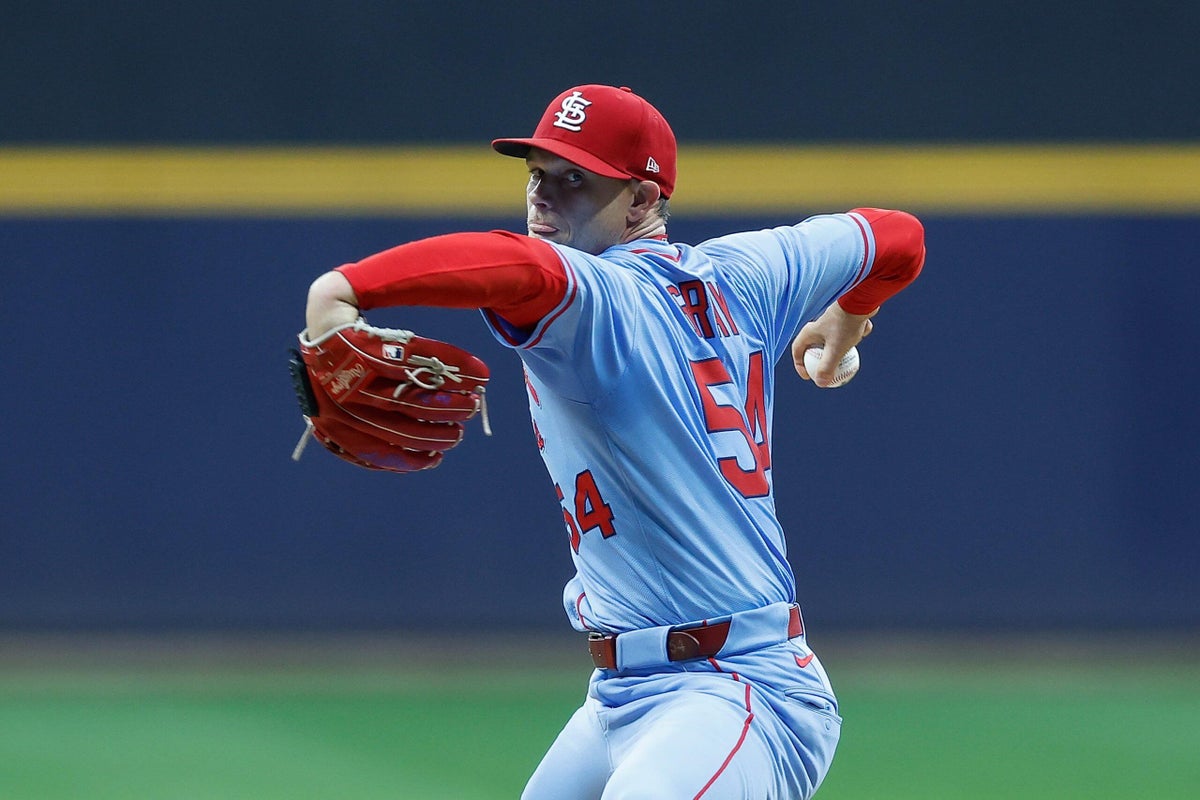
Just 15 days after Boston Red Sox chief baseball officer Craig Breslow labeled a frontline starter to pitch behind Garrett Crochet in a postseason game as a priority for the club, he traded two pitchers to the St. Louis Cardinals for veteran right-hander Sonny Gray on Tuesday.
Gray, a three-time All-Star and American League Cy Young Award runner-up in 2023, fit the mold as a solid No. 2 in past seasons, but what is the 36-year-old capable of providing in 2026?
“When you think about what Sonny has been in this league, it’s a guy who’s been to the front of rotations,” Breslow said in a videoconference. “Those things that we think pitchers carry from year to year are things like strikeout rates and walk rates and ability to stay off barrels, he excels there. So we’re really excited about adding a guy that was coming off back-to-back 200 strikeout seasons and shouldering a significant workload.”
With Opening Day still months away, Breslow didn’t think it made sense to put a number on a starter this early. He also didn’t rule out adding to the rotation.
For his part, in waiving his no-trade clause, Gray showed his desire to once again pitch in a big market for a playoff contender.
Despite lingering concerns over his rotation place, there were several qualities that stood out to Red Sox officials. Pairing his 200-strikeout potential behind Crochet was a driving force, according to a team source. He finished with a National League-leading 5.29 strikeout-to-walk ratio.
Sonny to the Sox.
Welcome to Boston, Sonny Gray! pic.twitter.com/cZ88JDCINy
— Red Sox (@RedSox) November 25, 2025
Strikeouts have an increased value for a club with infield defensive issues, particularly as starters Brayan Bello and Lucas Giolito provided a more contact-oriented approach in 2025. Bello recorded 124 strikeouts in 166 2/3 innings, and Giolito collected 121 punchouts in 145 innings.
Gray’s durability is also something the Red Sox value. Crochet carried the rotation last season over 205 1/3 innings, but Bello and Giolito, who dealt with injuries, pitched roughly 40-50 innings fewer.
While an NL evaluator noted Gray is more of a five- or six-inning starter at this point, he still made 32 starts in 2025. His 180 2/3 innings would’ve ranked second in Boston, and in each full season since 2019, Gray has made 24 or more starts.
Another attractive quality, according to a team source, is Gray’s ability to limit pull-side damage to right-handed hitters, meaning fewer balls off Fenway’s wall in left. Gray allowed 16.3 percent pull-side balls in the air last season, slightly better than the league average of 16.7 percent. Overall, Gray held lefties to a .668 OPS compared to a .788 OPS versus righties.
Still, he’s not perfect.
He’s not Crochet 2.0 and profiles more as a No. 3 starter at this point in his career. But he clearly has attributes the Red Sox value. That they moved so quickly at the start of the offseason in securing him suggests an urgency not to miss on adding to the starting group. In Gray, they are upgrading the rotation with a veteran pitcher that will cost just $21 million after the cash return.
Previously, the Red Sox declined to offer Giolito the one-year, $22.05 million qualifying offer. Gray represents a similar, if not better pitcher than Giolito, for roughly the same price. In doing so, the Red Sox acquired a starter without the need to give up any top prospects or position players.
Breslow did acknowledge that Gray’s one-year deal, as opposed to some other longer free-agent contracts, gives the club flexibility for some of its young pitching prospects to break into the rotation come 2027.
At the trade deadline, the Red Sox were tied to Minnesota Twins starter Joe Ryan, but they couldn’t line up on a package for the 29-year-old. At the time, the Red Sox did not want to include a big league outfielder in the deal, and the Twins were not interested enough in the proposal presented. In Gray, they’ve acquired a starter without the upside and youth of Ryan but have parted with just two young pitchers in Richard Fitts and Brandon Clarke, meaning the Red Sox can use bigger prospect packages elsewhere this winter to bolster the rotation or upgrade the offense.
Fitts pitched in the rotation and bullpen each of the last two years, but he also dealt with injuries that kept him from finding a solid footing. Clarke, while not among Boston’s top 10 prospects, looked promising as a product of Boston’s pitching development system, despite dealing with a recurring blister that skewed his numbers.
At the end of the season, Gray noted a desire to be traded to a contending team as St. Louis was entering a rebuilding phase. The Red Sox, having reached the playoffs for the first time since 2021, have intentions of remaining in the postseason hunt with a young core. Gray adds to Boston’s playoff experience, as Crochet was the only starter with October experience, albeit via the bullpen as a member of the Chicago White Sox.
Breslow noted Gray’s eagerness to pitch alongside Crochet and desire to help each other get better. Gray possesses a solid, but not spectacular, track record in the postseason with a 3.26 ERA in six postseason starts for the Athletics, Twins and New York Yankees.
Gray’s desire to come to Boston raised questions, however, about returning to a big-market team. He was vocal about how much he didn’t like his time in 2017-18 with the Yankees. In 41 games, 34 starts, Gray posted a 4.51 ERA, his worst-career stretch.
Those familiar with Gray indicated it wasn’t the big market Gray didn’t like, but the way the Yankees wanted him to pitch. Gray was intrigued by the Red Sox because they don’t want to change him.
On Foul Territory TV, Gray’s former teammate and catcher Erik Kratz echoed a similar sentiment, noting the biggest problem in New York was a “contradiction of pitch usage” in which pitching coach Larry Rothschild wanted Gray to throw more of his slider while Gray wanted to mix in his curveball.
“Everyone was real quick to play the narrative of, ‘Oh, big market, the pressure got to him,’” Kratz said. “But I was there watching him. It wasn’t the pressure of the market.”
“We’re sitting in the bullpen in the playoffs, and he’s like, I just wanna throw how I wanna throw.”
Sonny Gray’s struggles with the Yankees shouldn’t influence how Red Sox fans feel about how he’ll perform in another large market, says @ErikKratz31. pic.twitter.com/oPW3Sm6j4K
— Foul Territory (@FoulTerritoryTV) November 25, 2025
The Red Sox have added one starter, though that doesn’t mean they can’t add another piece to the rotation, but at this point, the priority will be adding a power bat to the lineup. As Boston’s offseason has officially gotten underway, the early addition of Gray signals a busy winter ahead.