
When the season ended last month Red Sox chief baseball officer Craig Breslow identified several areas of need he expected to focus on this offseason. One was improving the club’s rotation, specifically by adding a frontline starter who could potentially start a playoff game.
Tuesday morning, Breslow did just that.
This week the Red Sox made their first big move of the winter, acquiring veteran right-hander Sonny Gray and cash considerations from the St. Louis Cardinals in exchange for right-hander Richard Fitts, left-handed pitching prospect Brandon Clarke and either a player to be named later or cash.
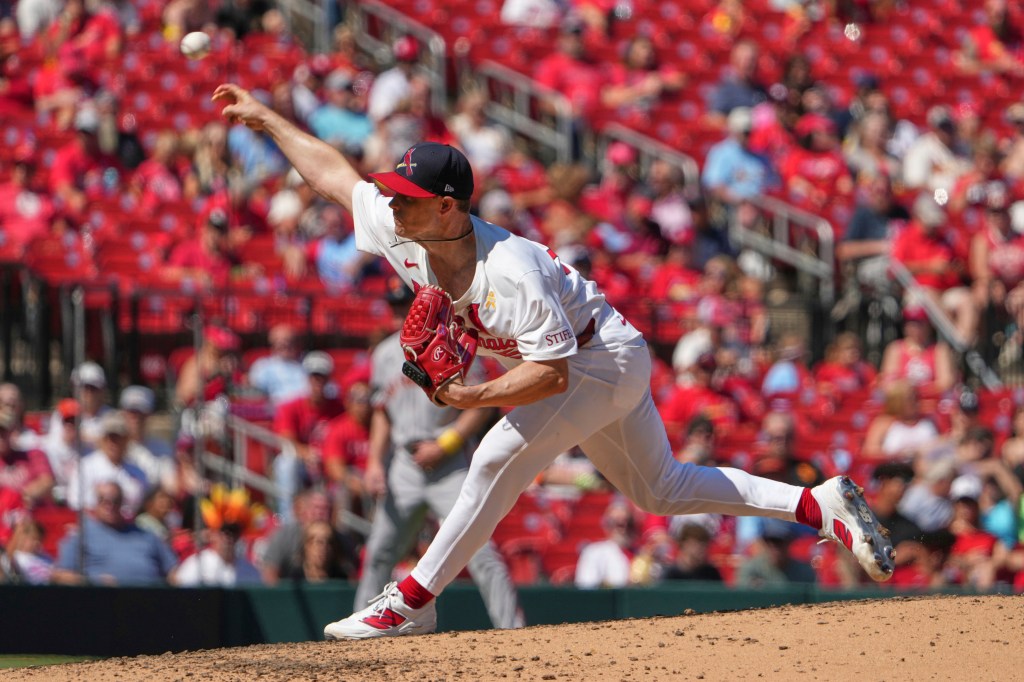
The 36-year-old Gray is a three-time All-Star who immediately slots into the top of Boston’s rotation behind ace Garrett Crochet and alongside Brayan Bello, but can he be the No. 2 starter fans have clamored for?
Here are some thoughts on the Gray trade and what it means for the Red Sox.
Consistent arm with high upside
Throughout his career Gray has been one of the most durable and reliable starters in MLB, so at minimum he should raise the rotation’s floor.
Since making his big league debut in 2013 Gray ranks fourth among all MLB pitchers in starts (330), sixth in innings pitched (1,918) and seventh in strikeouts (1,925). He has a 3.58 career ERA, five seasons with 3-plus wins above replacement and has finished top-10 in the Cy Young vote three times.
Gray has remained effective into his mid-30s too. His best season came in 2023 with the Minnesota Twins when he posted a 2.79 ERA in 184 innings to finish as AL Cy Young runner-up. He then signed a three-year, $75 million deal with the Cardinals and topped 200 strikeouts in each of his first two seasons in St. Louis.
“When you think about what Sonny has been in this league it’s a guy that has pitched at the front of rotations, and those things we think pitchers carry from year to year, things like strikeout rates and walk rates and ability to stay off barrels, he excels there,” Breslow said. “So we’re really excited about adding a guy that’s coming off back-to-back 200 strikeout seasons and shouldering a significant workload.”
All told, Gray’s track record suggests he should be a valuable contributor for the Red Sox. The question is whether that alone will be good enough.
A legit No. 2 starter?
The news of Gray’s acquisition prompted a mixed reaction from fans and outside observers. Some were happy the Red Sox found a way to acquire a pitcher of Gray’s caliber at a relatively low price, while others were disappointed the Red Sox didn’t aim higher.
The Red Sox could certainly still make another big ticket addition, but if they don’t is Gray enough to give the Red Sox a championship-caliber rotation?
This past season Gray went 14-8 with a 4.28 ERA, 201 strikeouts and 38 walks in 180.2 innings. His 5.29 strikeout to walk ratio was the best in the National League, and while his ERA wasn’t anything special, his 3.39 Fielding Independent Pitching mark ranked seventh in the NL.
For those unfamiliar, Fielding Independent Pitching measurers a pitcher’s performance based on events they control — like strikeouts and walks — while removing the effects of team defense and other random factors. The fact that Gray’s FIP was nearly a full run better than his actual ERA suggests his numbers were victimized by bad luck and poor defense.
Time will tell what kind of impact Gray ultimately has, but between his recent performance and the fact that Boston was willing to take on $21 million of his 2026 salary, there’s good reason to believe the Red Sox think he can be their No. 2 starter.
Improved farm depth pays off
Tuesday’s trade was a perfect example of how a team can benefit from a deep farm system.
Barring unforeseen circumstances Gray will be one of Boston’s most important starters next season, and the Red Sox were able to get him without having to give up any of their top prospects. Instead they were able to send out Fitts and Clarke, and while both are talented young pitchers with considerable upside, neither had a clear path to earning regular playing time in Boston.
Fitts faced a fierce battle in spring training for one of the Red Sox’s last rotation spots and potentially could have opened the season in Triple-A. Clarke, meanwhile, has electric stuff but is likely at least a couple of years away from reaching the majors. He also runs the risk of maxing out as a reliever if he can’t improve his command.
Breslow said that while it’s never comfortable trading away starting pitchers, it would be foolish to ignore the depth they’ve built up and the way they can use their surplus of young arms to fortify the big league roster.
“Nobody will sit in this chair and say they have enough starting pitching,” Breslow said. “Our job is to continue to develop that and create this internal pipeline and understand who are the guys we need to be cornerstones of this team and who potentially are pitchers we can use in trades to address other needs on our roster.”
How will Gray impact payroll?
Gray is in the final year of his contract, which was reportedly reworked so that he’ll be guaranteed $31 million in salary plus a $10 million buyout for when his 2027 mutual option is declined, as mutual options almost always are.
Of that $41 million, the Red Sox will be on the hook for roughly half, with the Cardinals footing the bill for the remaining $20 million.
According to Red Sox Payroll on Twitter, who has accurately tracked the Red Sox’s payroll since 2011, Gray’s acquisition will bring the club’s 2026 payroll to just under $225 million, or $19 million under the first Competitive Balance Tax threshold.
With numerous other additions expected, the Red Sox are likely to clear the CBT for the second straight year.
What’s next?
Now that the Red Sox have addressed the starting rotation, Breslow is likely to shift his focus to the position player market.
In addition to potentially bringing back Alex Bregman, the Red Sox are known to be looking for a power bat. Free agent sluggers Pete Alonso and Kyle Schwarber are two of the top players available in free agency, and if neither of them work out the Red Sox could also pursue Japanese stars Munetaka Murakami and Kazuma Okamato, both of whom were posted for MLB clubs to sign earlier this month.
The Red Sox could also still try to trade one of their five starting-caliber outfielders, most likely one of Jarren Duran or Wilyer Abreu, and the club also needs to add left-handed relief help.