
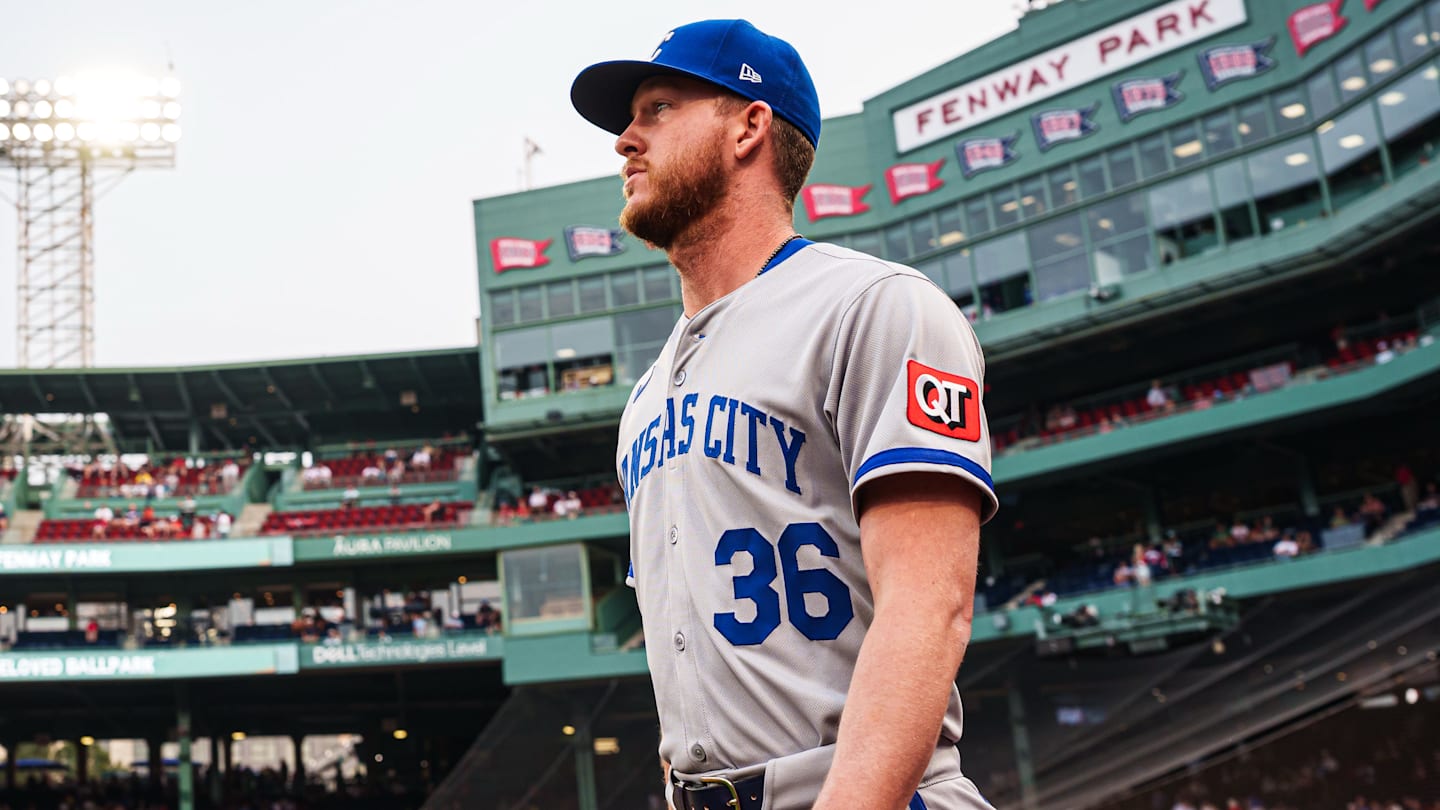
Being a fly on the walls inside Kauffman Stadium last week would have been interesting. That’s when the Kansas City Royals made the necessary decisions to set their 40-man roster for both arbitration and Rule 5 draft purposes. Some of those moves, like tendering deals to Vinnie Pasquantino, Maikel Garcia and Lucas Erceg, passed with nary a shrug or second thought.
Others, though, left close and casual observers alike scratching their heads. Especially curious, aside from keeping and giving Jonathan India a new deal, were some of the club’s pitching decisions.
Why, for example, did the Royals keep Bailey Falter? How could they let Taylor Clarke go? Is bringing James McArthur back too risky?
Those moves pose major questions for the 2026 season. How general manager J.J. Picollo and manager Matt Quatraro answer them will be interesting.
What will Bailey Falter’s role be with the Royals next season?
That’s hard to say. Hoping to shore up his club’s injury-riddled rotation for what proved to be a futile stretch run, Picollo shipped prospects Evan Sisk and Callan Moss to Pittsburgh to get Falter at the trade deadline.
The lefty was a respectable 7-5 with a 3.73 ERA at the time, but pitched badly in what turned out to be short service for Kansas City.
How bad was he? Opponents unmercifully battered Falter for 15 runs and 20 hits in the 12 innings he managed to pitch before a left bicep problem forced him to the injured list in late August and limited his subsequent 2025 work to a minor league rehab assignment.
It was at least slightly surprising, then, that Falter survived the non-tender deadline. But keeping him has some upside — he’s under team control through the 2028 campaign, and he has experience starting and relieving, which makes him a swingman candidate for next season.
That Falter has no minor league options left suggests he’s a viable candidate for an Opening Day roster spot. The Royals probably want to get a longer look at him, but he won’t be around long if he struggles early.
Where might James McArthur fit on the Royals’ roster?
Only one place, and that’s in the bullpen, where not so long ago he made a serious run at the closer’s job.
After his astonishingly bad June 28, 2023, major league debut — Cleveland pounded him for seven runs and six hits in only an inning — he finished the season with a remarkable 12-game run during which he struck out 19 in 16.1 innings, didn’t surrender a run or issue a walk, and saved four games. McArthur appeared ready for a big role in the club’s future.
And the 18 saves he recorded in 2024 suggest he was, indeed, prepared for a long and bright Royals career.
But McArthur also struggled, so much so that the 2.63 ERA with which he finished April ballooned to 5.32 at the end of May. The promise of a decent June — he went 2-1 with a 1.80 ERA and three saves — disappeared in July when he gave up 10 runs in just 8.2 innings. And his much better August ERA of 1.50 was swallowed up when he yielded four runs in just 2.1 innings in September and landed on the injured list with a season-ending elbow injury.
That McArthur then missed all of the 2025 campaign made Kansas City’s decision to tender him a 2026 contract curious at best, and strange at worst; the post-injury risk is obvious.
But so, too, is that McArthur was quite effective for a time, and the Royals don’t give up on players easily. Whether he recaptures the magic of his late-2023 season or the form that produced 18 saves in 2024 remains to be seen, but the club is willing to find out.
McArthur may begin 2026 at Triple-A Omaha (he has an option to burn), but expect the Royals to give him another big league bullpen shot before the season ends.
Who will replace Taylor Clarke in middle relief for the Royals?
Clarke was far from the 2025 bullpen’s weakest link. Yes, he struggled early, but a strong 1.82 ERA, 20-appearance second half confirmed his value and seemed to render him all but a lock for a 2026 roster spot.
That made the Royals’ decision to non-tender him surprising and left them with a middle-relief role to fill. Because their best work seems to come in late-inning situations, John Schreiber and newcomer Alex Lange probably aren’t candidates for the job.
But Angel Zerpa and Daniel Lynch IV could be. The Royals tend to deploy Zerpa later rather than sooner — Quatraro utilizes him most frequently from the seventh inning on. But his career 4.03 ERA across the fourth, fifth, and sixth innings is better than the 4.81 he’s posted over the final third of games.
Lynch, however, fares even better in the middle innings, where he worked to a 3.21 ERA in 21 games this year. He’s also quite reliable — only two of the 21 runs he inherited in 2025 scored, and he’s allowed less than 20% of inherited runners to cross the plate during his five-season big league career. Give him the early edge over Zerpa.