
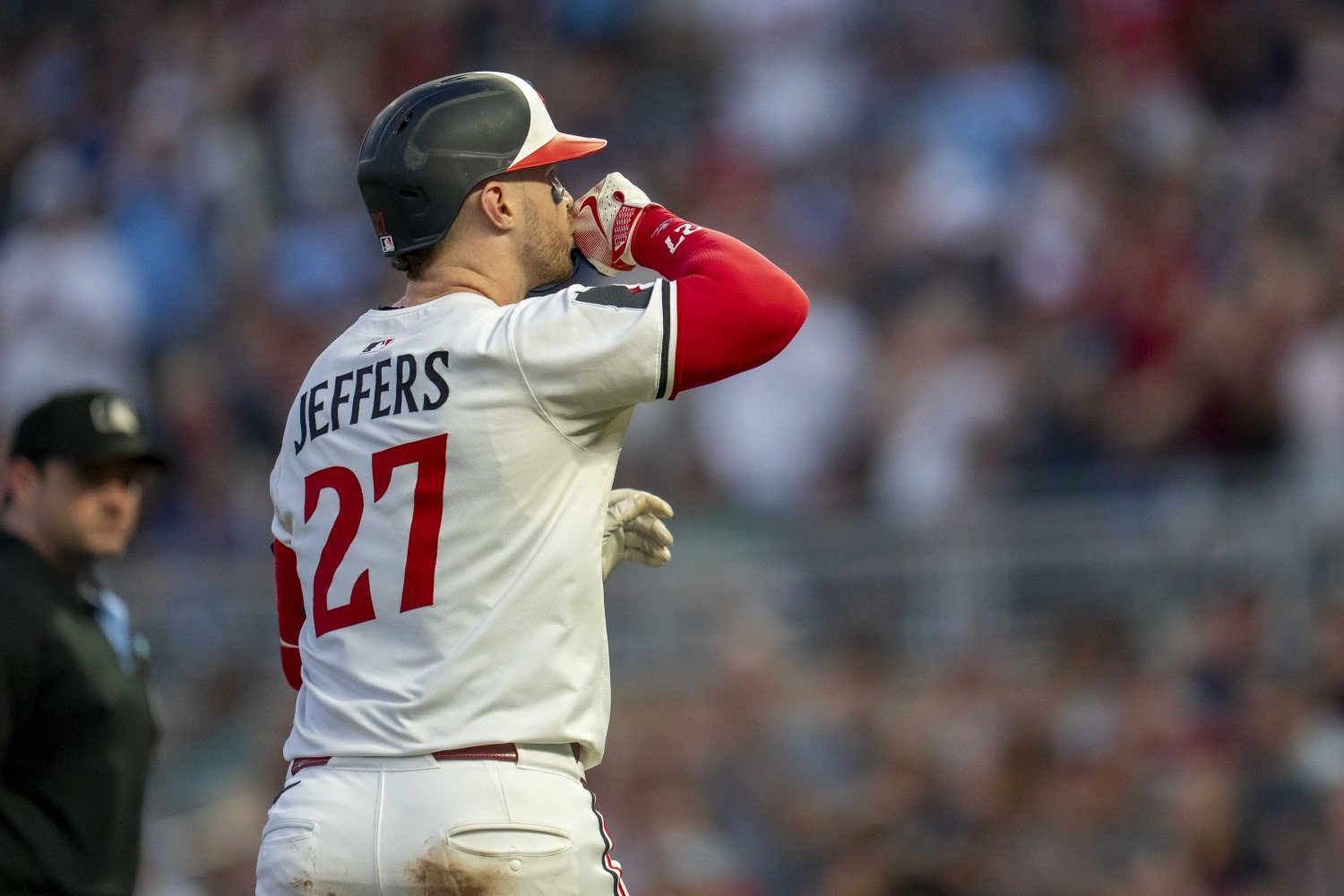
Last Friday, the Minnesota Twins traded for veteran catcher Alex Jackson from the Baltimore Orioles for Triple-A utility player Payton Eeles. Jackson’s acquisition all but solidifies the position for next season, with him serving as Ryan Jeffers‘s backup—perhaps with Jhonny Pereda and Mickey Gasper serving as depth options in Triple A. Still, with Jeffers in his final season under team control and the organization rostering no MLB-caliber catchers in the high minors, significant concerns remain about the position’s long-term depth.
Minnesota’s current projected 2026 payroll hovers around $89 million, including Carlos Correa‘s $11 million (paid to Houston) and with estimated earnings for players with unresolved arbitration cases. Despite operating under strict, unnecessary spending limitations, team decision-makers should still have the spending power necessary to extend Jeffers. Meaningful negotiations between the front office and Jeffers’s representation are unlikely to occur until the organization’s new limited partners are officially announced. Still, optimism about the Twins’ ability to extend Jeffers should persist.
Despite not being a top-10 catcher in baseball, the 28-year-old is one of the AL’s best offensive backstops, solidifying himself as a key right-handed bat in the middle of Minnesota’s lineup. Obviously, he isn’t deserving of an extension on par with what Cal Raleigh (six years, $105 million) or Will Smith (10 years, $140 million) received in recent years. Nor, however, will he sign for peanuts. Realistically, Jeffers could net a contract in the three-year, $30-million range, identical to the contract the Twins handed Christian Vázquez before the 2023 season.
As of now, Jeffers and reliever Justin Topa are the only 40-man roster inhabitants set to depart the organization after next season, clearing roughly $7.6 million from a payroll that (as mentioned earlier) is already under $100 million. Players like Joe Ryan, Bailey Ober, Royce Lewis, and Trevor Larnach (if he isn’t traded this offseason) will reach arbitration-3 status next offseason, making them more expensive. Also, pre-arbitration players Matt Wallner, Kody Clemens, and Simeon Woods Richardson will reach arbitration-1 status, similarly making them pricier. Still, Minnesota will have one of the lighter payrolls in baseball entering next season, meaning the club has the financial cushion necessary to hand Jeffers a multi-million dollar raise over multiple seasons.
The 2027 regular season is likely to be affected by a work stoppage (even if the lockout ends before any games are actually lost), muddying the picture of how valuable extending Jeffers would be for Minnesota. For that reason, Minnesota is unlikely to offer him a one-year extension. Considering how thin the club’s catching depth is behind Jeffers in the high minors and the fact that top catching prospect Eduardo Tait isn’t anticipated to make his major-league debut until 2028 or 2029, the organization might not have a choice but to extend their veteran backstop to a multi-year contract, despite their recent reluctance to hand out eight-figure contracts. That’s ok. He’s worth it, and the room to invest in him is there.