
Long before the world knew him as the two-way unicorn who throws 102 mph fastballs and launches 500-foot home runs, a 16-year-old boy in rural Iwate Prefecture sat down with a single sheet of paper and drew a perfect 8×8 grid. In the center square he wrote, in careful teenage handwriting:
 “Be selected No. 1 by all eight NPB teams.”
That sheet (now famous in Japan as Ohtani’s “mandala chart” or “dream sheet”) was built on the Harada Method, a deceptively simple yet brutally effective system created by Takashi Harada, a once-obscure junior-high track coach who turned the worst team in the country into national champions for six straight years.
The Harada Method is not motivational fluff. It is a relentless exercise in reverse-engineering greatness.
How the grid works
 1. The Open Heart Goal
At the very center sits one audacious, ego-free purpose. For Ohtani it was not “make lots of money” or “become famous.” It was to become so undeniably excellent that every professional team in Japan would have to pick him first. The goal has to be objectively measurable and slightly terrifying.
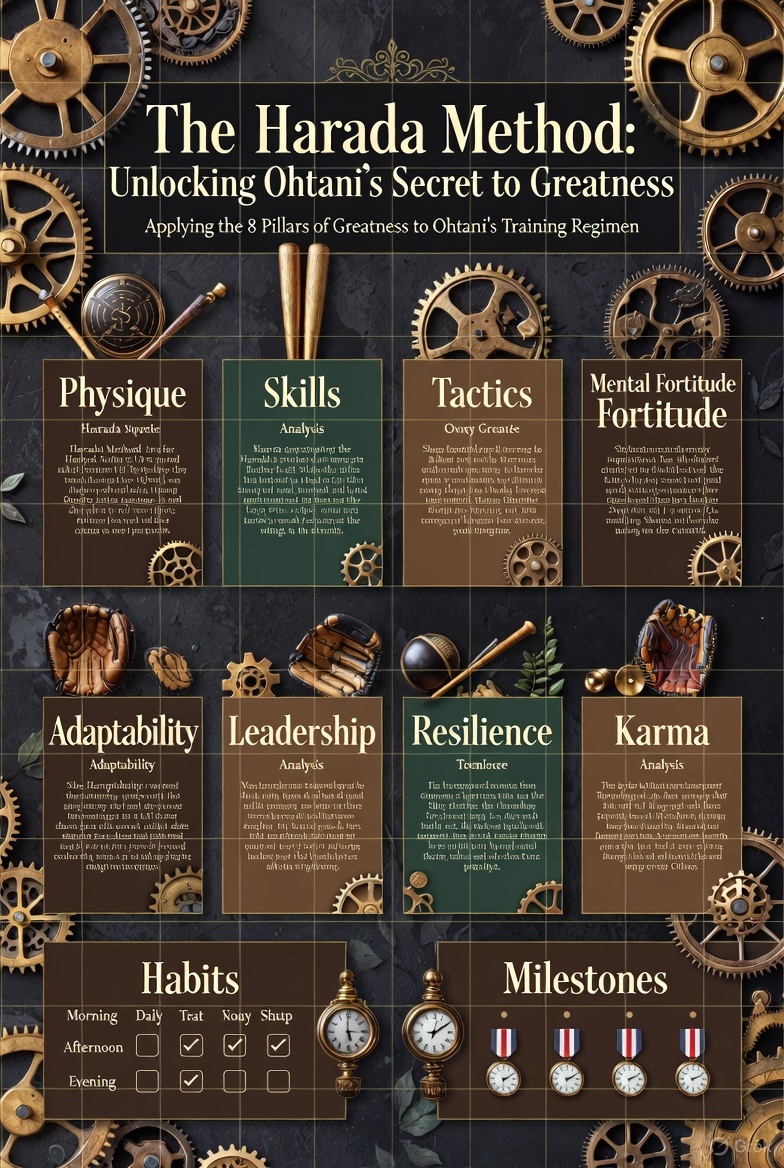
2. The Eight Pillars
Around the central cell you place the eight domains you must master to reach that goal.
Ohtani’s were:
Physique;
Control (command of pitches);
Sharpness (mechanical efficiency);
Speed (both pitching and running);
Pitch repertoire;
Character;
Luck/Karma;
Mental toughness.
Notice that only five are purely physical. Three are intangible.
 3. The 64 Actions
Each pillar is broken into eight concrete, repeatable behaviors. For “Luck/Karma,” one of the most famous sections, Ohtani wrote:
Pick up trash in the dugout and around the field;
Bow deeply to umpires and opponents;
Greet everyone with energy;
Be the kind of person others naturally want to support;
Keep the locker room spotless;
Thank the bus driver;
Read one book every two weeks;
Write thank-you letters.
For “Mental toughness” he listed things like “strike out and smile on the way back to the dugout” and “never blame the umpire, even in my heart.”
4. Daily Execution & Review
The completed chart becomes a living checklist. Every night Ohtani marked which of the 64 micro-habits he had executed perfectly. Over years, thousands of tiny green checkmarks turned an ordinary high-school arm into a once-in-a-century phenomenon.
The coach who started it all
Takashi Harada took over a track team that finished dead last among 380 schools. Using the same 64-square system, he won the regional championship in three years and held the title for the next six. Later he left teaching to train corporate executives (Toyota, Panasonic, Suntory) and troubled youth alike. The core insight is mercilessly simple: world-class success is the accumulated residue of world-class habits, and the fastest way to install those habits is to make them visible, countable, and tied to a purpose bigger than ego.
Also read:
Why the “Karma” column matters most
In the West we tend to separate skill from character. The Harada Method refuses to. Ohtani’s chart explicitly states that cleaning the field, helping teammates stretch, and reading books are just as important as adding 1 mph to his fastball. His reasoning, repeated in interviews: “If you become the kind of person people want to see succeed, the universe finds a way to help you.”
The results speak louder than philosophy. In 2012 every single NPB team did indeed try to draft him No. 1. The Hokkaido Nippon-Ham Fighters won the lottery and immediately promised to let him hit and pitch (something no Japanese team had ever allowed). Five years later he was in Anaheim rewriting baseball history, and in 2024 he became the first player ever to hit 50 home runs and steal 50 bases in the same season while throwing triple-digit heat.
The sheet of paper is now displayed at the Baseball Hall of Fame in Cooperstown next to Babe Ruth’s locker. A boy’s 64 squares turned into the most complete baseball player the modern era has ever seen.
Greatness, it turns out, is just a grid that you refuse to leave unchecked.