
When the Chicago Cubs acquired Michael Busch ahead of the 2024 season, it was clear where the upside existed. He was a bat-first prospect without a true defensive home and, as a result, without a pathway to playing time with his former team in Los Angeles. Typically with a prospect that fits that profile, you worry about the athleticism aspect and whether there’s a glove to play at all, let alone where to play it.
In Busch’s case, though, he had the athleticism; the Dodgers had deployed him primarily at second and third base as an upper-level prospect in their minor-league ranks. The Cubs, however, made the almost-immediate decision to entrench him at first base, a position where the team lacked a long-term solution. The immediate returns were promising, too.
Over the course of that first season, Busch demonstrated improvement on both sides of the ball. He finished above average by wRC+ in each individual month (save one), progressively cut down on his strikeout rate throughout the season, and ended the year with his highest isolated power figure in an individual month (.243). Defensively, he landed on the positive side of the Outs Above Average threshold, finishing with 2 OAA.
Even with such steady improvement throughout his rookie campaign, the needed areas of improvement were clear. The ideal progression would’ve included a continued decrease in what landed as a 28.6 percent strikeout rate, more consistency on the power side (.192 ISO for the full year), and further (and sustainable) development on the defensive side. There were intricacies therein, but those represented the simple version of the pathway toward improvement for Busch ahead of ’25.
Busch’s percentile distribution from this season alone is indicative of him meeting the moment:
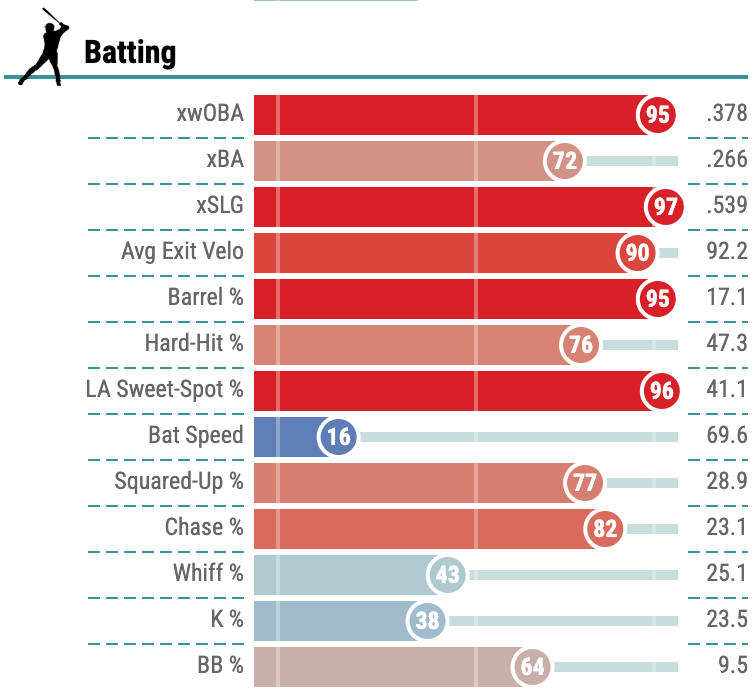
Above all, Busch was able to drive his power numbers way up via his quality of contact. The fact that he ended the year with a .261 ISO is indicative of a hard-hit rate that graduated from 39.9 percent in 2024 to 47.3 percent in 2025. That output came against fastballs and off-speed pitches, each of which represented his two highest swing rates among the three pitch groups (breaking balls being the other). They sat neck-and-neck, with fastballs accounting for a 48.2 percent swing rate and off-speed at a 48.3 percent mark. While there were still some swing-and-miss issues, the approach was illustrative of a good process on Busch’s part. Good process begets hard contact which, in turn, begets impact output. Hence, the near-70-point ISO jump year over year.
Busch didn’t demonstrate quite the same growth defensively, however, as his OAA dropped to -2. Of course, first base is a difficult position to judge on metrics alone. It is worth noting, though, that his work to his right dropped from 1 OAA in ’24 to -4 OAA in ’25. It’s a strange development considering the defensive wizardry occurring to his right in the form of Nico Hoerner. Nevertheless, the metrics are indicative of a step back with the glove.
Which, at least, offers continued clarity in what shape Busch’s next phase of development could take.
There’s a need for continued improvement in the contact game. The quality of contact and chase rates are each, in their own way, indicative of a player with a keen awareness of the zone. Approach isn’t the concern. Instead, Busch needs to demonstrate continued improvement in the swing-and-miss element of his game, particularly on off-speed pitches. Given the high volume of swings against that pitch type, the fact that Busch is whiffing at off-speed 37.9 percent of the time (easily his highest against any of the three primary pitch groups) represents a clear developmental target. The outcomes with contact are positive. He simply needs to make more of it.
That lands in conjunction with additional consistency on the defensive end. Again, it’s hard to judge first base on the merits of analytics alone. But given Busch’s decline that unfolded specifically in moving to his right, there’s some work to be done. Doing so as a right-handed fielder at this particular position isn’t easy (and that fact is likely some of what pinned down his OAA last year), but when you’re working with a second baseman who thrives to his left (4 OAA for Hoerner in that direction), the statistical outcomes should look at least a little bit better in a larger, multi-year sample.
It almost feels somewhat “nit-picky” given the massive strides that Michael Busch made between 2024 and 2025 to suggest he needs to find another gear. He finished this past year as an upper-tier power bat with a refined approach. Now in possession of a clear skill set and a defensive home, it’s a matter of more specific improvement. Development isn’t linear, but the fine-tuning stage should yield only a better player, not one in need of a total profile overhaul.