
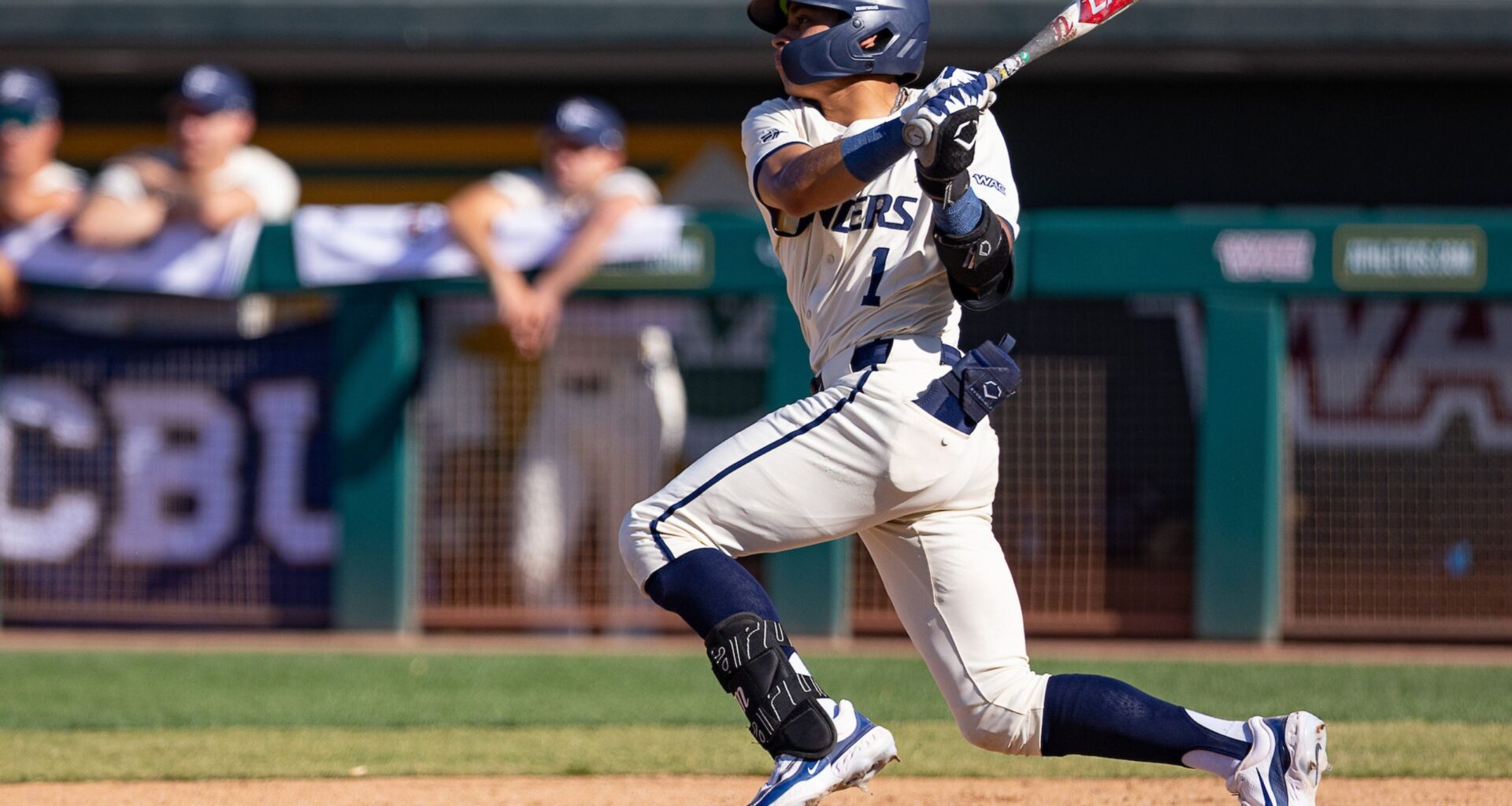
In conjunction with Ben Badler’s 2027 high school draft rankings update, we’re jumping over to the college side to break down five 2027-eligible hitters who are headed in the right direction as the season approaches.
The 2027 draft is a lifetime away and lots will change before then, but you can expect to see these prospects on the expanded 2027 college draft list we’ll be releasing later this month.
Ian Armstrong, C, Saint Mary’s
Armstrong hit the ground running last spring, slashing .364/.402/.576 with 19 extra-base hits and 40 RBIs across 45 games. He didn’t play over the summer, but next year he’ll suit up for the Yarmouth-Dennis Red Sox in the Cape League.
Armstrong stands almost straight up in the box with an ear-high handset. A noticeable leg lift leads into a pretty standard stride, though he will sometimes land with his front side a bit closed off. It’s not a “make or break” trait for an offensive profile, as 2025 seventh-round pick Cam Maldonado did the same thing to a far more noticeable extent. Still, it is something to keep an eye on with Armstrong to see if it becomes a real hindrance when it comes to generating quality contact to his pull side.
Swing minutiae aside, Armstrong has above-average bat speed to go along with plus bat-to-ball skills. Last spring, he worked an 89% overall in-zone contact rate, including a 91% mark against all fastballs. Armstrong is a bit susceptible to secondaries and will sometimes expand the zone down and/or away against sliders and changeups, but it’s something that didn’t hold him back in 2025. He’s demonstrated an ability to use the entire field, and he profiles as someone with a fairly respectable hit-power combination. Neither tool will end up as plus, though both could be average come draft time. I know that might sound like an uninspiring sentence, but for a catcher who’s an impact defender, that’s a more than viable offensive profile.
I just alluded to it, but Armstrong’s calling card is his defense. Not only is he a quiet receiver who consistently works below the baseball, but he also moves well laterally. Armstrong’s footwork is advanced, and he has a plus arm to go along with quick, efficient transfers.
Already a pro-level defender, Armstrong also has solid building blocks offensively and could end up as one of the top collegiate backstops in the 2027 class.
Hank Gomric, OF, Saint Louis
As a freshman in 2025, Gomric was one of the Billikens’ most productive hitters to the tune of a .304/.397/.428 line with seven doubles, five home runs and 37 RBIs. He spent part of his summer in the Prospect League, where across a dozen games, he collected four extra-base hits and drove in six runs.
Listed at 6-foot-5 and 220 pounds, Gomric has a high-waisted and rather lean frame with room to fill out. It’s not all that hard to envision Gomric adding 15 or so pounds of good weight and having a more physical look to him when all is said and done. He tinkered with his stance and setup throughout the 2025 season, but towards the end of the year, Gomric kept his upright look and started with his hands somewhat far back to go along with a slightly-open front side.
Gomric moves well for someone his size and is a small-strider with budding bat speed. Like anyone that tall, he’ll need to continue to focus on keeping his long levers in sync throughout his swing, but the results were positive in his freshman campaign, and the foundation for a well-rounded offensive profile is in place.
To go along with his plus contact skills—last spring he posted an overall in-zone contact rate of 90%—it’s easy to be bullish on Gomric’s power potential. He already has present thump, to go along with no-doubt plus power upside. Gomric’s average exit velocity last spring was slightly over 90 mph, he has a knack for pulling the ball in the air and he goes after pitches in his “nitro zone.” Most of his long balls last spring came to the pull side, but he has shown the ability to drive the baseball into the opposite field gap. When you add in the fact that Gomric is a 6-foot-5 lefthanded hitter who will only get stronger, his profile becomes that much more exciting.
Defensively, Gomric spent all of last season in left field and flashed some range to either side. He’ll need to shore up his routes, and his arm strength is fringy, but it will be interesting to see where Gomric plays on the grass this spring and whether or not interim coach Matt Miller will give him some run in center field.
A blend of “now” tools and upside, Gomric is a name on which to keep close tabs both this season and next.
Matt Ineich, 2B/SS, West Virginia
Ineich slipped through the cracks a little bit in the portal, but make no mistake: He was a big-time get for coach Steve Sabins and his staff. The sophomore infielder is fresh off an excellent freshman season at Ohio, where he hit .387/.467/.514 with 12 extra-base hits, 25 RBIs and 21 walks to just 11 strikeouts. While Ineich’s Northwoods League stint was limited to just seven games, he made the most of it by going 11-for-28 (.393) with a trio of doubles and five RBIs.
Ineich stands fairly tall in the box with an ear-high handset and a slightly-open front side. He has a quiet, simple operation with minimal moving parts, resulting in a swing that is quick and compact.
Ineich’s calling card offensively is his hit tool. He is comfortable using the entire field to go along with double-plus bat-to-ball skills. Last spring, he posted overall and in-zone contact rates of 91% and 95%, respectively. He consistently moves the baseball, and both his approach and swing decisions are polished.
Ineich does a nice job of picking up shapes and seeing spin out of the hand. He seldom expands the strike zone, and only a few of his swings came outside the “shadow zone” on Synergy. Perhaps unsurprisingly, Ineich is very much a hit-over-power profile, and the vast majority of his power production—both collegiately and professionally—will likely come in the form of extra-base hits instead of home runs.
Ineich last season got plenty of run at shortstop and handled the position well. However, with Gavin Kelly back for the Mountaineers, Ineich will likely be their everyday second baseman. Ineich is a good athlete with quick feet and has shown comfort throwing from multiple slots, but from this chair, I think his defensive package profiles best at second base long term.
Chris Ramirez, SS, Cal Baptist
Ramirez wasted no time making an impact for the Lancers, and last season he hit .350/.424/.414 with 11 extra-base hits, 30 RBIs and a walk-to-strikeout ratio of 24-to-16 en route to taking home both WAC freshman of the year and defensive player of the year honors. Ramirez’s production didn’t stop in the spring, though. He made his way out to the Cape for the second half of the summer and hit .380/.475/.440 with three doubles, eight RBIs and 10 walks to only three strikeouts.
Ramirez fits the description of “hitterish” to a tee. He stands tall in the box with a narrow base, and a noticeable leg lift leads into a rather small stride. He has quickness in his hands, and his hand-eye coordination is elite. He adjusts remarkably well in his swing, and I would argue that his contact skills are the best among all college players in the class at this point.
At school, Ramirez’s overall and in-zone contact rates were a gaudy 91% and 95%, respectively, but this summer, he was arguably the hardest player to strike out in the entire Cape League. He swung and missed only eight times across a 17-game span and had only two whiffs against all offspeed offerings.
Ramirez does an outstanding job of staying in the middle of the field. While his power is well-below-average, his hit tool is plus, and he figures to continue to hit at a high level both in college and in pro ball.
Though undersized, Ramirez held his own and then some at shortstop last spring. He has a quick first step with great instincts, smooth actions and an advanced internal clock. Ramirez has particular range to his glove side and has shown that he’s comfortable attacking the baseball, throwing on the run and making plays from multiple arm angles. I cited Ramirez’s quick hands at the plate, and it’s also a trait evident on the dirt, both in terms of getting the ball out of his glove and on double play transfers. Ramirez’s arm strength—or lack thereof—might prevent him from sticking at shortstop long term, but he profiles as an at least above-average defender at second base. As a cherry on top, Ramirez’s baseball sense on both sides of the ball is fantastic.
Jake Souders, OF, Samford
Souders last spring cemented himself as one of Samford’s most impressive hitters by posting a .327/.391/.502 line with 22 extra-base hits and 46 RBIs. He didn’t miss a beat over the summer in the Great Lakes League, where across 12 games he hit .357/.431/.595 with seven extra-base hits and 12 RBIs.
At 6-foot-2 and 215 pounds, Souders has an athletic and physical frame with strength throughout. He has big-time bat and hand speed, and his loudest tool right now is his raw power. Souders last spring posted a maximum exit velocity of 114 mph—and did the same this fall with a wood bat—but he’ll need to optimize his angles a bit and pull the ball in the air on a more regular basis in order to maximize his in-game power. Souders’ contact skills taking a step forward would also help out in that regard. His bat-to-ball skills right now are slightly below-average, and he’s shown the tendency to both whiff and chase against spin.
Souders is a little bit of a stiff mover on the grass, and his off-the-bat reads and routes to the baseball will both need to improve. However, he has enough arm strength to handle either corner outfield spot.
At the end of the day with Souders, you’re likely looking at a power-first rightfielder who has 25-plus home run upside.