
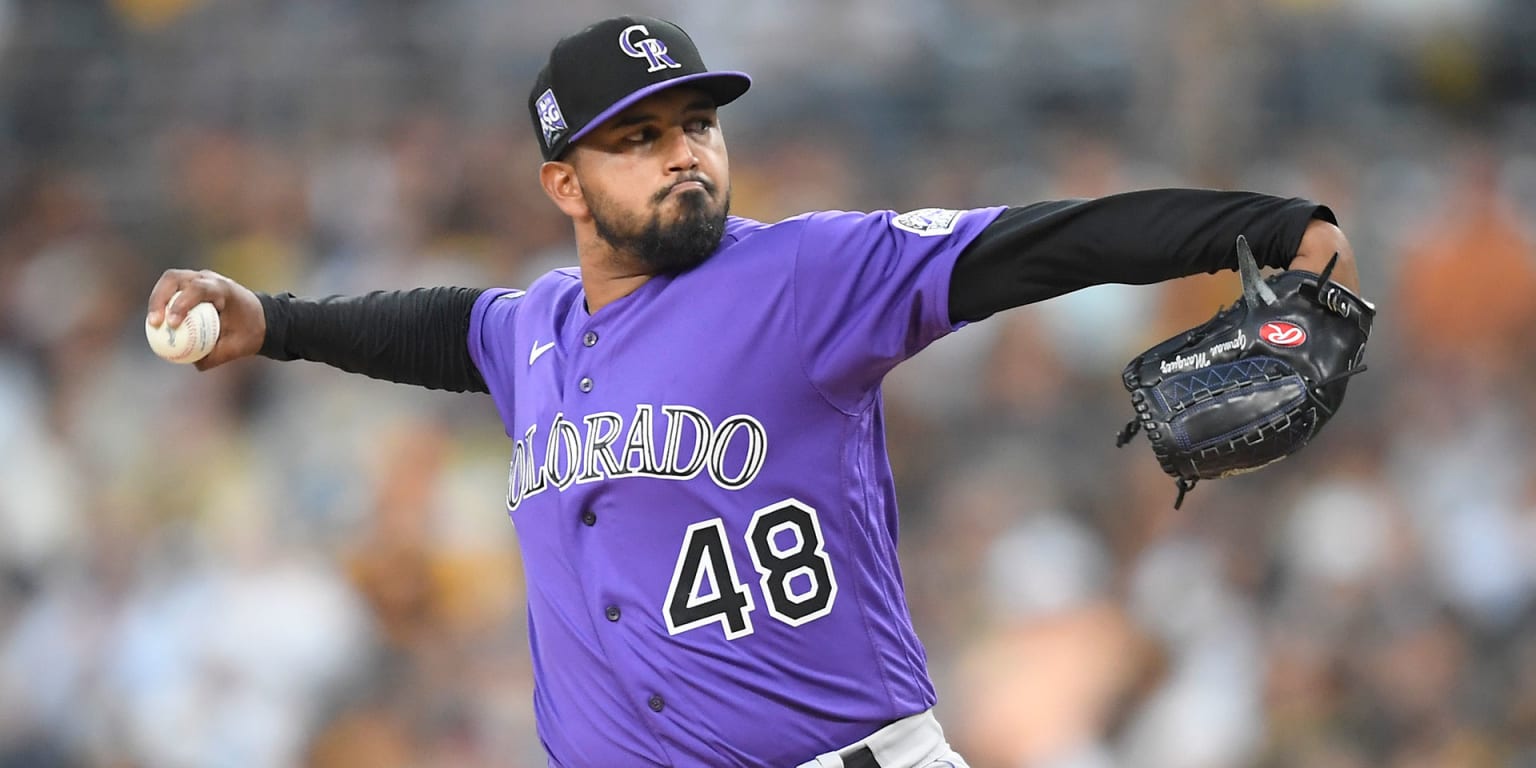
 Credit: AP Photo
With an uncertain rotation heading into the Winter Meetings, San Diego making an addition is a given. The extent of their spending is less certain, so with one of the league’s premier pitching coaches and pitching resource and development departments, a rebound candidate could very well be on the table.
Quite frankly, there is no arm in greater need of a rebound season than former Rockies All-Star German Marquez.
The right-hander came into the league quite well, as he finished fifth in Rookie of the Year voting in 2017. Marquez made the All-Star team in 2021, a season that saw him post 180 innings of 4.40 ERA (3.86 FIP) baseball. From his first full season in 2017 to the end of 2021, Marquez was one of the most dependable starters in baseball, pitching 793.2 innings to a 4.25 ERA, 3.84 FIP, 24% strikeout rate, and 6.9% walk rate. He also posted a ground-ball rate of 48.3% in that span, which served him well at Coors Field.
While he was never a true “ace”, Marquez provided the Rockies with solid production, which led him to sign a five-year, $43 million pre-arbitration extension that would lead him to free agency.

Starter Germán Márquez and the Colorado Rockies are in agreement on a five-year, $43M contract extension, pending a physical, league sources with knowledge of the deal tell ESPN. It includes a club option that can vest into a mutual option if he has two top-3 Cy Young finishes.
— Jeff Passan (@JeffPassan) April 2, 2019
After 2021, Marquez’s results began to trend in the wrong direction. Marquez’s 2022 season saw him post very identical advanced stats to his 2021 season, but his ERA and FIP spiked by almost half a run each. Marquez saw a 33% increase in home runs allowed, and his home ERA surged to 6.70 mark (with a 5.11 FIP to boot).
Marquez would go on to make only four starts between 2023-24, missing most of that time due to undergoing Tommy John surgery. Upon returning, he made one start in 2024 before missing the remainder of the season due to a stress reaction in his right elbow. He was able to shake off the arm troubles for most of 2025, missing a month from late July to late August due to shoulder inflammation.
However, the results were not back to prime Marquez, as he posted a groan-worthy 6.70 ERA in 26 starts (126.1 innings). The advanced numbers don’t paint a pretty picture either, as among pitchers with at least 120 innings pitched, his FIP was sixth-worst in the league at 5.47. xERA and xFIP had an equally pessimistic view on his season, as his 5.79 xERA and 5.35 xFIP were each fourth-worst among pitchers with as many innings.
Looking at the pitch data is just as bleak. Fangraphs’ Stuff+ model had only one of Marquez’s five pitches (the knuckle-curve) as above average with a 113 Stuff+. His four-seam, sinker, slider, and changeup were all below-average. Of the four, only the slider was close to average (91 Stuff+ – 9% below the average slider).
The run values were objectively not good, as he ranked in the 1st percentile in total pitching run value and fastball run value; his breaking balls were in the third percentile. Marquez barely used the changeup, throwing it only 50 times in 2025, but it registered a -2 run value. The knuckle curve was the only pitch in his entire arsenal to have a batting average against below .300 at .210. His other offerings were tattooed all season, with opponents slugging over .500 against everything else.
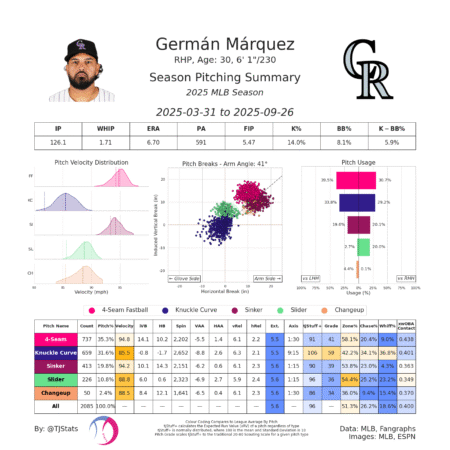 Graphic by Thomas Nestico (@TJStats)
So, considering that his biggest contribution in 2025 was his 126.1 innings, Marquez makes sense for the Padres, considering their lack of upper-minors starting pitching depth. Padres starters were 21st in the league in innings pitched last season. Of San Diego’s arms, only Nick Pivetta, Randy Vasquez, and the freshly departed Dylan Cease topped Marquez in innings pitched last season.
Marquez’s market is unlikely to be the most demanding, considering his lack of innings from 2023-24 and borderline disastrous results in 2025. With that in mind, his market value could be in line with what Patrick Corbin and Kyle Hendricks got in the 2024-25 offseason. Kyle Gibson’s 2025 Orioles deal could also be in the ballpark, considering Marquez’s youth compared to other veteran arms (Marquez will be 31 on Opening Day). A one-year deal in the $3-6 million range with a team option for 2027 could very well be in the cards should a pairing occur between the Padres and Marquez. Once the signing happens, then he and the Padres’ pitching staff can get to work on his arsenal.
Getting Marquez out of Coors Field is step one to the signing. Pitching at the notoriously pitcher-friendly Petco Park could be beneficial for Marquez, who was more of a fly-ball pitcher in 2025. Marquez has made 12 career appearances at Petco Park, where he has gone 6-4 with a 4.88 ERA. However, that ERA has ballooned as a result of two 2025 outings, so the numbers look like this:
2016-2024: 10 G (9 GS), 59.1 IP, 6-2, 3.94 ERA, 3.70 FIP, 68 K, 16 BB, 29.3% K, 6.9% BB
2025: 2 GS, 7 IP, 0-2, 15.40 ERA, 5.50 FIP, 3 K, 0 BB, 7.3% K, 7.3% BB
Before 2025, Marquez pitched well at Petco Park, even in the Padres’ brown and gold era. His best outing in that span came back in 2021, when he struck out nine in seven shutout innings on July 10, 2021.
Pitching half his games at Petco with the marine layer early on in the season could bring his numbers back to serviceable, but getting the most out of Marquez will require more than simply a change of scenery. Marquez’s stuff has always had below-average movement compared to comparable right-handed pitchers. Adding late life to the four-seamer and sinker can certainly help with that, as can the location of his offerings. Marquez’s fastball was mostly landing in the heart of the zone, which led to batters hitting .358 against it.
His sinker also sat low and in to right-handed batters (or low and away for left-handers). Putting these pitches in what can be considered “hot zones” was simply poor philosophy or execution from an outside perspective. While Marquez posted an overall Location+ of 95, his curve and changeup posted Location+ marks of 88 & 81, respectively. These numbers indicate that Marquez struggled at throwing his secondaries where the target location was. Part of this struggle can come from the elevated nature of Coors Field, but NL West teams were particularly tough for him on the road.
Doing some research on German Marquez and found the most bonkers stat I’ve seen in a while:
2025 Marquez on the road vs non-NL West teams:
3.11 ERA in 43.2 IP (8 Starts)
2025 Marquez on the road vs NL West teams:
14.70 ERA in 24.1 IP (7 Starts) pic.twitter.com/kv1lwPkdtU
— Diego Garcia (@StatNerd_Base) November 29, 2025
Pitching at Petco compared to Coors Field takes care of half the issues. A change in his pitching philosophy could be in the cards. Marquez’s heat maps, as previously discussed, show a pitcher who lived in the heart of the zone. Marquez has used his knuckle curve as his larger breaking pitch to generate swings and misses below the zone, while his slider has been reserved for the low and outside corner. If there is something that Marquez lacks, it’s a breaking ball with significant horizontal movement. His slider possessed below-average tail and break compared to the average around the league for right-handed pitchers, and as a result, generated a pedestrian 23.2% whiff rate.
Since high-spin breaking pitches suffer as a result of the Colorado altitude, pitching at a much more controlled environment like Petco could be the proving grounds for implementing a sweeper into his arsenal. Adding in a sweeper at a 41-degree arm angle would not require a significant change to Marquez’s mechanics, as arms like Shawn Armstrong and Jason Adam sit in a similar angle and get between 12-15 inches of break on their sweepers. Working with the Padres’ staff on developing a sweeper could allow for Marquez to provide more differentiation between his breaking balls. Adding a pitch with horizontal movement could allow him to generate more whiffs on his knuckle curve and slider, especially if they come from the same arm slot.
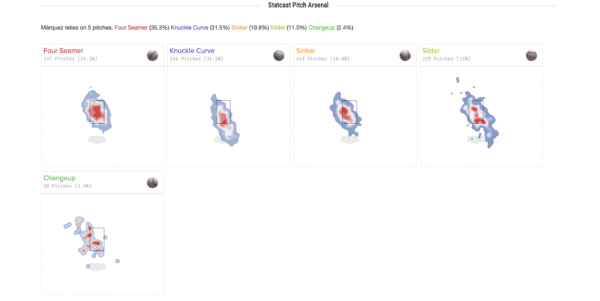 Pitch Maps by Baseball Savant, MLB
Lastly, while Marquez got hit harder by right-handed batters in 2025, left-handed batters hit .311 with a .922 OPS against him. His biggest weapon against left-handers was the curveball, using it 34% of the time, while going to either a fastball almost 60%. His changeup was only used 4% of the time against left-handers, which was in line with his career norms. While this may have been done for the sake of getting ground balls, it also reflects part of the issue.
Marquez’s changeup was still significantly below-average compared to the average comparable changeup, as it had 12.1 inches of tail, but nowhere near enough drop. For comparison, Joe Musgrove used the changeup 8% of the time in total in 2024, but most of that usage came against left-handed batters. Musgrove’s changeup had nearly identical horizontal movement to Marquez, but with six inches more drop. Marquez’s changeup could see more drop away from Colorado, so finding a way to incorporate the offering against left-handed batters could provide him a weapon for soft contact against powerful left-handed batters, something the NL West is chock-full of.
With the Padres in need of starting pitching and with an uncertain amount of money available for spending on the market, taking a flier on an arm in need of a bounce-back is a very likely option. German Marquez, coming off a nightmare season, is likely on the hunt for a prove-it deal to give new life to his career. Under the circumstances, it’s hard to name a better fit.

A born and raised San Diegan, Diego Garcia is a lifetime Padres fan and self-proclaimed baseball nerd. Diego wrote about baseball on his own site between 2021-22 before joining the East Village Times team in 2024. He also posts baseball content on his YouTube channel “Stat Nerd Baseball”, creating content around trades, hypotheticals, player analyses, the San Diego Padres, and MLB as a whole.
A 2024 graduate of San Diego State, Diego aims to grow as a writer and content creator in the baseball community.
Continue Reading