
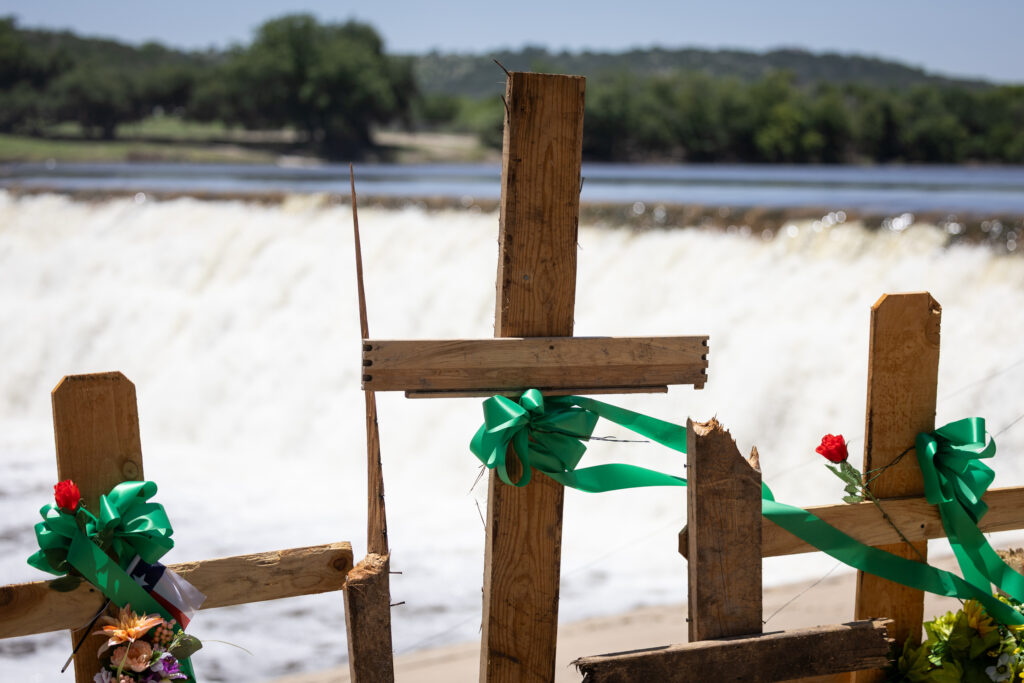
Back in July, the Texas Hill Country was hit by catastrophic flash flooding that killed at least more than a hundred people, displaced thousands of residents and caused more than $1 billion in property damage.
The human stories from this event are heartbreaking and the recovery has been slow – and the Texas Rangers are taking a major role in the effort.
Hundreds of Rangers and criminal investigation special agents have spent months in the area trying to safely recover and identify the remains of the victims. Right now, all but two people have been accounted for.
Peter Holley is senior writer for Texas Monthly and he’s been following this story. He joined the Texas Standard to discuss his recent piece. Listen to the interview above or read the transcript below.
This transcript has been edited lightly for clarity:
Texas Standard: I know for several days after the event on that July 4 weekend, there were many who were still unaccounted for. Where does that toll stand right now to the best of your knowledge?
Peter Holley: Most of the victims have been recovered, the vast majority in fact. The actual toll is 119 people lost their lives.
But there’s two victims in particular, Cile Steward, a Mystic camper, an eight-year-old little girl, and Jeff Ramsey, a 63-year-old father, who are still missing. And the Rangers are in the process of desperately still looking for their remains.
I think a lot of people seeing the response to that weekend, those deadly rains… It has been a massive ongoing effort and I think a lot of people are a bit mystified – why, after all this time, there are still two people missing.
What are the explanations that you’re hearing?
I think it’s important to put the disaster into context, and part of that context is the size and scope of this flood.
You know, we typically focus on the Kerrville area, but the reality is that this flood crossed 127 miles. It’s pretty much the distance from Austin to Waco.
Your story focuses on Texas Ranger Captain John J. Miller and his crew. Why did you want to focus on that team and how is this investigation going from their standpoint?
Yeah, I focused on John, in part, because I found out that John Miller – who has this incredible background both as a Green Beret and a person who’s getting his Ph.D at Texas State – but he’s also from Kerrville himself.
This is an individual who grew up with his family swimming in the very river that he’s now searching for missing people.
» GET MORE NEWS FROM AROUND THE STATE: Sign up for Texas Standard’s weekly newsletters
This recovery effort seems to be going in phases and you note that right now the Rangers are in phase five. What does that mean? What does that entail?
Yeah, phase five is a very technical effort to find the victims. It involves a whole bunch of different types of mapping.
One of the most impressive ones is hydrostatic mapping, in which Rangers are creating a three-dimensional scan of under the water and looking for places where they may have missed body parts.
They’re also relying heavily on satellite imagery, and the result of that imagery is that researchers and searchers can then go pinpoint locations where there’s anomalies on the ground and they can follow up on foot.
They’re also using drones in this effort. So you’re getting mapping tools and an effort to find victims from all sorts of different ways, and they’re still very, very much engaged in that effort.
Well, I think we’re getting a better understanding of what made this particular flood so catastrophic and one of the things that you point out in the story is just the sheer topography of this area.
Could you say more about that and how it’s been such a factor?
Yeah, when you look at the ground, which the Rangers have been doing – of course, extensively by looking at maps and historic maps as well – you notice that the area around the Guadalupe River, particularly around the South Fork, is extremely sloped. These are high slopes that would be difficult for anybody to walk up or even drive up.
And the result of that is that water poured down those slopes and into the Guadalupe River and created this rush of water that was, I guess, reinforced by the slopes.
In a typical flood, the Guadalupe may have gone down more quickly. But because of the slopes and the streams that were coming off the slopes, the water stayed much higher for much longer, which trapped bodies and trapped debris and made this entire flood much more catastrophic.
I know in preparing this story you spent considerable time in Kerrville. What is your takeaway from how folks are doing there right now?
You know, I think that any time a tragedy takes place in an area where people have had recreational memories and memories of happiness, a place like the Guadalupe, a community is forced to renegotiate its relationship with that river. And I think that’s a process that takes a lot of time.
And I think if you look at it from the big picture, I think we’re still at a fairly early point in that renegotiation process. I think people are still deeply involved in therapy, they’re still raising money, and, in fact, they’re still pulling the clothes of little kids out of that river.
So we’re still pretty early on, and I think it’s gonna take a long time, maybe years, for people to make peace with what happened there.