
Want more ways to catch up on the latest in Bay Area sports? Sign up for the Section 415 email newsletter here and subscribe to the Section 415 podcast wherever you listen.
The good news for Giants fans is that Duane Kuiper and Mike Krukow have no plans to move aside anytime soon. Change has been steady in the front office and dugout, but the lovable broadcast tandem has remained a constant – they’re among the franchise’s most longest-tenured employees.
“We have never even had a conversation about retiring,” Krukow told The Standard, “but we’re at a point in our lives where we don’t take for granted what we’re doing, and we don’t waste an opportunity. We never know when it’s going to be our last broadcast. It’s just the way it is. We take every broadcast and treat it like it’s going to be our last one, which I think is healthy.”
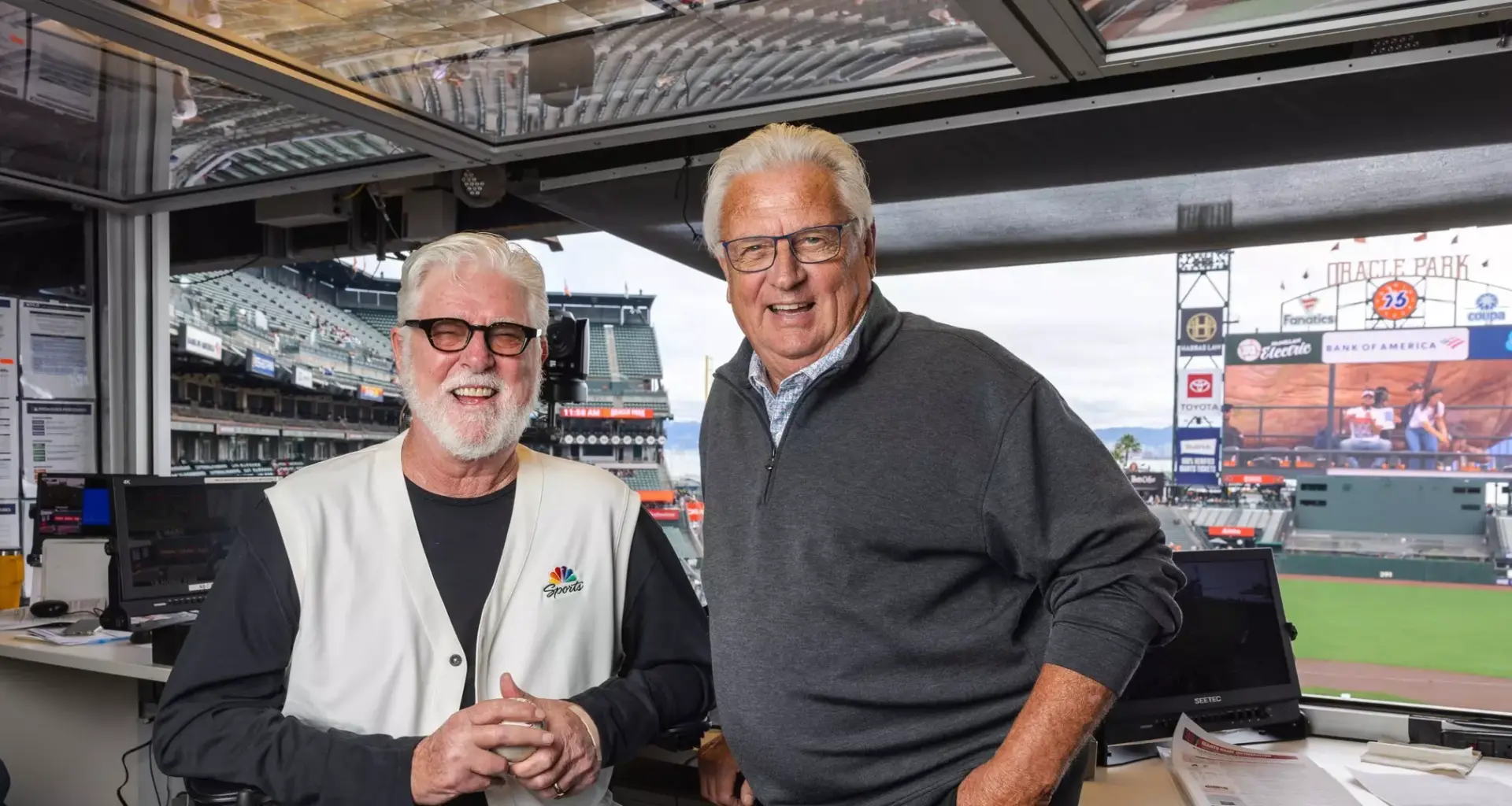
Kuiper, 75, and Krukow, 73, grew up together in the game. As players, broadcasters, and friends. Now they can’t imagine life away from the ballpark or broadcast booth. Or, for that matter, each other.
“Sitting next to each other for four or five hours,” Kuiper said in a separate Standard interview, “how can you not say, ‘Well, I want to do this until I absolutely can’t do it,’ and that’s where we’re at.”
We don’t yet know who’ll fill out rookie manager Tony Vitello’s rotation or bullpen or who’ll play right field, but we do know that when the season starts in March, Kruk and Kuip plan to be together in the TV booth along broadcast row in the Oracle Park press box.
Since their partnership was initiated in the early 1990s and became permanent in 1994, they’ve seen, done, and called it all. They ushered out Candlestick Park and ushered in Pac Bell Park. They chronicled all the Barry Bonds home run chases. They told the stories of the 2010, 2012, and 2014 World Series runs. They described the developments of six managers (going on seven) and hundreds and hundreds of players. They’ve been named in various polls as baseball’s top broadcast twosome. And they won more Emmys than we care to list here.
Through it all, their chemistry, knowledge, and humor have been warmly welcomed into homes and establishments throughout Northern California and beyond.
“We are really lucky, and we know it,” Krukow said, “and we don’t take a day for granted.”
The relationship has not wavered – in fact, it probably has grown – since Krukow began calling road games from the NBC Sports Bay Area studio, due to his degenerative muscle disease (inclusion body myositis) that has prevented him from traveling. Kuiper has had a significant health issue of his own, having missed part of the 2021 season as he underwent chemotherapy.
Nevertheless, the “splitcast” has been a major hit.
 Alma Lynch holds the curtain as Kuiper and Krukow prepare for an on-camera appearance during a TV broadcast. | Source: Amanda Andrade-Rhoades/The Standard
“We don’t get to be together on the road, but yet, here I am in San Diego, and he’s in a monitor literally a foot away from me,” Kuiper said. “I can see him, and he can see me. I can talk to him, and he can talk to me. And then in two hours, we’re going to actually call a game together. Well, how does it not get any better than that?
“And it works. We have people now who say, ‘We can’t tell that you’re in one town and he’s in another’ just because we’ve done it for so long.”
6 days ago

Friday, Nov. 21

Tuesday, Nov. 18

Kuiper and Krukow need not prove themselves to anybody. Anyone who has listened to them over the years gets it. But there’s this one thing that’s missing, that has somehow eluded both of them, that isn’t required or necessary to justify their broadcasting excellence – yet it still would be cool to achieve.
It’s the Ford C. Frick Award, which is annually presented to one baseball broadcaster during the Hall of Fame induction weekend in Cooperstown, N.Y. Kuiper and Krukow have been on the ballot several times each without the outcome Giants fans have desired.
Kuiper is one of 10 candidates on the latest ballot, the results of which will be announced next Wednesday at baseball’s winter meetings in Orlando. The electorate, which includes previous Frick award recipients (the Giants’ Jon Miller and 12 others) and three broadcast historians, voted in November and was asked to consider the candidates’ “commitment to excellence, quality of broadcasting abilities, reverence within the game, popularity with fans, and recognition by peers.”
It all epitomizes Kuiper. Then again, many fan bases across the baseball landscape would argue their guy on the ballot is deserving: Brian Anderson, Joe Buck, Skip Caray, René Cárdenas, Gary Cohen, Jacques Doucet, John Rooney, Dan Shulman, and John Sterling.
 Duane Kuiper is on the Ford C. Frick Award ballot this year. | Source: Amanda Andrade-Rhoades/The Standard
While many Giants fans would love for Kuiper and Krukow to be honored in Cooperstown together, that’s not possible for now. While the hall has considered altering its guidelines, it doesn’t believe a change in the number of award winners every year needs to be amended, hall president Josh Rawitch reiterated this week.
It must be noted that the first year the award was presented, 1978, Mel Allen and Red Barber were co-winners, the only time there were multiple recipients. Allen and Barber were partners on Yankee broadcasts in the 1950s and 1960s.
The next best thing for Giants fans is for Kuiper and Krukow to be honored individually, and whoever gets in first might just say something affectionately such as, “This award is for both of us.” Not that it would suffice in Giantsville, where folks believe both should be honored and join the likes of Miller in the so-called broadcasters’ wing in Cooperstown.
Next Wednesday’s Frick award recipient will be honored during the July 25-26 induction. The ensuing induction in 2027 could be a doozy for the Giants and their fans because Buster Posey will be eligible on the writers’ ballot for the first time and Bruce Bochy and Dusty Baker should be on the Contemporary Baseball Era ballot. Brian Sabean is eligible for that ballot as well.
However, no Giants broadcaster will be involved. That’s because every fifth year, the broadcaster ballot lists long-ago candidates whose careers ended before 1994, the start of the wild-card era, and that’s how it’ll play out for the class of 2027.
Anyway, the best news is that Kuiper and Krukow will remain partners in 2026 and beyond. Their two-year contracts run through the end of next season, but that’s a formality. They should be able to call games as long as they want. The more the merrier in fans’ minds.
Speaking of which … after Kruk and Kuip called nearly 25 road games together in 2025, there’s talk of pushing the number to 30 or a bit more in 2026. Along with all the home games.
 A view from the Giants’ broadcast booth overlooking the field at Oracle Park. | Source: Amanda Andrade-Rhoades/The Standard
Changes are coming on the roster and coaching staff, but the TV booth remains a source of comfort, familiarity, and friendly voices spanning generations of Giants history, thanks to Kuiper and Krukow – along with Miller, who joined the team in 1997, and Dave Flemming (2004), who generally call games on radio.
The Giants have been wise to leave them all alone and let them entertain audiences as they know how, and it hasn’t mattered which direction the on-field product has gone, including in the extreme days of analytic-driven Farhan Zaidi and Gabe Kapler.
“No one’s ever told us what to say,” Kuiper said. “They always appreciated us being former players. If anyone was going to say something, it would’ve been the regime that just left. But they didn’t. After 35 years, it would be hard for them to ask us to change our colors.”
The passion, energy, and performance remain unchanged. Kuiper said he still feels anticipation before every broadcast while Krukow said he still gets butterflies.
“We know what’s at stake here,” Krukow said. “We also know the history of this franchise and city. We know the expectations because of the people who preceded us. So there’s a good healthy pressure that you feel every day you come to work, and it does not allow you to phone it in because of what the people that had the job before you did and how professional they were with how they represented the game and this organization and city.”