
After last week’s first installment of our new Draft Gems series, we’re back this week with deep dives on five more mid-major college draft prospects who rank outside the top 100 on our current 2026 MLB Draft rankings.
As time marches on and our rankings eventually expand to 500, you can expect to see players from this series officially represented on the draft board. For now, though, these names represent some off-the-radar draft talent worth keeping an eye on heading into next year.
Carter Beck, OF, Indiana State
Beck began his career at Division II Mary University in Bismarck, North Dakota, where he hit .355/.432/.634 with 10 doubles, 12 home runs, 53 RBIs and 11 stolen bases. He didn’t miss a beat after transferring to Indiana State, as this spring he posted a .335/.417/.564 line with 15 doubles, 11 home runs and 56 RBIs en route to a first-team all-MVC selection.
Beck has a strong, athletic frame and has a slightly-crouched stance in the box with a medium-high handset and open front side. There’s a degree of explosiveness in Beck’s swing, and he has present bat speed. Beck’s hit tool—particularly as it pertains to laying off changeups down and away and shoring up his swing decisions—could use a coat of polish, but he does have above-average bat-to-ball skills. Last spring, he posted an overall in-zone contact rate of 88% and was consistently on the barrel. While Beck uses the entire field, he has displayed a particular knack for driving the baseball to the opposite field.
Beck’s data also stands out. On top of his 105.8 mph 90th percentile exit velocity, last spring he posted a maximum exit velocity of 111.2 and a 50% hard-hit rate. Getting more aggressive against pitches in his “go zone” and pulling the ball in the air more would likely pay dividends. We often talk about pitchers having “good clay to mold,” and the same applies here with Beck.
Beck’s arm in center field is fringy, but he’s an advanced athlete with good instincts. He flashes both gap and vertical range, and can really “go and get it” to make a play. Despite his modest arm, Beck’s supplemental defensive tools will give him a chance to stick in center professionally.
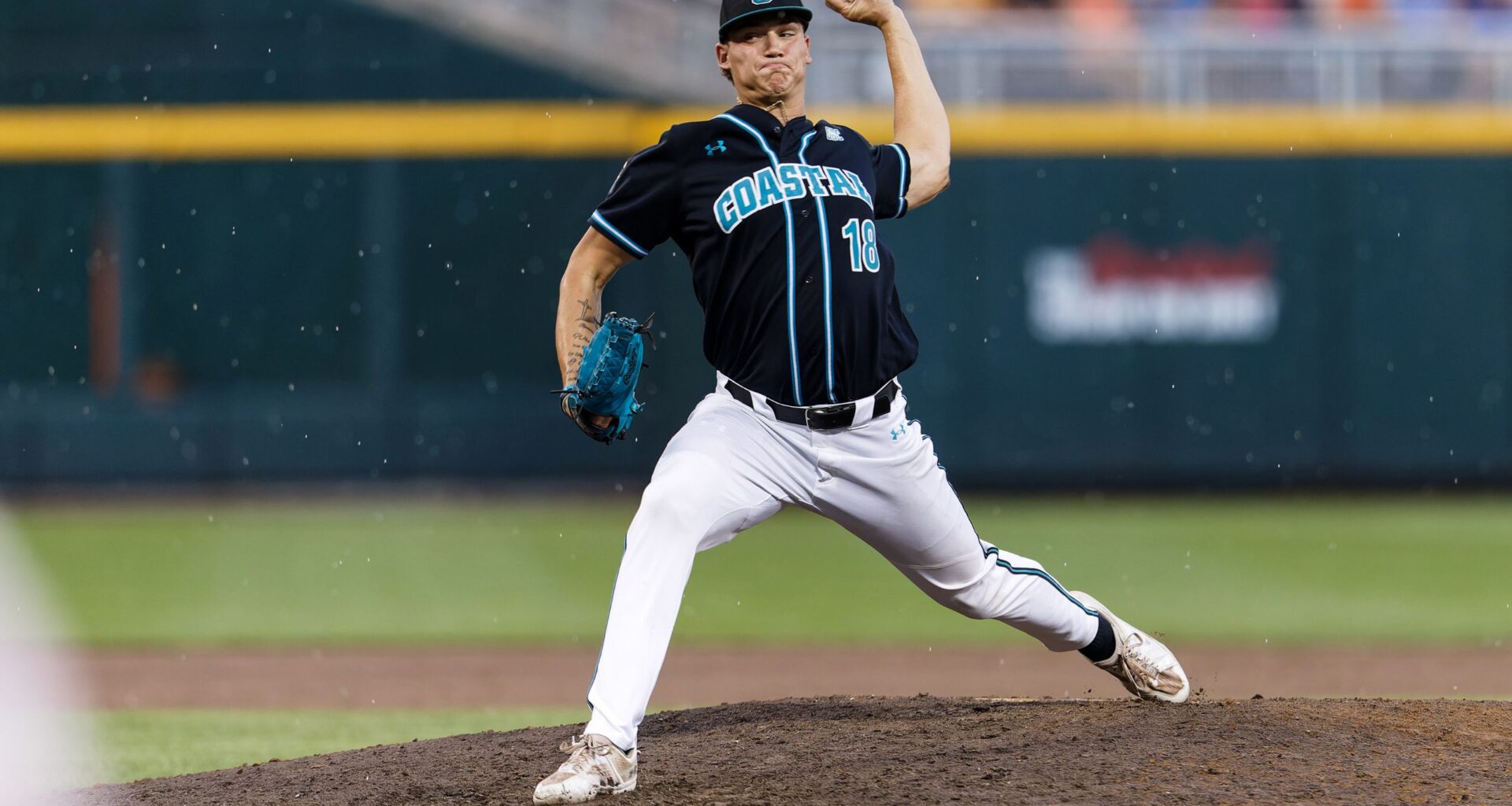
Hayden Johnson, LHP, Coastal Carolina
After logging meaningful innings as a freshman in 2024, Johnson took a major step forward in 2025 to emerge as one of Coastal Carolina’s most trusted relievers. He was a key cog in the Chanticleers’ run to the College World Series final and worked a 2.82 ERA with 55 strikeouts to 18 walks across 38.1 innings.
Standing 6-foot-5 and 218 pounds, Johnson has a lean, high-waisted frame with budding physicality. He operates exclusively out of the stretch, has a fast, whippy arm stroke and attacks hitters out of a high three-quarters slot. There’s also a bit of drop-and-drive in Johnson’s operation, which plays in his favor.
Johnson’s fastball had an average velocity of 92 mph last spring, but it was up to 95 and generated impressive miss and chase rates of 31% and 35%, respectively. His fastball velocity isn’t necessarily thunderous, but the pitch averaged nearly 21 inches of carry to go along with solid spin traits—it averaged over 2,300 rpm in 2025—and a somewhat flat vertical approach angle. When you combine Johnson’s fastball quality with his ability to consistently locate it in the top half of the zone on his arm side, it’s not all that difficult to see why he regularly generates whiffs with it.
Johnson’s low-to-mid-80s slider is his most impressive offering. Given that he works exclusively on the first base side of the rubber, it’s a particularly tough look for lefthanded hitters. The pitch flashes plus with sharp and long lateral life to go along with late depth at times. For as good as Johnson’s slider is against lefties, it isn’t a one-trick pony. It’s also effective against righthanded hitters thanks to Johnson’s ability to manipulate its shape. Against righties, it will sometimes look like a true gyro slider, but other times, it will flash two-plane tilt when he’s looking to back-foot it for a swing and miss.
Johnson rounds out his arsenal with a mid-to-upper-70s curveball, which he predominantly deploys against righthanded hitters. It takes on an 11-to-5 shape with a bit of bite, but Johnson will sometimes get on the side of it.
Strictly a reliever to this point, Johnson could make the jump into Coastal Carolina’s rotation this spring. To that end, I would be shocked if whichever team drafts him in July doesn’t attempt to develop him as a starter.
Brett Lanman, LHP, Abilene Christian
Lanman has pitched in Abilene Christian’s weekend rotation since he was a freshman. In 2024, he took home WAC pitcher of the year and freshman of the year honors after working a 3.48 ERA with 79 strikeouts across 72.1 innings. While he didn’t have the same degree of success in 2025, Lanman still managed to collect 84 strikeouts across 72 innings before a solid three-start stint in the Cape Cod League that saw him allow four runs with 11 strikeouts in 10 innings.
Listed at 6-foot-5 and 236 pounds, Lanman has an ideal pitcher’s frame with particular length and physicality in his lower half. He has an abbreviated arm stroke and attacks hitters out of a near-over-the-top slot while creating natural deception. Lanman’s fastball, which sits in the upper 80s/low 90s and has been up to 95, plays up thanks to its under-the-hood traits. He creates north of seven feet of extension, which, combined with over 19 inches of ride, allows his fastball to get on hitters quick. Unsurprisingly, it’s most effective and generates the most empty swings when located in the top half of the zone.
Lanman’s upper-70s/low-80s cut-slider hybrid is his most reliable swing-and-miss pitch, though it’s shorter in shape. He completes his arsenal with a mid-to-upper-70s curveball that flashes depth but is pretty vanilla from a dynamism standpoint, as it lacks sharpness.
Between his body and above-average command, Lanman looks the part of a starter professionally. However, his secondaries will need to make a jump, and he’ll also need to add a true, viable third pitch. Lanman threw just six changeups in 2025, so it will be interesting to see if a player development department focuses on developing his “cambio.”
Reece Moroney, SS, Rhode Island
Following a 2024 freshman campaign in which he won the starting shortstop job, Moroney took a big-time jump this past spring and hit .356/.464/.462 with 17 extra-base hits, 42 RBIs and 24 stolen bases. He was an all-conference selection and finished out his summer on the Cape, where he went 6-for-15 (.400) with six RBIs in seven games.
While he has well-below-average power and always will, Moroney stands out for his hit tool. He stands fairly upright in the box with a slightly-open front side and high handset to go along with a small leg lift and minimal stride. Moroney’s simple swing comes without many moving parts, and he takes a direct path to contact with some quickness in his hands.
Moroney’s contact skills are plus, and last season he posted overall and in-zone contact rates of 82.5% and 89.2%, respectively. His pitch recognition skills are advanced, as well, and he does a nice job seeing shapes out of the hand. He posted an overall chase rate of just 21%, and his passiveness—his in-zone swing rate last year was just 61.9%—actually plays in his favor given his offensive approach.
Moroney defends well at shortstop, where he has an average arm to go along with solid actions. He has quick feet, takes good angles to the baseball and is comfortable moving laterally in either direction. Moroney’s afforementioned hand quickness is also evident on the dirt, as he gets the ball out of his glove efficiently and also gets off quick transfers when turning double plays. There’s a chance Moroney will need to move off the position as he progresses through pro ball, but his defensive skill set profiles nicely at second base.
As a cherry on top, Moroney is a plus runner who puts pressure on opposing defenses both when exiting the box and on the base paths. His legs also serve him well at shortstop.
Braydon Sanford, RHP, Oral Roberts
After experiencing typical freshman growing pains in 2024, Sanford made his way out West and enjoyed a productive summer with the Arroyo Seco Saints of the California Collegiate League. Across nine appearances spanning 10.1 innings, he pitched to a 1.74 ERA with 17 strikeouts against just three walks. He then established himself this spring as a stalwart in the Golden Eagles’ bullpen, compiling a 4.70 ERA with 37 strikeouts in 30.2 innings.
A high-waisted, 6-foot-4 righthander, Sanford has an athletic delivery that features a deep arm stroke, and he attacks hitters out of a high three-quarters slot with present arm speed. He relies heavily on his fastball-slider combination, which accounted for 91% of all pitches he threw last spring, per Synergy.
Sanford’s heater has been up to 97 mph and averaged nearly 20 inches of carry, though it’s not a real bat-misser at the moment. Below-average extension and stock spin traits are both contributing factors in that, but Sanford’s inconsistent command is perhaps the biggest culprit. If he can consistently locate the pitch in the upper portions of the zone, more whiffs should follow. Additionally, flattening his rather modest vertical approach angle of -4.88 degrees by improving his linear move down the mound would also likely yield positive results.
Shifting gears, Sanford’s low-to-mid-80s slider is a weapon and true swing-and-miss pitch. He throws it with conviction, and last spring it garnered an impressive 63% miss rate. It will flash two-plane break with some teeth at its best and is most effective against righthanded hitters. He has shown the ability to back-foot it against lefthanded hitters.
Sanford falls into the reliever bucket at the end of the day. Both his fastball quality and command will need to improve in order for him to maximize his two-pitch mix, but he will be a Midwest name to follow this spring.