
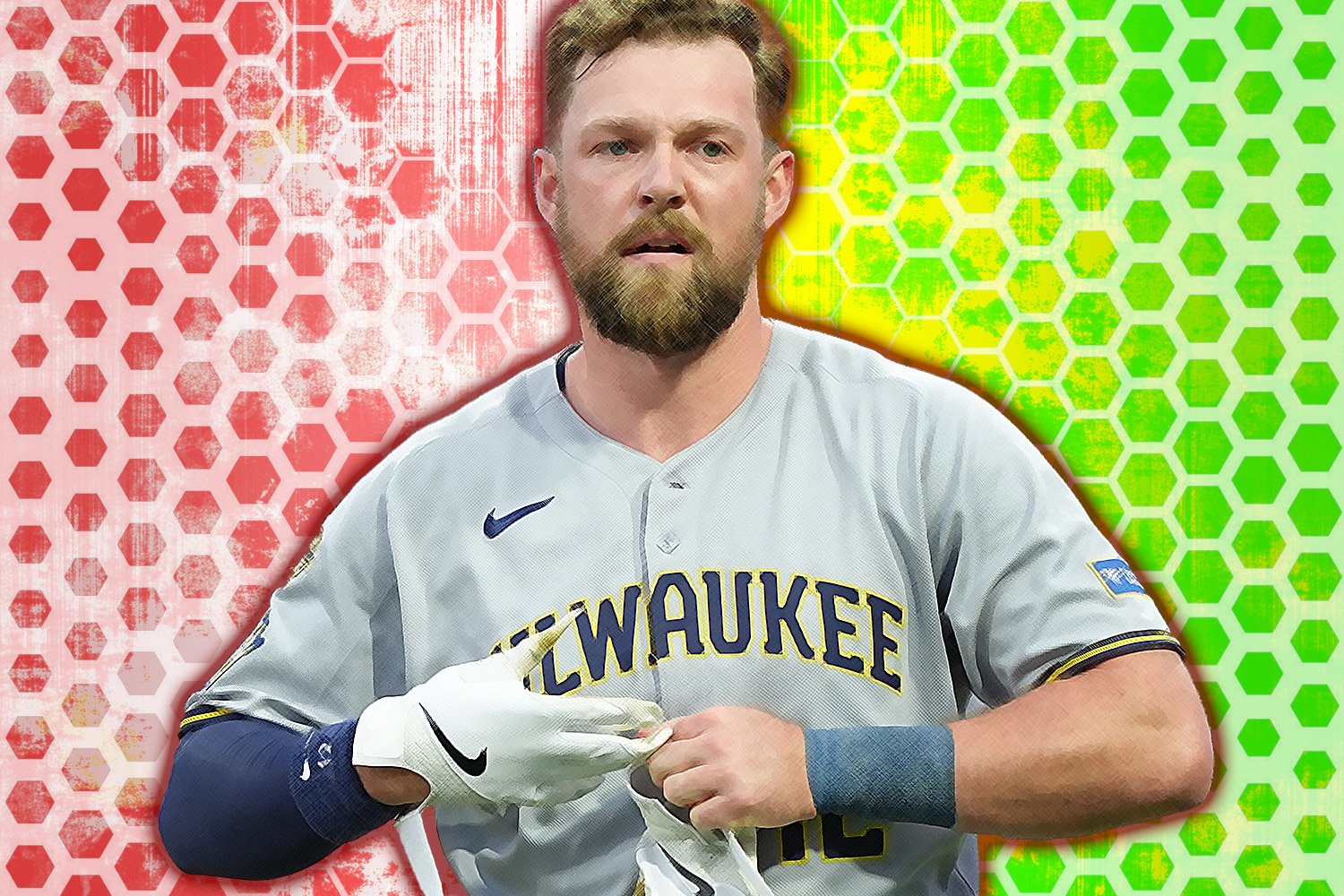
The Twins have quite a bit of work to do this offseason. Among the laundry list of gaping holes on the current team is first base, where they struggled to generate any meaningful offensive production last year. Minnesota’s first basemen combined for a .678 OPS in 2025, placing them 25th in MLB. With Ty France now gone, Kody Clemens sits atop the depth chart but doesn’t have nearly enough upside to get fans excited about the position heading into next season.
Naturally, this means that the Twins could pursue a player in free agency and, given their frugal ways, are likely out of the running for Pete Alonso and even Ryan O’Hearn. However, Rhys Hoskins could be just affordable enough for Minnesota to be interested. Unfortunately, his sticker price is one of the only things he has going for him for 2026.
He most recently completed a two-year stint with the Brewers, which, despite being a highly anticipated signing at the time, was immensely underwhelming on all fronts. For a total of $30 million ($34 million if you count the $4 million buyout of his mutual option), Milwaukee received a first baseman with a 102 OPS+ and 0.7 rWAR, hardly a strong return on investment. There was inherent risk following a long injury layoff in 2023, but even with 221 games under his belt, he never seemed to return to the hitter he was with the Phillies.
The most drastic drop was undoubtedly in his ability to hit for power. Across six seasons in Philadelphia, he had a slugging percentage of .492, while he managed a slugging percentage of just .418 while with Milwaukee. Although this is a steep decline, by 2025, both his average and maximum exit velocities were back in the same ballpark (teehee) as his best years in Philadelphia. This means that he hadn’t really lost the raw power he’s had his whole career, but it points to something more insidious.
Instead, it seems the reason for this apparent discrepancy is that his quality of contact varied depending on the pitches he was seeing. In 2025, he pummeled fastballs but struggled immensely against breaking balls. Here are some of his batted ball metrics when separated by pitch type.
# of pitches
Average Exit Velocity
BA
SLG
wOBA
Fastball
715
92.7 mph
0.281
0.556
0.402
Breaking
545
85.5 mph
0.179
0.253
0.209
Offspeed
169
88.5 mph
0.194
0.226
0.254
As you can see, there’s a huge spread between the average exit velocity on fastballs and breaking balls. An average exit velocity of 92.7 mph is on par with Corey Seager’s season numbers, whereas an average exit velocity of 85.5 mph would be on par with Sal Frelick’s season numbers. This crucial vulnerability, along with returning injury issues, is what caused his OPS to decline from .877 in May to just .532 in June as opposing pitchers began to exploit his shortcomings. Unless he makes major adjustments, expect this steady diet of breaking balls and offensive slump to continue, especially as a more varied pitch mix is becoming vogue.
Another symptom to check is his bat speed. Unfortunately, we only have bat-tracking data starting in 2024, which doesn’t provide enough data to definitively say whether he’s in the midst of a gradual decline. At 32 years old, his bat speed isn’t going to get any faster. In the two seasons for which we do have data, he was around the 40th percentile. It isn’t the reason for his diminished production at the plate, but it sure isn’t helping either.
Offensively, he still does some things well. His plate discipline is as good as ever, and he has yet to post a walk rate below 10% for any season in his career. He still makes excellent swing decisions, posting an elite chase rate of just 19.9% last year. Finally, his batted-ball profile was still elite last season, with 34.5% of his batted balls pulled in the air, more than double the MLB average of 16.7%. But again, these positive batted ball results come almost exclusively against fastballs. Of the 25 total extra base hits he had, 19 of them came against fastballs, including all but one of his home runs.
Based on the way that things have been going for him recently, Rhys Hoskins should be seen as more of a depth piece or placeholder than a starting option capable of moving the needle. Sure, the Twins don’t exactly have the most appealing options at either position, but does it really make sense to spend additional money on a player who could be at most a side-grade? If anyone knows not to throw good money after bad (or throw good money at all), it’s Minnesota’s front office.
It remains to be seen whether the Twins will spend 2026 in rebuild mode, but even if they were focused on competing, it would make more sense to prioritize reloading the bullpen that was torn down at last year’s trade deadline over getting a first baseman in decline. At this point, signing anyone may be enough to cause excitement, but recent data suggests that a Rhys Hoskins contract could be more of a bearish signal than a bullish one.